The crisis explained
Happily in Slovakia the value of all mortgage loand is only 17% of Slovak GDP
in the UK its well over 350% of UK GDP
The Crisis of Credit Visualized from Jonathan Jarvis on Vimeo.
Nobel winner Joseph Stiglitz discusses which flavour of capitalism will survive
CORRUPTION PERCEPTIONS INDEX
Latest CORRUPTION PERCEPTIONS INDEX | ||||
| country | country | 2008 CPI | surveys | confidence range |
| 1 | Denmark | 9,3 | 6 | 9.1 - 9.4 |
| 1 | New Zealand | 9,3 | 6 | 9.2 - 9.5 |
| 1 | Sweden | 9,3 | 6 | 9.2 - 9.4 |
| 4 | Singapore | 9,2 | 9 | 9.0 - 9.3 |
| 5 | Finland | 9,0 | 6 | 8.4 - 9.4 |
| 5 | Switzerland | 9,0 | 6 | 8.7 - 9.2 |
| 7 | Iceland | 8,9 | 5 | 8.1 - 9.4 |
| 7 | Netherlands | 8,9 | 6 | 8.5 - 9.1 |
| 9 | Australia | 8,7 | 8 | 8.2 - 9.1 |
| 9 | Canada | 8,7 | 6 | 8.4 - 9.1 |
| 11 | Luxembourg | 8,3 | 6 | 7.8 - 8.8 |
| 12 | Austria | 8,1 | 6 | 7.6 - 8.6 |
| 12 | Hong Kong | 8,1 | 8 | 7.5 - 8.6 |
| 14 | Germany | 7,9 | 6 | 7.5 - 8.2 |
| 14 | Norway | 7,9 | 6 | 7.5 - 8.3 |
| 16 | Ireland | 7,7 | 6 | 7.5 - 7.9 |
| 16 | United Kingdom | 7,7 | 6 | 7.2 - 8.1 |
| 18 | Belgium | 7,3 | 6 | 7.2 - 7.4 |
| 18 | Japan | 7,3 | 8 | 7.0 - 7.6 |
| 18 | USA | 7,3 | 8 | 6.7 - 7.7 |
| 21 | Saint Lucia | 7,1 | 3 | 6.6 - 7.3 |
| 22 | Barbados | 7,0 | 4 | 6.5 - 7.3 |
| 23 | Chile | 6,9 | 7 | 6.5 - 7.2 |
| 23 | France | 6,9 | 6 | 6.5 - 7.3 |
| 23 | Uruguay | 6,9 | 5 | 6.5 - 7.2 |
| 26 | Slovenia | 6,7 | 8 | 6.5 - 7.0 |
| 27 | Estonia | 6,6 | 8 | 6.2 - 6.9 |
| 28 | Qatar | 6,5 | 4 | 5.6 - 7.0 |
| 28 | Saint Vincent and the | 6,5 | 3 | 4.7 - 7.3 |
| 28 | Spain | 6,5 | 6 | 5.7 - 6.9 |
| 31 | Cyprus | 6,4 | 3 | 5.9 - 6.8 |
| 32 | Portugal | 6,1 | 6 | 5.6 - 6.7 |
| 33 | Dominica | 6,0 | 3 | 4.7 - 6.8 |
| 33 | Israel | 6,0 | 6 | 5.6 - 6.3 |
| 35 | United Arab Emirates | 5,9 | 5 | 4.8 - 6.8 |
| 36 | Botswana | 5,8 | 6 | 5.2 - 6.4 |
| 36 | Malta | 5,8 | 4 | 5.3 - 6.3 |
| 36 | Puerto Rico | 5,8 | 4 | 5.0 - 6.6 |
| 39 | Taiwan | 5,7 | 9 | 5.4 - 6.0 |
| 40 | South Korea | 5,6 | 9 | 5.1 - 6.3 |
| 41 | Mauritius | 5,5 | 5 | 4.9 - 6.4 |
| 41 | Oman | 5,5 | 5 | 4.5 - 6.4 |
| 43 | Bahrain | 5,4 | 5 | 4.3 - 5.9 |
| 43 | Macao | 5,4 | 4 | 3.9 - 6.2 |
| 45 | Bhutan | 5,2 | 5 | 4.5 - 5.9 |
| 45 | Czech Republic | 5,2 | 8 | 4.8 - 5.9 |
| 47 | Cape Verde | 5,1 | 3 | 3.4 - 5.6 |
| 47 | Costa Rica | 5,1 | 5 | 4.8 - 5.3 |
| 47 | Hungary | 5,1 | 8 | 4.8 - 5.4 |
| 47 | Jordan | 5,1 | 7 | 4.0 - 6.2 |
| 47 | Malaysia | 5,1 | 9 | 4.5 - 5.7 |
| 52 | Latvia | 5,0 | 6 | 4.8 - 5.2 |
| 52 | Slovakia | 5,0 | 8 | 4.5 - 5.3 |
| 54 | South Africa | 4,9 | 8 | 4.5 - 5.1 |
| 55 | Italy | 4,8 | 6 | 4.0 - 5.5 |
| 55 | Seychelles | 4,8 | 4 | 3.7 - 5.9 |
| 57 | Greece | 4,7 | 6 | 4.2 - 5.0 |
| 58 | Lithuania | 4,6 | 8 | 4.1 - 5.2 |
| 58 | Poland | 4,6 | 8 | 4.0 - 5.2 |
| 58 | Turkey | 4,6 | 7 | 4.1 - 5.1 |
| 61 | Namibia | 4,5 | 6 | 3.8 - 5.1 |
| 62 | Croatia | 4,4 | 8 | 4.0 - 4.8 |
| 62 | Samoa | 4,4 | 3 | 3.4 - 4.8 |
| 62 | Tunisia | 4,4 | 6 | 3.5 - 5.5 |
| 65 | Cuba | 4,3 | 4 | 3.6 - 4.8 |
| 65 | Kuwait | 4,3 | 5 | 3.3 - 5.2 |
| 67 | El Salvador | 3,9 | 5 | 3.2 - 4.5 |
| 67 | Georgia | 3,9 | 7 | 3.2 - 4.6 |
| 67 | Ghana | 3,9 | 6 | 3.4 - 4.5 |
| 70 | Colombia | 3,8 | 7 | 3.3 - 4.5 |
| 70 | Romania | 3,8 | 8 | 3.4 - 4.2 |
| 72 | Bulgaria | 3,6 | 8 | 3.0 - 4.3 |
| 72 | China | 3,6 | 9 | 3.1 - 4.3 |
| 72 | Macedonia (Former Yugoslav Republic of) | 3,6 | 6 | 2.9 - 4.3 |
| 72 | Mexico | 3,6 | 7 | 3.4 - 3.9 |
| 72 | Peru | 3,6 | 6 | 3.4 - 4.1 |
| 72 | Suriname | 3,6 | 4 | 3.3 - 4.0 |
| 72 | Swaziland | 3,6 | 4 | 2.9 - 4.3 |
| 72 | Trinidad and Tobago | 3,6 | 4 | 3.1 - 4.0 |
| 80 | Brazil | 3,5 | 7 | 3.2 - 4.0 |
| 80 | Burkina Faso | 3,5 | 7 | 2.9 - 4.2 |
| 80 | Morocco | 3,5 | 6 | 3.0 - 4.0 |
| 80 | Saudi Arabia | 3,5 | 5 | 3.0 - 3.9 |
| 80 | Thailand | 3,5 | 9 | 3.0 - 3.9 |
| 85 | Albania | 3,4 | 5 | 3.3 - 3.4 |
| 85 | India | 3,4 | 10 | 3.2 - 3.6 |
| 85 | Madagascar | 3,4 | 7 | 2.8 - 4.0 |
| 85 | Montenegro | 3,4 | 5 | 2-5 - 4.0 |
| 85 | Panama | 3,4 | 5 | 2.8 - 3.7 |
| 85 | Senegal | 3,4 | 7 | 2.9 - 4.0 |
| 85 | Serbia | 3,4 | 6 | 3.0 - 4.0 |
| 92 | Algeria | 3,2 | 6 | 2.9 - 3.4 |
| 92 | Bosnia and Herzegovina | 3,2 | 7 | 2.9 - 3.5 |
| 92 | Lesotho | 3,2 | 5 | 2.3 - 3.8 |
| 92 | Sri Lanka | 3,2 | 7 | 2.9 - 3.5 |
| 96 | Benin | 3,1 | 6 | 2.8 - 3.4 |
| 96 | Gabon | 3,1 | 4 | 2.8 - 3.3 |
| 96 | Guatemala | 3,1 | 5 | 2.3 - 4.0 |
| 96 | Jamaica | 3,1 | 5 | 2.8 - 3.3 |
| 96 | Kiribati | 3,1 | 3 | 2.5 - 3.4 |
| 96 | Mali | 3,1 | 6 | 2.8 - 3.3 |
| 102 | Bolivia | 3.0 | 6 | 2.8 - 3.2 |
| 102 | Djibouti | 3,0 | 4 | 2.2 - 3.3 |
| 102 | Dominican Republic | 3,0 | 5 | 2.7 - 3.2 |
| 102 | Lebanon | 3,0 | 4 | 2.2 - 3.6 |
| 102 | Mongolia | 3,0 | 7 | 2.6 - 3.3 |
| 102 | Rwanda | 3,0 | 5 | 2.7 - 3.2 |
| 102 | Tanzania | 3,0 | 7 | 2.5 - 3.3 |
| 109 | Argentina | 2,9 | 7 | 2.5 - 3.3 |
| 109 | Armenia | 2,9 | 7 | 2.6 - 3.1 |
| 109 | Belize | 2,9 | 3 | 1.8 - 3.7 |
| 109 | Moldova | 2,9 | 7 | 2.4 - 3.7 |
| 109 | Solomon Islands | 2,9 | 3 | 2.5 - 3.2 |
| 109 | Vanuatu | 2,9 | 3 | 2.5 - 3.2 |
| 115 | Egypt | 2,8 | 6 | 2.4 - 3.2 |
| 115 | Malawi | 2,8 | 6 | 2.4 - 3.1 |
| 115 | Maldives | 2,8 | 4 | 1.7 - 4.3 |
| 115 | Mauritania | 2,8 | 7 | 2.2 - 3.7 |
| 115 | Niger | 2,8 | 6 | 2.4 - 3.0 |
| 115 | Zambia | 2,8 | 7 | 2.5 - 3.0 |
| 121 | Nepal | 2,7 | 6 | 2.4 - 3.0 |
| 121 | Nigeria | 2,7 | 7 | 2.3 - 3.0 |
| 121 | Sao Tome and Principe | 2,7 | 3 | 2.1 - 3.1 |
| 121 | Togo | 2,7 | 6 | 1.9 - 3.7 |
| 121 | Viet Nam | 2,7 | 9 | 2.4 - 3.1 |
| 126 | Eritrea | 2,6 | 5 | 1.7 - 3.6 |
| 126 | Ethiopia | 2,6 | 7 | 2.2 - 2.9 |
| 126 | Guyana | 2,6 | 4 | 2.4 - 2.7 |
| 126 | Honduras | 2,6 | 6 | 2.3 - 2.9 |
| 126 | Indonesia | 2,6 | 10 | 2.3 - 2.9 |
| 126 | Libya | 2,6 | 5 | 2.2 - 3.0 |
| 126 | Mozambique | 2,6 | 7 | 2.4 - 2.9 |
| 126 | Uganda | 2,6 | 7 | 2.2 - 3.0 |
| 134 | Comoros | 2,5 | 3 | 1.9 - 3.0 |
| 134 | Nicaragua | 2,5 | 6 | 2.2 - 2.7 |
| 134 | Pakistan | 2,5 | 7 | 2.0 - 2.8 |
| 134 | Ukraine | 2,5 | 8 | 2.2 - 2.8 |
| 138 | Liberia | 2,4 | 4 | 1.8 - 2.8 |
| 138 | Paraguay | 2,4 | 5 | 2.0 - 2.7 |
| 138 | Tonga | 2,4 | 3 | 1.9 - 2.6 |
| 141 | Cameroon | 2,3 | 7 | 2.0 - 2.7 |
| 141 | Iran | 2,3 | 4 | 1.9 - 2.5 |
| 141 | Philippines | 2,3 | 9 | 2.1 - 2.5 |
| 141 | Yemen | 2,3 | 5 | 1.9 - 2.8 |
| 145 | Kazakhstan | 2,2 | 6 | 1.8 - 2.7 |
| 145 | Timor-Leste | 2,2 | 4 | 1.8 - 2.5 |
| 147 | Bangladesh | 2,1 | 7 | 1.7 - 2.4 |
| 147 | Kenya | 2,1 | 7 | 1.9 - 2.4 |
| 147 | Russia | 2,1 | 8 | 1.9 - 2.5 |
| 147 | Syria | 2,1 | 5 | 1.6 - 2.4 |
| 151 | Belarus | 2,0 | 5 | 1.6 - 2.5 |
| 151 | Central African Republic | 2,0 | 5 | 1.9 - 2.2 |
| 151 | Côte d´Ivoire | 2,0 | 6 | 1.7 - 2.5 |
| 151 | Ecuador | 2,0 | 5 | 1.8 - 2.2 |
| 151 | Laos | 2,0 | 6 | 1.6 - 2.3 |
| 151 | Papua New Guinea | 2,0 | 6 | 1.6 - 2.3 |
| 151 | Taijikistan | 2,0 | 8 | 1.7 - 2.3 |
| 158 | Angola | 1,9 | 6 | 1.5 - 2.2 |
| 158 | Azerbaijan | 1,9 | 8 | 1.7 - 2.1 |
| 158 | Burundi | 1,9 | 6 | 1.5 - 2.3 |
| 158 | Congo, Republic | 1,9 | 6 | 1.8 - 2.0 |
| 158 | Gambia | 1,9 | 5 | 1.5 - 2.4 |
| 158 | Guinea-Bissau | 1,9 | 3 | 1.8 - 2.0 |
| 158 | Sierra Leone | 1,9 | 5 | 1.8 - 2.0 |
| 158 | Venezuela | 1,9 | 7 | 1.8 - 2.0 |
| 166 | Cambodia | 1,8 | 7 | 1.7 - 1.9 |
| 166 | Kyrgyzstan | 1,8 | 7 | 1.7 - 1.9 |
| 166 | Turkmenistan | 1,8 | 5 | 1.5 - 2.2 |
| 166 | Uzbekistan | 1,8 | 8 | 1.5 - 2.2 |
| 166 | Zimbabwe | 1,8 | 7 | 1.5 - 2.1 |
| 171 | Congo, Democratic Republic | 1,7 | 6 | 1.6 - 1.9 |
| 171 | Equatorial Guinea | 1,7 | 4 | 1.5 - 1.8 |
| 173 | Chad | 1,6 | 6 | 1.5 - 1.7 |
| 173 | Guinea | 1,6 | 6 | 1.3 - 1.9 |
| 173 | Sudan | 1,6 | 6 | 1.5 - 1.7 |
| 176 | Afghanistan | 1,5 | 4 | 1.1 - 1.6 |
| 177 | Haiti | 1,4 | 4 | 1.1 - 1.7 |
| 178 | Iraq | 1,3 | 4 | 1.1 - 1.6 |
| 178 | Myanmar | 1,3 | 4 | 1.0 - 1.5 |
| 180 | Somalia | 1,0 | 4 | 0.5 - 1.4 |
German Chancellor compares Slovakia and ireland as opposite ends of the spectrum in economic wellbeing
In an unprompted reference to Ireland Merkel gave the strongest signal yet that Berlin might act under Article 100 of the Maastricht Treaty, allowing financial assistance for countries experiencing “difficulties caused by natural disasters or exceptional occurrences beyond its control.”“Of course there is a certain room to manoeuvre in the stability and growth pact and a country like Ireland that has been hit quite hard by the banking crisis is clearly in a different situation to a country like Slovakia with fewer banks and where the distorting forces at work are weaker,”
Merkel told the foreign press in Berlin. “We have shown solidarity and that will remain so. We should use Sunday’s summit for member states affected to give an honest report of their situation.
German officials have said that assistance for several EU members, including Ireland, is all but inevitable. They are now “brainstorming” possible options and are considering making individual preconditions for each aid recipient. One request could be for Ireland to increase its corporate tax rate of 12 per cent, which has lured to Dublin many leading German companies, and their tax revenue.
The implications of the above are two-fold, firstly Slovakia's courage in introducing the EURO on time and with full merit is paying huge dividents in comparison with basket-cases like Romania and Bulgaria.
Slovakia's low national debt at around 35% is also proving the wisdom of the tough criteria of the Maastricht treaty prepared our small country well for the torrent of destabilising events in the world economy.
Ireland and the anglosaxon model of financial services intermediaries forming the backbone of the economy is proving to be a fairly illusory backbone indeed but crucially its the crazy borrowing that needs to stand trial for the predicament of Ireland.
Conclusion: be liberal in all things but be extremely conservative in finances...
Is Slovakia the economic oasis in a turbulent world.
Clearly the economy has decelerated and is now going to grow more than 5% faster than Germany in 2009. Forecasts are perilous at the moment, but the consensus seems to be pointing to somehere between 2.7 to 4% GDP growth in 2009.
It looks like 2009 is going to be a bleak year but we seem to be doing ok for now and for the foreseeable future. national debt in slovakia is a low 30% of GDP and with the euro as our currency slovakia is not a victim to currency speculators like the neighbouring countries are.
We are living in historically turbulent times but the conservative values in the old sense that permeate slovak financial planning are paying big dividents in these rocky times. Unlike places like Dubai that seem to underline the deadend of unsustainable anglosaxon models of capitalism.
Dubai: No Longer an Oasis in an Economic Desert
As Robert F. Worth reports in Tuesday’s New York Times, Dubai, the port city in the United Arab Emirates that was once considered the future of economic power in the Middle East, has been in the grip of a downward economic spiral.
And more and more foreigners, who make up 90 percent of the city’s population, have been on receiving end of the inevitable layoffs. Without jobs, these ex-workers have only one place to go: elsewhere. Mr. Worth writes that “jobless people here lose their work visas and then must leave the country within a month.”
Some are simply abandoning the city:
With Dubai’s economy in free fall, newspapers have reported that more than 3,000 cars sit abandoned in the parking lot at the Dubai Airport, left by fleeing, debt-ridden foreigners (who could in fact be imprisoned if they failed to pay their bills). Some are said to have maxed-out credit cards inside and notes of apology taped to the windshield.
For now, it seems clear, European and American expats should look elsewhere for economic opportunity.
BBC quality unattainable by commercial television
The only thing worth watching is Screenwipe
BBCFOUR's output shows what tv should be like...
click below to see why
http://www.youtube.com/watch?v=CthlAAZ3Rwo&feature=PlayList&p=6A2C4224B981014B&index=11#t=4m06s
capitalism yes, but not free market capitalism
For most of our american friends this would be unimaginable but it seems that worldwide we are heading towards systems that have the following characteristics:
- state heavy economy, maybe 50% of GDP
- banks all nationalised with a utility-like function
(run for the public good) - private equity, leverage, off balance, investment banking all outlawed
- Stock market abandoned as a concept
- high taxation
"Circumstances have certainly forced a paradigm shift. A new, ruthless form of capitalism evolved when the competition between capitalist and communist systems ended.
The end of communism may have led some to think capitalism could suddenly get away with everything. But it may also be that the dangerous tide of events in the financial world today would have come about regardless of this change. "
The saga continues...
Slovak officials said later on Wednesday
that they had secured new supplies to cover
consumption until the end of January.
Slovakia, which gets almost all its gas from
Russia, declared a state of emergency on
January 6th, under which gas deliveries to
large clients were reduced, causing about 1,000
companies to shut down or cut production.
Fico said that the Slovak government had
stressed Ukraine’s responsibility for the crisis
and said it had “negatively affected Ukraine’s
credibility.
--------------------------
Here in Bratislava the government is already being aided by Austria and Germany as well as France in terms of Gas shipments. Nobody has noticed any difference in heating and all is normal for now.
However right after this crisis is over I think its high time that we extend the western european gas pipeline that reaches as far as Vienna which is just a few kilometers from the slovak border and Bratislava. The supplier countries on that side are many but chiefly Algeria.
The EU needs to understand Slovak concerns and allow the nuclear plant at bohunice to switch on at full capacity. It is in good condition and has been modernised because Slovakia was hoping that it would be okayed by the austrians that are chiefly against re-opening it.
of course the minute the crisis is over Slovakia would mothball the plant again.
----------------------
Ukraine, Russia Agree to Hold Gas Talks in Moscow on Jan. 17
By Kateryna Choursina
Jan. 15 (Bloomberg) -- The governments of Ukraine and Russia will meet on Jan. 17 in Moscow in an attempt to resolve the natural gas dispute which has disrupted deliveries of the fuel to European Union for nine days.
Ukrainian Prime Minister Yulia Timoshenko and Russian counterpart Vladimir Putin discussed gas supplies and agreed on the meeting by phone at midnight yesterday, according to a statement on the Ukrainian government Web site today.
Timoshenko sent a telegram to Putin guaranteeing Ukraine will ship to European countries all gas supplied by Russia to Ukrainian pipes “apart from 8 percent of gas used to fuel gas pumping,” according to the statement.
Talks between Ukraine and Russia on the price for gas deliveries to Ukraine and transit fee Russia pays for shipments to Europe via Ukrainian pipes have reached deadlock. Russia cut all deliveries to Ukrainian consumers on Jan. 1 and stopped supplying gas to Europe on Jan. 7.
Gas, Putin, and EU. Russia turns the gas back on in all probability on Monday
Russia’s state-run gas exporter will restart shipments “when the observers are in place,” Sergei Kupriyanov, Gazprom’s spokesman, said by text message today.
Czech Prime Minister Mirek Topolanek, acting for the European Union, secured a three-way agreement enabling monitors to check flows into Ukraine’s pipelines from Russia. Gazprom, supplier of a quarter of Europe’s gas, halted transit on Jan. 7, accusing Ukraine of siphoning fuel after it cut supplies to Russia’s neighbor amid a price and debt dispute. Ukraine denied the charge.
If all “goes well”, the monitors may be in place today, Topolanek told reporters in Prague today. The EU, Russia and Ukraine agreed to provide as many as 25 observers each to the mission.
“Ukraine is going to have to put its cards on the table,” Ronald Smith, chief strategist with Moscow-based Alfa Bank, said today. “It will be apparent who is telling the truth. With the monitors it will be very clear what’s going on. On the pricing side there’s no reason for Ukraine not to pay market-based prices for its gas.”
Serious Situation
Once gas starts to flow in Ukraine, it may take about 36 hours for it to reach EU states, where in some the situation is “serious,” Topolanek said. The Czech Republic has called an energy council meeting for all EU members tomorrow in Brussels, Industry Minister Martin Riman said.
E.ON AG expects full deliveries of gas three days after the fuel enters Ukraine, Kai Krischnak, spokesman for the German utility’s Essen-based E.ON Ruhrgas AG gas division said today. E.ON has “no information” on when Gazprom plans to resume shipments, he said. Poland is yet to receive any news on when supplies may flow via Ukraine, Joanna Zakrzewsk, a spokeswoman for Polskie Gornictwo Naftowe i Gazownictwo SA, said today.
The shutdown renewed calls in the 27-nation EU to develop nuclear power and alternative sources of energy. Fuel supplies are dwindling as temperatures as low as minus 15 degrees Celsius (5 degrees Fahrenheit) in the Balkans spur energy demand.
“Ukraine signed the protocol so that Ukraine is not a barrier for Russia to resume gas deliveries to the European Union,” Timoshenko told reporters after the accord’s signing during the night.
No Confirmation
Gazprom is yet to receive “even a copy” of the document signed in Kiev, the company said in a statement today. Chief Executive Officer Alexei Miller said yesterday flows would resume once the gas producer received confirmation that Ukraine had signed the accord. Czech Prime Minister Topolanek, whose country holds the EU’s sixth-month rotating presidency, said today the agreement is being distributed.
European monitors started arriving in the Ukrainian capital two days ago as they sought to defuse the dispute that has affected at least 20 countries.
One group of observers arrived today in the eastern city of Luhansk near a compressor station and one is en route to a station in the northern town of Sudzha, Valentin Zemlyanskyi, a spokesman for state-run energy company NAK Naftogaz Ukrainy, said by phone today. Three other groups should be in their posts in the south and west of Ukraine by 6 p.m. tonight, he said.
Gazprom’s European customers receive 80 percent of supplies through pipelines that cross Ukraine. Gazprom halted transit flows on Jan. 7, cutting overall deliveries to Europe were cut by about 60 percent, after accusing Ukraine of diverting gas intended for other buyers for its own use, a charge denied by the country. Supplies from Russia to Ukraine itself were suspended Jan. 1 pending a new contract.
The Slovak government yesterday approved the restart of a nuclear reactor, in the face of opposition from the European Union, to meet the country’s energy needs as the halt in Russian gas supplies continued.
Prime Minister Robert Fico told reporters the move would be for a “necessary” period until the gas market stabilizes. The reactor in Jaslovske Bohunice was closed Dec. 31 as part of the conditions imposed on Slovakia when it joined the EU.
Slovak Finance minister is awarded ‘Best Finance Minister in Europe for 2008’
In its latest issue, the magazine mentioned Pociatek’s work in preparing the country for the adoption of the euro and underlined his efforts to maintain the longterm sustainability of Slovakia’s public finances.
Previous Slovak finance ministers to be awarded by an international publication are Brigita Schmognerova in 2000 and Ivan Miklos in 2004, who were both named ‘Finance Minister of the Year’ by Euromoney magazine.
Gas and russian supplies to the EU
In all of this bullying behaviour one can see that it is increasingly a set of actions that fits with a russia that is stunned by the sudden decline of oil prices and therefore revenues. This has suddenly made its clout decline rapidly and created looming internal problems.
Slovakia's PM past friendly approach to Russia within the confines of overarching EU diplomatic policies seems prescient. It seems that we will be spared the revenge of Russia for pro-bush stances in basing missile bases in Czech republic and Poland.
I believe Fico's approach has been pragmatic and logical, small countries should not seek to take on former superpowers. In that miscalculation Poland are beginning to take care of US interests (albeit the powermad GW BUSH ones) in the region, for little in return.
This analysis below seems to back this up..
ANALYSTS have noted that
Russian gas supplies have played a
prominent role in Russian foreign
policy in the past, and the fact that
the Czech Republic and Poland
seem to have been singled out for
the most severe reductions in gas
supplies at the height of the winter
season is no coincidence, given
their support for the US plan to
station so-called Star Wars missile
batteries on their territories.
Until Tuesday, Slovakia had
appeared not to have been targeted
for the most severe reductions
in gas supplies, possibly as a
reward for not supporting the US
missile plan, which Russia says
is offensive and not defensive in
nature. Another factor in the gas
war is that the Czech Republic has
just assumed the presidency of the
European Union.
Given its right-wing pro-US
government and the fact that
until 20 years ago Czechoslovakia
was a docile member of the
Warsaw Pact, the Russian move
to cut supplies to New European
countries has great historical
resonance.
The most recent Russian-
Ukrainian spat over alleged nonpayment
of bills for gas supplies
has provided the Kremlin with a
wide range of opportunities to flex
its energy muscles in pursuit of a
much bigger political agenda.
Slovakia's timely euro entry at the time the door to the euro is closing possibly for the forseeable future...
Slovakia's Euro Entry
By Radoslav Tomek and Andrea Dudikova, Bloomberg news (bloomberg.com)
Dec. 31 (Bloomberg) -- Slovakia, which becomes the 16th member of the euro region tonight, is counting on the currency to help shield it from the brunt of the global crisis that’s pummeling emerging markets.
Slovakia, which joined the European Union in 2004, will be the second former communist country to make the switch after it held down inflation, debt and its budget deficit. The former Yugoslav republic of Slovenia was admitted two years ago.
The nation is making the change while eastern European currencies and economies plunge because of the worldwide credit squeeze. The European Central Bank may balk at further expansion of the euro bloc for now, foiling other countries’ efforts to gain financial support and fend off deeper recessions.
“We are watching our neighboring countries, whose situation is getting more and more complicated because of the crisis,” Finance Minister Jan Pociatek said in a Dec. 23 phone interview from Bratislava, the Slovak capital. “Now it’s clear that we are making the switch at the right time.”
The region’s economic and market slump is prompting most of the EU’s eastern states, including Poland, Hungary and the Baltic states of Latvia and Estonia to follow Slovakia’s lead and push for faster euro-region membership. Whether there are capable of achieving the numbers and convincing eurozone members to accept them now is a big question. The most likely scenario is postponement beyond the end of this worldwide recession.
While the Slovak koruna remained locked and unchanged in value to the euro in preparation for the Jan. 1 changeover, the Polish zloty lost 24 percent, the Czech koruna dropped 11 percent and the Hungarian forint fell 13 percent in the second half.
ECB Aid
Hungary on Oct. 16 was forced to accept a 5 billion-euro ($7.2 billion) loan from the ECB, and the EU is considering an additional aid package for Latvia, a former Soviet republic. Latvia, once the fastest-growing economy in the 27-nation EU, is suffering from the deepest recession in the bloc.
Slovakia contrasts with the Czech Republic, a former federal partner in the defunct Czechoslovakia and the only EU nation without a euro target date. While President Vaclav Klaus opposes adoption, Prime Minister Mirek Topolanek said the Cabinet may set a date by next year.
As other countries in the region struggle, the Slovak administration is negotiating with six investors to spend at least 5 billion koruna ($237 million) each to build factories in Slovakia, Economy Minister Lubomir Jahnatek, 54, said on Dec. 16.
Volkswagen AG, Europe’s largest carmaker, cited the switch as a key reason for choosing to upgrade its Slovak factory and prepare it for a new car model, Jahnatek said. The German carmaker originally planed to put the project in the Czech Republic.
Credit Risk
The spread between Polish and Slovak five-year credit-default swap rates increased to 85 basis points on Dec. 26 from 9.5 points on Sept. 22, meaning it would cost 85,000 euros ($120,900) more to protect 10 million euros of Polish debt from default, compared with Slovak debt.
Though the Frankfurt-based European Central Bank is willing to provide aid to non-members, it will probably be more wary about widening the euro region during the next several years.
Executive board members, including Juergen Stark, say the current monetary union is being tested by the financial meltdown and are concerned that many new members, who founded free-market systems starting in 1989, have yet to prove they have stable- enough economic development, economists say.
“The political case for euro entry may have strengthened in the context of the current crisis, but the economic obstacles to joining have not gone away,” said Audrey Childe-Freeman, a senior currency analyst with Brown Brothers Harriman & Co. in London.
Lithuanian Rejection
The application by Lithuania to adopt the euro at the end of 2006 was vetoed because of concern its inflation rate would soar once in. The rate jumped from 3.6 percent in May 2006, when its bid was rejected, to 12.5 percent in June. Hungary was forced to drop its 2010 target date after the deficit ballooned to the widest in the EU.
“The ECB does not only require a nominal convergence but it wants a sustainable convergence,” said Laurent Bilke, an economist at Nomura International Plc in London.
Slovakia was successful in keeping inflation below the euro- adoption limits because of the record strength of its currency, the koruna, which capped import prices. Its budget deficit was kept under control because of increased revenue from economic growth.
Gross domestic product expanded a record 14.3 percent in the fourth quarter of last year and grew an annual 7 percent in this year’s third quarter. The global crisis will slow growth to 4 percent next year, the Paris-based Organization for Economic Cooperation and Development said on Nov. 25. Still, that contracts with 2.5 percent for the Czechs, 3 percent in Poland and Hungary’s economy may slip into recession, the OECD said.
Currency ‘Shield’
Adoption of the euro will act as “as a shield against the global turmoil,” said Elizabeth Gruie, a currency strategist at BNP Paribas SA in London. “It’s clearly a buffer against the financial stress we’ve had.”
In Slovakia, citizens snapped up 1.2 million packages, which contained a basic set of euro coins, before the switch. Some bank branches and the post office sold out within hours after sales began on Dec. 1, said Igor Barat, the government’s euro coordinator.
“Of course I am happy,” said Marek Farkas, a 37-year old waiter in Bratislava. “It helps Slovakia’s image. Look how envious our neighbors are. They would love to have it too.”
Last Updated: December 30, 2008 18:00 EST
Bratislava new year celebrations coming up and other news
Just letting you know that there is going to be a dual celebration of euro adoption/new year
In amongst and despite worldwide financial chaos, Slovakia is receiving a Korean investment for a new KIA/Hyundai factory in Zilina that will produce engines and of course create new jobs. Sony's plans to expand production of flat panel TVs in Nitra have been postponed but not cancelled. It seems that many companies are cutting elsewhere and expanding or keeping production in Slovakia.
Volkswagen is also investing further apparently...
Despite all that the economic outlook in the US and some european countries is grim.
The central banker of Slovakia is keeping a serious handle on the developing situation in other countries. The local slovak economy is doing ok still growth is projected around 4% GDP growth next year, with more in Bratislava's center where I live.. I am guessing, The proximity and relative stability of Vienna is creating a microclimate of stability so far.
Finally I think I would like to join this journalist below before that titanic moron leaves the white house.. I think a serious slapping of GW Bush should be allowed to happen on public television. His economic crimes are even worse than the war ones and they will haunt us for generations of paying back debt..
anyway... Enjoy...
Partyslava
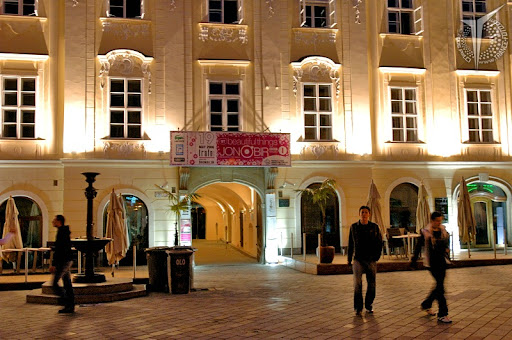
The Bratislava New Year’s Eve celebration that go by the slogan “Welcome to Partyslava”! is now a mega-event, on a par with the celebrations of any other major European city.
The Main Square is at the epicentre of the festivities, together with the neighbouring Hviezdoslav Square in front of the opera house and the embankment along the River Danube between Nový Most and Starý Most bridges. Access to the fun zones in the city centre is through check points, which have a preventive function.
For several hours on the last day of 2008 the 
In the early evening the area in front of the national opera house will already become a large dance floor with DJs playing various genres of lively music, reaching a peak after midnight.
In the half hour or so leading up to the arrival of the New Year, tens of thousands of locals and visitors will make their way to the Danube embankment to bring in the New Year 2009 together under a huge fireworks and lights display. In the past few years the fireworks have been launched directly from boats floating on the Danube, creating a truly magnificent spectacle.
So if you decide to celebrate the arrival of the New Year 2009 in Bratislava – or rather Partyslava, as the city was called a few years ago by some visitors from abroad – be prepared for some madness, but also a cheerful crowd of locals, where even the typical Central European cold will be warmed.
There is no doubt that the economic slowdown in slovakia is taking place. Living in Bratislava i can't say we feel it yet. People are consuming and the well run economy is still performing closing 2008 with 7.1 GDP growth.
It is remarkably difficult to make a prediction for the new year of 2009 but these is my information/hunch.
Slovakia will weaken mostly in the regions, hit by the lower export volumes from factories whose export markets are slow. This has affected jobs in Nitra region.
Generally i make very pessimistic assumptions and prefer to be pleasantly surprised, so i predict GDP between 2-4% for slovakia in 2009, this is below estimates, but it will generally keep the unemployment steady and the people reasonably prosperous.
Bratislava is likely to do better than this, and so far one would have to be hunting high and low to find evidence of a slowdown.
It seems that Slovakia will not have a recession at all, unless we are talking about end of world scenarios...
Slovakia is likely to remain the fastest growing economy in the EU and an interesting country where it enjoys the safe haven of the EURO, and the competitive position of an emerging market at the same time.
In such daunting times its a blessing to live in such a relatively stable place, however one has to spare a thought for the UK and iceland that have been savaged by this crisis..
Boat ride from Vienna Austria, to Bratislava Slovakia in less than an hour through beautiful surroundings
ok lets lighten up a little, this has to be the nicest way to cross borders :)
the beauty of the nature between the two countries has been preserved largely because of the cold war which imposed lack of "development" :)
Greed is not good after all
Sadly it can't be true that all 6 billion of us can afford the good things in life, being rich is all about having more possessions than the average person. Somebody has to lose somewhere in the end, there is ofcourse some truth that overall increased economic activity raises all boats, however for the most part we have become more unequal societies, and while hard working people should be rewarded and those not working shouldn't this should not be taken to extremes.
In short in the last 40 years the things we sacrificed in order to afford more status symbols and cheap consumer goods are:
- Real friendship and family relationships and community because of an increasingly transactional and competitive nature in the way we relate to other people because of the way we "consume" others as products. This mentality harms our emotional health.
- Safety: No good quality pensions in our old age by removing the state from the pension system.
- Safety of good quality healthcare in our old age by removing the state from healthcare.
The market turmoil shows that certain things should be left to the state which is the only institution that can have the long term horizons, the necessary balance-sheet and the incentives necessary to support pensions and healthcare. It has proven impossible to align the interests of business/shareholders and their customers.