Wages and buying power:gap between Austria and Slovakia/Czech/Poland shrinking
This is the conclusion reached by a new study conducted by the Vienna Institute for International Economic Studies on behalf of the consulting company TPA Horwath. The study looked primarily at unit labour costs and buying power in ten countries in Central and Eastern Europe: in other words, what the state collects in each case, take-home pay for individual workers, and what you can actually buy for that amount in various neighbouring countries.
In the case of unit labour costs, the differences are still huge. Unit labour costs in Eastern Europe are below those in Austria. People also earn significantly less, although their wages are increasing, and the amount they have left over varies.
Well paid jobs at banks and insurance companies
In Austria, in 2010 average labour costs were EUR 3,966 a month. This put Austria streets ahead of Central and Eastern European countries included in the analysis. Slovenia, a model country in economic terms, has on average 44 per cent of Austrian labour costs. The earnings level in Austria here is 54 per cent higher than for the economy as a whole. Similar industry-specific differences can also be seen in Slovenia and Croatia. The earnings gap is considerably larger in all the other Eastern European countries studied: as much as 80 per cent in Poland and 143 per cent in Romania.Net earnings: much smaller gap
However, a very different picture emerges in a comparison of average net earnings (gross wages after deduction of taxes and social security contributions) and real buying power – in other words, what people can buy with their incomes. Here it becomes apparent that the gap between Austria and the Eastern European countries is much smaller. For example, in 2010 the ratio of net earnings to so-called purchasing power parity in Slovenia was 63 per cent of the Austrian level (of EUR 1,800), followed by Croatia (59%) and the Czech Republic (58%). The level of net earnings was somewhat lower in Poland (53%), Slovakia (49%) and Hungary (42%).
Where do employees have more take-home pay
|
Convergence of wages
The analysts extrapolated current trends from these varying costs and deductions: unit labour costs are rising steadily in Eastern Europe. In fact, despite everything, in almost all the countries studied this is happening at a faster rate than in Austria. As a result, wages are slowly converging on those in Austria. At present, average labour costs are 44 per cent of the Austrian level. Growing competitiveness is driving this primarily because Central European countries are increasingly using modern “western” technologies. Furthermore, Central European countries are gradually developing a strong industry that is far more productive than small businesses.Receptive to investors
Finally, despite relatively high tax and contribution ratios, the institute’s experts found a striking receptiveness to investors in Central and Eastern European countries. For example, at the height of the prolonged global economic crisis, taxation policy raised value added tax rates rather than taxes on work.
The work cost factor is decisive for the choice of location
| |
There are still very significant differences in the case of direct taxes (such as income and corporation tax), the experts at TPA Horwath in Vienna concluded. In Austria, in 2009 direct taxes accounted for around 30 per cent of total taxes, which was however still below the average for the EU 27. Hungary was next, fairly well below Austria with a rate of 25 per cent of direct taxes in total earnings, then Romania, Poland and the Czech Republic between 24 and 21 per cent. Direct taxes played the smallest role in Slovakia (around 19 per cent). Trend: during the crisis, Eastern European countries tended to increase value added tax, while lowering income and corporate tax. This was a definite advantage for investors.
An American who has lived in Slovakia since 1991 talks about living here
especially the bits about blava
soft toy travellers - a service now available in Prague is also coming to Bratislava
In prague they have the strangest ideas :) The text is from their website
Travel Agency for Teddy bears and cuddly toys.
Is your stuffed toy exceptional to you? Give him an extraordinary present - a trip to Prague - the beautiful heart of Europe. Except amazing experiences, he will bring back home many great photos and other presents.
Do you collect stuffed toys, dolls or other fun “non-living” friends and you believe they also deserve rest and vacation or an outstanding experience in an interesting country? Then this service is meant for you and for your favourite toy. Let your loyal friends enjoy an unusual experience.
We want to pamper your favourite toy.
Our care
We believe your stuffed toy or any other favourite is a precious companion in your life. We appreciate your trust and the trust of your friend, therefore, our goal is to provide care of the highest quality. We are going to take a good care of your “tourist” paying attention to its needs – from the moment of arrival in the Czech Republic to the moment of its return into your arms.
Guido Westerwelle in Bratislava - The German FM reaffirms the good climate in German/Slovak relations
Guido Westerwelle in Bratislava
On the first visit to Slovakia since taking office arrived on Wednesday the German Foreign Minister Guido Westerwelle at the invitation of its Slovak counterparts M. Lajcak.
"The physical presence of the Minister G. Westerwelle in Bratislava and his meetings with the President and Prime Minister gives new dimension to our relationship," said Mr Lajcak after joint negotiations.
Germany sees Slovakia as a reliable strategic partner in political and economic areas.
"There are no geographical boundaries between us and Germany, they are our neighboring country, we welcome the active engagement in the Central Europe , and we expect that it will continue," said Minister M. Lajčák.
He and his German partner expressed satisfaction with the high quality of the mutual relations and strong trade contacts. Germany is one of the biggest investors in Slovakia as well as trading partner. „The satisfaction of the German investors in Slovakia is important for our government since more than 400 German companies employ around 70 000 of our citizens,“ Mr. Lajčák added.
In similar new today Volkswagen just announced an expansion of its huge site near Bratislava. The German automaker continues to work on its project focused on the production of new vehicles New Small Family (called UP!). Pursuant to its investment plan, the company will spend about €107m in order to increase its daily capacity by 600 cars to 1,800 per day.
The German Minister Mr. Westerwelle recalled the attitude of the current German government to place emphasis on good relations not only with the bigger members of the EU but also with the smaller ones. „All of us are inhabitants of the same European house that’s why it is important to treat each other with respect and on the same level,“ Mr. Westerwelle said.
He also appreciated the success story of Slovakia, which had managed to build its statehood and to transform political and economical system in a relatively short period of time. Both ministers have discussed the EU enlargement in Western Balkans too. At the end of their talks they signed joint declaration about an amendment to the treaty on cultural cooperation, which should strengthen the legal status of the German School in Bratislava.
Vienna local tram company seeks to revive Bratislava tram service
The former tram service linking Vienna and Bratislava | |
Wiener Lokalbahnen seeks to revive Bratislava tram service
A subsidiary of Wiener Linien, Vienna's public transport provider, is proposing to revive the legendary tram service to Bratislava by 2013.
Detailed plans but no finalised concept yet
Wiener Lokalbahnen, which already runs a service from Vienna to Baden known as the "Badner Bahn", is a wholly owned subsidiary of Wiener Linien. Chairman of the board Harald Brock confirms that basic consideration has been given to the idea of resurrecting the tram service to Bratislava and that there is sufficient interest in the service. The old tram line is currently used by the S7 suburban railway from Vienna to Wolfsthal and ends there. The 7km section from Wolfsthal to Petržalka was removed after the war and would have to be relaid.Costs put at 70 million euros
The costs are put at 70 million euros and financing has not yet been finalised. Brock hopes for contributions by the provinces of Vienna and Lower Austria and by Slovakian companies. He points out that a tram project would have the advantage that the bridge in Petržalka would not have to be modified, as it is already suitable for trams if not for the heavier Austrian Railway (ÖBB) trains.Tram and train rails no problem
At present the line section to Wolfsthal can only be frequented by heay railway trains. Thus the revitalised trams would travel from Vienna to Bratislava on different types of track. According to Wiener Lokalbahnen it does not present any technical problems. The idea is to use light-rail trams similar to those on the route from Vienna to Baden in Lower Austria, which also travel partly on tram lines and partly on the railways.Project will supplement ÖBB local service
The project will supplement rather than compete with the ÖBB local service because it would stop at smaller villages between the two capitals. ÖBB itself is currently developing high-speed sections to Slovakia. The Bratislava trams would travel at least every 15 minutes, says Brock, and the journey would take a little over an hour. There are several possible departure points in Vienna including the Badner Bahn terminus on Karlsplatz or possibly Simmering.Badner Bahn in front of the Vienna State Opera | |
Positive response to date - Schicker: all routes to Bratislava are required
Reactions to date have been positive but reserved. Michael Zentner, spokesman for Wiener Linien, said that the decision was still under consideration but that financial support would be required at all events. Rudi Schicker, Vienna executive councillor for urban development, traffic and transport, is optimistic. He says that the plan has been on the table for some time and that there is a large demand for routes to Bratislava from the Vienna area. ÖBB describes the plan as "stimulating": the ÖBB plans for developing high-speed sections and a Bratislava tram route serving smaller villages would be complementary.Growing demand
Wiener Lokalbahnen mentions the growing demand on the Vienna-Bratislava route as demonstrated by the Twin City Liner, which has been operating to high capacity for two years on the Danube. A second high-speed vessel is currently being built in the shipyard in Christansand, Norway, and will join its sister vessel in 2008. This growing demand also points to a possible business niche for a new tram service. It would complement rather than compete with the Twin City Liner and ÖBB.Some remains of the Bratislava tram line can still be found today | |
Bus: 1.50 euros from Hainburg to Bratislava
In the meantime there are plans to improve the bus link between Wolfsthal and Bratislava. The Austrian Post Office currently has a concession for services to Slovakia, and Euroline buses provide an hourly link between Vienna and Bratislava. "The problem is that they only stop in Wolfsthal if there are free seats," says Wolfsthal mayor Gerhard Schödinger. Passengers who don't book a seat in advance are frequently left behind. And even with a seat reservation the Euroline buses often fail to stop in Wolfsthal. The Bratislava public transport service is seeking to remedy the problem: it is applying for a licence and proposes to operate a service between Bratislava city centre and Hainburg for 1.50 euros. A solution could well be in the offing, and Postbus AG has also expressed an interest in a cooperation with Slovakian partners.And finally...
Der Spiegel - Slovakia's Surprising Financial Strength
http://www.spiegel.de/international/business/0,1518,629857,00.html

Porsche Cayenne 2.0 to be made in Bratislava
Porsche Cayenne 2.0
Details of the second-generation Porsche Cayenne have been leaked out two months before the upmarket four-wheel drive’s public unveiling at the Geneva motor show. This is also going to be made in Bratislava, Slovakia's capital city along with VW's new hit series of UP! cars.
The information brings to light the all-new-for-2010 Cayenne’s five-strong range of engines, including the first details on the new petrol-electric hybrid drivetrain it will share with the second-generation Volkswagen Touareg, alongside which it has once again been conceived, developed and engineered.
As with its predecessor, the second-generation Cayenne will continued be manufactured at parent company Volkswagen’s factory in Bratislava, Slovakia alongside the new Volkswagen Touareg and existing Audi Q7.
Porsche will also continue offering its new four-wheel drive system with the choice of three petrol engines – all updated versions of the units used in the outgoing first-generation model. They include a 296bhp 3.6-litre V6 in the entry level Cayenne, a 395bhp naturally aspirated 4.8-litre V8 in the mid-range Cayenne S and a range-topping 493bhp turbocharged 4.8-litre V8 in the top-of-the-line Cayenne Turbo.
Also planned from the outset of UK sales in May is a successor to the Cayenne Diesel running a lightly modified version of the existing model’s Volkswagen-developed 237bhp 3.0-litre V6.
Porsche Cayenne Hybrid
The big news, however, is Porsche’s decision to add a Cayenne Hybrid to its ranks as part of efforts to give its new four-wheel drive a more environmentally friendly image than its predecessor. Set to form an integral part of the new line-up, it uses an Audi developed 328bhp supercharged 3.0-litre V6 petrol engine in combination with a 46bhp electric motor that draws energy from a lithium ion battery mounted within spare wheel well in the floor of the boot. It's an arrangement that will be mirrored in the upcoming Panamera Hybrid. Official Porsche figures put combined reserves at 375bhp – or just 20bhp shy of the Cayenne S.
All second-generation Cayenne models will receive a new eight-speed automatic boasting an automatic stop/start function as well as brake energy regeneration as standard. Porsche claims fuel consumption has been reduced by up to 23 per cent, with three of the five new Cayenne models registering better than 28mpg on the combined European cycle.
More specific is its claim for the new Cayenne Hybrid, which Porsche says returns an impressive 34.5mpg, making it the most fuel efficient model in the entire Porsche line-up while endowing it with a CO2 emission rating under 200g/km.
Slovakia vs. Czech republic - Economic development
Basically Slovakia had an abrupt crisis with a sharp contraction but also an equally large improvement.
Zdenek Tuma, the governor of the Czech National Bank, said being in the euro had helped spare Slovakia the worst of the economic disruption that affected the rest of the region including his country.
For example Slovakia’s cost of borrowing on international markets was cheaper than for the Czech Republic.
Slovakia’s economy is forecast to grow 3.1 per cent in 2010, far greater than the 0.3 per cent forecast by the Czech finance ministry.
As growth returns, investors are trickling back, with some saying they are tempted by the prospect of avoiding currency risk. “The euro allows us to make long-term plans and it eliminates exchange rate risks caused by the volatility of the Slovak crown,” says Vladimir Machalik, a spokesman for Volkswagen Slovakia, which is starting production of a new small car in its factory outside Bratislava.
In a further sign of confidence Taiwan’s AU Optronics signed a €191m agreement last month to open an LCD television component factory in Slovakia.
Although Slovak workers have become slightly more expensive than those of Poland and Hungary, they are still much cheaper than their rivals in western Europe, and investors already in the country are unlikely to make decisions to relocate based on possibly temporary changes in exchange rates.
Politically, joining the euro has proved to be a coup for Robert Fico, the prime minister. A survey shows that almost 80 per cent of Slovaks approve of their new currency, which Mr Fico has called Slovakia's “shield”.
It also proves that despite his faults Robert Fico is a commited left of centre politician that agrees with the overall development strategy of Slovakia, but wanted to make sure that where there are market failures or lack of competition this is rectified and that there are real rules in the game.
However, Czechs have maintained their reservation about rushing towards the common currency. Mirek Topolanek, former prime minister and leader of the centre right Civic Democratic party, says the Czech Republic may be ready in 2015 to begin discussing joining the exchange rate mechanism, a precursor to joining the euro.
But Czech businesses do not seem to share this assessment. “We (Czech republic) need the euro as soon as possible in order to be able to address the current problems caused by the world financial crisis,” says Jaroslav Cerny, spokesman for Skoda Auto, a Volkswagen subsidiary.
“A failure to introduce the euro may drive not only our current suppliers, but also all potential investors, out of the Czech Republic.”
Johnson Controls' headquarters moved from Mexico to Bratislava, Slovakia
Establishing headquarters will initially create about 130 new jobs to add to the 3000 the company already employs.
Slovakia was chosen because of the network effects that the presence of three car corporations in Slovakia create. The appealing cost savings the stability of the country, its proximity to other european capitals, and the euro being the legal tender in Slovakia no doubt helped make this decision. The Johnson Controls' financial headquarters in Mexico will be closed down ceding almost all competencies to Bratislava.
"This step will enable us to improve the level of service to internal and external customers, increase transparency and reduce costs," Johnson Controls spokeswoman for Europe, Astrid Schafmeisterová, said.
Johnson Controls in Slovakia is based in Bratislava, Lozorno, Lucenec, Martin, Namestovo and Zilina.
further reading:
About the company: Johnson Controls
Johnson Controls has expanded remarkably since Professor Warren Johnson founded the company to manufacture his invention, the electric room thermostat. Since its start in 1885, Johnson Controls has grown into a global leader in automotive parts. The company makes automotive interiors that help make driving more comfortable, safe and enjoyable.
For buildings, it offers products and services that optimize energy use and improve comfort and security.
Johnson Controls also provides batteries for automobiles and hybrid electric vehicles, along with systems engineering and service expertise.
| Johnson Controls, Inc. 5757 N. Green Bay Avenue P.O. Box 591 Milwaukee, WI 53201 (414) 524-1200 | Stephen A. Roell, Chairman, President and Chief Executive Officer R. Bruce McDonald, Executive Vice President and Chief Financial Officer |
| Employees | Approximately 130,000 worldwide |
| History | 1885 in Milwaukee, Wisconsin by Warren Seymour Johnson, inventor of the first electric room thermostat. |
| businesses | Automotive Experience: Global leader in interior systems for light vehicles including passenger cars and light trucks. Systems supplied include seating, overhead, door, instrument panels, storage, electronics. Power Solutions: World’s largest manufacturer of lead acid automotive batteries and developer of advanced battery chemistries. About 80% of batteries are sold through the automotive aftermarket and 20% are sold as original equipment. Building Efficiency: Leading full-line service provider of mechanical equipment as well as systems that controlheating, ventilating, air conditioning (HVAC), lighting, security and fire management in non-residential buildings. Services include complete mechanical and electrical maintenance. World leader in integrated facility management for Fortune 500 companies, managing more than one billion square feet worldwide. |
| Stock | Traded on the New York Stock Exchange under ticker symbol JCI |
Come to bratislava for xmas, Wien is too chaotic :)
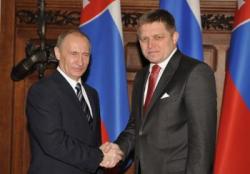
Slovak PM meets Vladimir Putin (Russian PM) about joint gas venture to link Austria to russian gas
What is being proposed is to link the Austrian market to the soviet era pipeline that ends in Bratislava. This pipeline only needs a few kilometers of extension to be linked to the austrian market and network.
Click on the map to see more detail:
Slovakia will gain by giving Russia a big reason not to cut supply to europe as it would inconvenience more european countries.
Below there is a video talking about the fledgling deal:
In related news: According to the European Union energy commisioner gas consumers won’t suffer if Ukraine starts another transit war with Russia this winter.
Kiev blocked transit pipelines from Russia last January in a payment row, leading to power cuts across the EU. But Energy Commissioner Andris Piebalgs says they've agreed ways to avoid Ukraine altogether.AP: “Our gas storages are 100% full, we've increased all types of switching opportunities for countries which can't cover gas for a very long period. We also have emergency plans if they are needed. On the Russian side I believe there are also plans for increasing supply from other pipelines if there is a problem with one of them. During January there will be more gas flowing through the Yamal Europe pipeline. So it is important that both sides reunite and that the final consumer does not feel threatened at all.”
More background on the pipeline and it's significance (from wikipedia):Druzhba pipeline (Russian: нефтепровод «Дружба»; also had been referred as the Friendship Pipeline and the Comecon Pipeline) is the world's longest oil pipeline, it carries oil some 4,000 kilometres (2,500 mi) from southeast Russia to points in Ukraine, Belarus, Poland, Hungary, Slovakia, Czech Republic, and Germany.[1] The name "Druzhba" means "friendship", alluding to the fact that the pipeline was intended to supply oil to the energy-hungry western regions of the Soviet Union, to its "fraternal socialist allies" in the former Soviet bloc, and to western Europe. Today, it is the largest principal artery for the transportation of Russian (and Kazakh) oil across Europe.
History
On 18 December 1959, the 10th session of the Council for Mutual Economic Assistance (Comecon), held in Prague, adopted a decision and an agreement was signed on construction of a trunk crude oil pipeline from the USSR into Poland, Czechoslovakia, GDR and Hungary.[2] Each country was to supply all necessary construction materials, machinery and equipment. In 1962, first oil reached to Czechoslovakia, in September 1963 to Hungary, in November 1963 to Poland, and in December 1963 to GDR. The whole of the pipeline was put into operation in October 1964. The first oil pumped through the Druzhba pipeline originated from the oil fields in Tatarstan and Samara (Kuybyshev) Oblast. In 1970s the Druzhba pipeline system was further prolonged at the expense of parallel lines.[3]
Route
The pipeline begins from Almetyevsk in Tatarstan, southeastern Russia, where it collects oil from western Siberia, the Urals, and the Caspian Sea. It runs to Mozyr in southern Belarus, where it splits into a northern and southern branch. The northern branch crosses the remainder of Belarus across Poland to Schwedt in Germany.[2] It supplies refineries in Płock and in Schwedt. The northern branch is also connected by the Płock-Gdansk pipeline with the Naftoport terminal in Gdansk, which is used for oil re-exports.[4] In Schwedt the Druzhba pipeline is connected with the MVL pipeline to Rostock and Spergau.
The southern branch runs south through Ukraine. In Brody the Druzhba pipeline is connected with the Odessa-Brody pipeline, which is currently used to ship oil from the Druzhba pipeline to the Black Sea. In Uzhgorod the pipeline splits into lines to Slovakia (Druzhba-1 - original Druzhba route) and to Hungary (Druzhba-2). The line through Slovakia is divided once again near Bratislava: one branch leading in a northwest to Czech Republic and the other going southward to Hungary. The Druzhba-1 pipeline branches off toward Hungary at Ipeľ, crosses the Hungarian border at Dregelypalank and leads to Százhalombatta.[2] In Hungary, the Druzhba-1 pipeline supplies Duna refinery while Druzhba-2 supplies Duna and Tisza refineries.[5]
The Mažeikių refinery in Lithuania and Ventspils oil terminal in Latvia are connected to the main pipeline by the branch pipeline from Unecha junction in Bryansk Oblast. This branch has ceased operation in 2006 and is not likely to become operational in any time soon.
The part of Druzhba pipeline system, which runs via Belarus, is 2,910 kilometres (1,810 mi) long. The length of the pipeline in Ukraine is 1,490 kilometres (930 mi), in Poland in 670 kilometres (420 mi), in Hungary 130 kilometres (80 mi), in Lithuania 332 kilometres (206 mi), in Latvia 420 kilometres (261 mi), and in Slovakia and in the Czech Republic together around 400 kilometres (250 mi).[2][6]
Technical features
The Druzhba pipeline currently has a capacity of 1.2 to 1.4 million barrels per day. Work is currently underway to increase this in the section between Belarus and Poland. The pipe diameter of the pipeline varies from 420 millimetres (17 in) to 1,020 millimetres (40 in).[3] It uses 20 pumping stations.
Operators
The Russian part of the pipeline is operated by the oil company Transneft through its subsidiary OAO MN Druzhba. In Belarus the operator is Gomeltransneft Druzhba, in Ukraina UkrTransNafta, in Poland PERN company, in Slovakia Transpetrol, in the Czech Republic Mero and in Hungary MOL.[7]
Proposed extensions
[edit] Schwechat (Austria)–Bratislava Oil PipelineSchwechat–Bratislava two-way oil pipeline project was proposed in 2003. It would allow to supply the OMV owned Schwechat Refinery from the Druzhba pipeline.[7]
forecasts for the region and Slovakia
"The countries with fixed exchange rates, including Latvia, face difficulties because they must adjust their real exchange rates through domestic wages and prices. States that started the crisis in good shape and are internationally competitive, such as Poland, Slovakia and Slovenia, could see GDP growth of 2-5 per cent next year. But Hungary, with a difficult fiscal position, is forecast to remain in recession"
Meanwhile in the ever-confident anglo-sphere (again from the FT)
"After the shock came the arguments. No one expected the Office for National Statistics to say the economy shrank by 0.4 per cent in the third quarter; the survey data and early official data had been too strong.
Few were therefore minded on Friday to modify their entrenched positions about the UK economy, the policies needed to revive it or whether the figures contained any useful information. Stuck in the middle of these clashes, of course, was the ONS.
Its preliminary data on gross domestic product are an attempt to provide an early snapshot of economic performance. The downside is that its coverage is limited, with this first estimate based on only 40 per cent of the total hard data on output and nothing on spending or incomes.
George Osborne, the shadow chancellor, said: "This is deeply disappointing news. Britain is now in the deepest and longest recession in its modern history. Britain's economy is still shrinking a full six months after France and Germany started growing."Meanwhile, economists agreed that the GDP figures made it more likely that the Bank of England would extend its efforts to create money and pump it into the economy in November by expanding the £175bn programme of asset purchases known as quantitative easing.
Yet the most vociferous arguments took place in the City, where analysts clashed over the importance of the figures.Danny Gabay of Fathom Financial Consulting insisted the appropriate reaction was far greater caution about predicting recovery.
"The UK has some formidable headwinds, not least of which is the over-burdened consumer which is having to cope with a broken banking system, rising unemployment, and falling income growth," he said.
This view was described as "baloney" at Goldman Sachs, which put greater weight on more optimistic recent surveys of companies. Analysing the accuracy of the past decade's preliminary GDP figures, Kevin Daly, Goldman Sachs economist, concluded that they contained "no statistically useful information about growth" because they were so heavily revised, often years after the event.
Titanic project for a mini Las Vegas in Bratislava
A huge €1.5 billion, five-year project bringing a US casino to Bratislava has been announced.Metropolis, Europe's number one entertainment, commercial and conference centre is to be built at the borders of Bratislava on gross buildable area of over 1.2-million square metres.
(the project will be built within Slovak territory).
How does Metropolis change the face of Bratislava?
- volume of investment:
- €1.5 billion. EUR
- start of construction: end of 2010,
- construction work: 3 to 5 years;
- Area: 1.2 million square meters,
- estimated number of tourists: 5 million per year,
- estimated tax return: €600 million euros,
- impact on GDP of the country: 5 percent
- number of long-term jobs: almost 9000
3-5 year construction related jobs: almost 20000.
"This project will be the new destination of the region, dramatically increasing Slovakia's tourism spend and number of visitors," the developer TriGranit said in a statement on Tuesday.

Metropolis as currently planned is a multifunctional development where one will find retail, leisure, Aqua Park, golf, hotels, casinos, cultural and congress facilities.
Harrah’s Entertainment Inc. - one of the operators planned for the complex – is the largest gaming entertainment company in the world. Harrah’s operates 54 casinos, hotels, convention and conference centers and golf courses on four different continents, just to mention the world famous Caesars Palace in Las Vegas, Nevada, or the Emerald Casino Resort in South Africa.
Construction works are scheduled to start at the end of 2010 and be completed in five years giving a boost to local construction activity.

The project has several planned phases: in the first one the shopping centre, the aqua park and the leisure centre with Adventure Park, three hotels and a US style casino with related amenities. The estimated completion date for the first phase is 2012.
Later phases will comprise of the conference facilities, golf courses, further casinos, hotels etc.
The 29 million people in the 220-kilometer catchment area represent the main target group for Metropolis.
The EUR 1.5 bn investment will create more than 10,000 new job opportunities in its construction phase, which will last almost five years. The facility is to generate some EUR 600 million in taxes for Slovakia annually. A total of five to six million tourists are expected to roam Metropolis every year, Simon Bayley, TriGranit's development director, told a press conference in Bratislava.
Bayley said the project is jointly financed by TriGranit and Harrah, but he did not wish to go into details, MTI reported.
The developer first Slovak development was
realized in Slovakia in 2000. After several successful Hungarian projects the Polus Center, Bratislava was the company's first foreign development. With this project TriGranit was a pioneer, because this was the Slovak capital's first American style commercial and entertainment centre. It was followed by the opening of Millennium Towers I, and II office towers - in 2001 and 2003 - what again fulfilled already the existing market demands. These were Bratislava?s first "A" class office buildings.
Harrah's (Las Vegas Casino operator) Managing Director of Development, Andrew Tottenham, said at a press conference in the Slovakian capital of Bratislava that the Metropolis could be followed by other projects in Europe but not on the same scale, according to Reuters. This is going to be their flagship in Europe.
Vienna and Bratislava gradually growing together a common interregional labour market
With Vienna and Bratislava gradually growing together a common interregional labour market in the Centrope region is becoming increasingly important as well.
“We want to develop and implement joint strategies and concepts in order to improve qualifications and raise employment in the Vienna-Bratislava region,” underlines Vienna’s Renate Brauner.
| |
| |
Acquiring professional experience abroad
The apprentice exchange between Vienna and Bratislava is part of this initiative. Young people currently serving their apprenticeship can get hands-on experience of working conditions in the partner countries. 10 young apprentices have the opportunity to do a three-week internship at a hotel in a partner city. “This initiative pus a strong focus on working together,” explains Renate Brauner. “When young people experience for themselves what it is like to work in an enterprise in the respective partner city they grasp and feel the common nature of the region on a very personal, direct level.”| | |
| International and elegant: hotels as a work place (here: Falkensteiner and Crowne Plaza) | |
Setting off for an internship abroad
Vice-Mayor Renate Brauner will see off the young apprentices from Vienna who will leave for their internships on a Twin City Liner. They are using this opportunity primarily because they want to get to know the culture and working world of their host country, improve their foreign language skills and make many marvellous memories. And who knows, maybe one or the other will like it so much that they return to their internship placement in order to work abroad after completing their apprenticeship| |
| |
Skyeurope is no more
Brokers on the Vienna stock exchange, where shares of the airline are traded, were the first to know late Monday evening.
"Restructuring trustee of SkyEurope today (Monday) submitted a proposal to start bankruptcy proceedings on the company – a subsidiary of SkyEurope Holding AG," Vienna stock exchange informed. This was caused by a lack of capital to finance the current activities of the company. "All the flights are cancelled immediately," representatives of the stock exchange added.
As a result the competing airlines are rushing to offer alternatives to Skyeurope. Ryanair, Wizzair and others are increasingly offering alternatives. A slew of low-fare airlines including easyJet PLC (EZJ.LN), Ryanair Holdings PLC (RYA.DB) and Wizz Air PLC Tuesday offered stranded SkyEurope passengers discounted flight tickets.
The discounted tickets followed Czech state-owned airline CSA Czech Airlines and privately held, Prague-based low-cost airline Smart Wings, which both late Monday offered SkyEurope's passengers alternative flights at discounted prices in the hope of keeping them customers in the future.
This is unlikely to alter much the traffic in Bratislava airport as Skyeurope was using Vienna as its primary base to many destinations.
ECONOMY: The prognosis is for positive growth this winter
The Slovak economy is expected to revive as soon this winter when National Bank of Slovakia expects growth of 2.4 percent for the whole of 2010, with a further boost of 4.1 percent in 2011.
According to Finance Minister Ján Počiatek, the ministry tried to make as conservative a prognosis as possible. The real development of the country's economy could still turn out to be better than expected by the ministry at the moment. The finance ministry painted an alternative scenario and it expects a revival of the economy next year, when it should grow by 1.1 percent. Subsequently, the growth should accelerate and reach 3.4 percent in 2011 and 4.8 percent in 2012, the finance ministry predicts.
In these times of negative GDP numbers that are becoming the norm this is indeed welcome news.
Experience nature between Vienna and Bratislava
The 9,300 hectare National Park stretches along the Danube, which flows freely here and forms the heart of the Park. With a length of 38 kilometres, the National Park is barely 4 kilometres wide at its broadest point, since the wetlands are only to be found directly by the Danube.
| |
| The Lobau has traditionally been a popular recreation area of the Viennese |
Escape from the city into the countryside
In the northern part of the National Park lies the wide Marchfeld plain. In the south, the Park’s border is formed by the escarpment of the Vienna basin. For the Viennese in particular, the Lobau area is a traditional and convenient place for relaxing. The Weitwanderweg 07 (long hiking trail) passes through the National Park, as does the Danube cycle path, which originates in Passau (Germany) and takes you via Hainburg to Hungary.
Bus from Bratislava
| A small step for bus services, a big step for the Bratislava/Hainburg region |
New bus line connects Bratislava and Hainburg
Since mid-March the Bratislava public transport authorities have been operating a regular direct commuter bus service between the Slovakian capital and the nearby Austrian town of Hainburg.
Resettlers erase political border
EU membership in 2004 was the final step in the removal of the formerly heavily guarded Iron Curtain between Slovakia and Austria. In subsequent years many Slovakian families moved to Austria, taking advantage of the favourable land prices and lucrative housing subsidies on the Austrian side of the border while continuing to work in Slovakia. The growing number of commuters prompted the Bratislava public transport authorities to expand its bus network beyond the border. Initial plans for the bus line date back to the time when Slovakia became a member of the EU.From idea to reality
Bus service 901 operated by the Bratislava public transport authority DPB AG has been running between the Slovakian capital and the Lower Austrian town of Hainburg since mid-March 2009.The service was originally planned to start operation when Slovakia acceded to the Schengen agreement. The first steps were taken in 2007 by Milan Cilek, deputy mayor of Bratislava, and Gerhard Schödinger, mayor of the Austrian border community of Wolfsthal, and from May 2008 a service ran as far as Wolfsthal.
Following further negotiations DPB AG Bratislava extended the service to Hainburg in March 2009, highlighting the good relations between Slovakia and Austria. Alongside its intensive cooperation with Vienna over the years, Bratislava is also encouraging good-neighbourly relations with towns on the Slovakian-Austrian border.
Peter Lizák, Slovakian ambassador in Vienna, regards the development of the transport infrastructure as a way of bringing the two countries closer together. Interregional bus services are a continuation of major projects such as the hourly rail service and the second Twin City Liner on the Danube between Bratislava and Vienna.
The planned construction of a bridge over the March between Záhorská Ves and Angern will make a further contribution to improving border communications between western Slovakia and Lower Austria. A tunnel under the Danube will also speed up the train service from Paris via Vienna to Bratislava.
| | |
| Mayor Andrej Ďurkovský and DPB boss Branislav Záhradník in the new Inter-Regio bus | |
Small step for the company, large step for the region
Representatives of municipalities on both sides of the border took part in the inaugural journey on the new bus service. Karl Kindl, mayor of Hainburg, and Andrej Ďurkovský, mayor of Bratislava, both agreed that a public transport service of this type was an important step in the development of the Slovakian-Austrian border region. DPB-AG chairman Branislav Záhradník described it as a “small step for the company but a large step for the region”.The Bratislava–Hainburg bus services runs at regular intervals from 5.30 am to 11.30 pm. A single journey costs €1.50 or €0.75 for children and young persons under 26 and pensioners.
DPB AG Bratislava is also planning to set up a regular bus service this year to the Hungarian border village of Rajka with the help of EU funding.
A two-way international bus link, the number 901 running between Bratislava-Wolfsthal-Hainburg began operating im March 2009.
The new route is an extension of the Bratislava-Wolfsthal link. A standard one-way ticket between Bratislava and Hainburg costs EUR 1.50. The bus run daily from 6.20 a.m. at intervals of around 60 minutes. The terminus in Bratislava will be located under the New Bridge (Novy Most).
By boat from Vienna’s city centre to the National Park
Every day until 26 October, you can reach the National Park in comfort from Vienna’s city centre in the National Park boat. From the mooring point on the Danube Canal in the city centre, the journey takes you past the Prater meadows, Freudenau and Praterspitz to the Danube itself downriver from the Freudenau power station, before you finally arrive at the landing point next to the Lobau oil harbour. Here, passengers are welcomed by employees of Vienna’s Municipal Department 49 (Forestry Office and Urban Agriculture). During a one hour excursion through thick alluvial woodland and past sheltered pools, visitors get an insight into the varied ‘water forest’ habitat, home to many different species.
Habitat for rare species
The ever-changing nature of the Danube, with tidal swings of up to 7 metres, leads to the wetlands being constantly reformed. As a result, the Danube creates habitats for numerous animals and plants. The nature reserve is home to more than 700 types of plant, more than 30 mammals, 100 species of bird, 8 types of reptile and 13 different amphibians, as well as about 60 types of fish. The magnificent kingfisher (Alcedo atthis), the symbol of the Donau-Auen National Park, was named Bird of the Year 2009 by BirdLife Austria. Threats to its habitat, however, have led to its becoming rarer. The kingfisher population in the Donau-Auen National Park counts among the most important in Austria.| | |
| A unique flora and fauna: from the yellow flag iris to the tree frog | |
Individual visitor programme of events
The National Park and the schlossORTH National Park Centre offer a large and varied programme of events for visitors throughout the year. Guided tours of the exhibitions in the schlossORTH Centre, activities on the Schlossinsel (castle island) wetland adventure area, hiking tours and boat excursions help to make all visitors more familiar with the world of the National Park. Besides the fixed events listed in the calendar, there is also the possibility to choose and arrange individual events from the varied visitor programme.Get away from everyday life and experience the wilderness
On 21 June, the great Donau-Auen summer festival is being celebrated along with ‘Nature Day 2009’. Under the motto ‘Nature knows no boundaries’, a boat excursion ‘on the Danube’s waves to Slovakia’ will be made. This Danube trip will give insights into the imposing river landscape and will open up new perspectives of the National Park, the Danube region and the confluence of the Danube and the Morava rivers.| | |
| If you are lucky you even get the chance to glimps deer on the old branch of the Danube | |
| | Informationen: National Park Boat (2 May until 26 October) Departure point: Danube Canal (near Salztorbrücke bridge, 150 metres upstream from the Franz-Josefs-Kai staircase) Departs daily: 9am Arrives daily: c. 1pm Prices: Adults, 10 euro, children 4 euro Places must be reserved in advance Lobau National Park and Forest Administration Tel: 01/4000/49480 E-Mail: pe-don@ma49.wien.gv.at www.wien.gv.at Register for all events at the schlossORTH National Park Centre A-2304 Orth/Donau Tel: +43 2212 3555 E-Mail: schlossorth@donauauen.at www.donauauen.at |