- The European Parliament and country parliaments will have more times to say their opinion about EU stuff. It also tries to clear up who does what in European and at each country.
- EU Parliament: the European Parliament, which we elect in those EU elections from time to time that nobody bothers to go to, will be making more laws now, as well as control EU money and deal with coutries outside EU.
- Parliaments of countries will get more involved controlling what the EU does.
- If 1million citizens from eu countries want something they will be able to have it happen maybe (this will be checked by parliament).
- If some country like UK or ireland wants to leave the EU, now they will be able to quit.
- EU Parliament: the European Parliament, which we elect in those EU elections from time to time that nobody bothers to go to, will be making more laws now, as well as control EU money and deal with coutries outside EU.
- A quicker and easier Europe, simpler methods and voting rules. Less procedures..
- Now if most coutries want something and one or two refuse, then the decision of many countries is what happens. For that to happen though at least 65% of the EU’s population must want it.
- New job of President. Who will last for two and a half years, main purpose is for other powers like US China etc to have somebody to talk to rather than needing to talk to 27 different leaders.
- New measures against terrorism and organised crime that need many countries to work together for best results.
- Now if most coutries want something and one or two refuse, then the decision of many countries is what happens. For that to happen though at least 65% of the EU’s population must want it.
- Rights for people.
- the Treaty of Lisbon preserves existing rights and adds more.
- political, economic and social freedom of European citizens.
- Solidarity between Member States: the Treaty of Lisbon provides that the Union and its Member States act jointly in a spirit of solidarity if a Member State is the subject of a terrorist attack or the victim of a natural or man-made disaster. Solidarity in the area of energy is also emphasised.
- Increased security for all: the Union will get an extended capacity to act on freedom, security and justice, which will bring direct benefits in terms of the Union's ability to fight crime and terrorism. New provisions on civil protection, humanitarian aid and public health also aim at boosting the Union's ability to respond to threats to the security of European citizens.
- the Treaty of Lisbon preserves existing rights and adds more.
-
- A new Foreign Affairs guy will increase the chance that EU opinions and interests will be heard more worldwide.
- Union's negotiating power, making it more effective on the world stage and a more visible partner for third countries and international organisations.
Slovak Finance minister is awarded ‘Best Finance Minister in Europe for 2008’
In its latest issue, the magazine mentioned Pociatek’s work in preparing the country for the adoption of the euro and underlined his efforts to maintain the longterm sustainability of Slovakia’s public finances.
Previous Slovak finance ministers to be awarded by an international publication are Brigita Schmognerova in 2000 and Ivan Miklos in 2004, who were both named ‘Finance Minister of the Year’ by Euromoney magazine.
Gas and russian supplies to the EU
In all of this bullying behaviour one can see that it is increasingly a set of actions that fits with a russia that is stunned by the sudden decline of oil prices and therefore revenues. This has suddenly made its clout decline rapidly and created looming internal problems.
Slovakia's PM past friendly approach to Russia within the confines of overarching EU diplomatic policies seems prescient. It seems that we will be spared the revenge of Russia for pro-bush stances in basing missile bases in Czech republic and Poland.
I believe Fico's approach has been pragmatic and logical, small countries should not seek to take on former superpowers. In that miscalculation Poland are beginning to take care of US interests (albeit the powermad GW BUSH ones) in the region, for little in return.
This analysis below seems to back this up..
ANALYSTS have noted that
Russian gas supplies have played a
prominent role in Russian foreign
policy in the past, and the fact that
the Czech Republic and Poland
seem to have been singled out for
the most severe reductions in gas
supplies at the height of the winter
season is no coincidence, given
their support for the US plan to
station so-called Star Wars missile
batteries on their territories.
Until Tuesday, Slovakia had
appeared not to have been targeted
for the most severe reductions
in gas supplies, possibly as a
reward for not supporting the US
missile plan, which Russia says
is offensive and not defensive in
nature. Another factor in the gas
war is that the Czech Republic has
just assumed the presidency of the
European Union.
Given its right-wing pro-US
government and the fact that
until 20 years ago Czechoslovakia
was a docile member of the
Warsaw Pact, the Russian move
to cut supplies to New European
countries has great historical
resonance.
The most recent Russian-
Ukrainian spat over alleged nonpayment
of bills for gas supplies
has provided the Kremlin with a
wide range of opportunities to flex
its energy muscles in pursuit of a
much bigger political agenda.
Slovakia's timely euro entry at the time the door to the euro is closing possibly for the forseeable future...
Slovakia's Euro Entry
By Radoslav Tomek and Andrea Dudikova, Bloomberg news (bloomberg.com)
Dec. 31 (Bloomberg) -- Slovakia, which becomes the 16th member of the euro region tonight, is counting on the currency to help shield it from the brunt of the global crisis that’s pummeling emerging markets.
Slovakia, which joined the European Union in 2004, will be the second former communist country to make the switch after it held down inflation, debt and its budget deficit. The former Yugoslav republic of Slovenia was admitted two years ago.
The nation is making the change while eastern European currencies and economies plunge because of the worldwide credit squeeze. The European Central Bank may balk at further expansion of the euro bloc for now, foiling other countries’ efforts to gain financial support and fend off deeper recessions.
“We are watching our neighboring countries, whose situation is getting more and more complicated because of the crisis,” Finance Minister Jan Pociatek said in a Dec. 23 phone interview from Bratislava, the Slovak capital. “Now it’s clear that we are making the switch at the right time.”
The region’s economic and market slump is prompting most of the EU’s eastern states, including Poland, Hungary and the Baltic states of Latvia and Estonia to follow Slovakia’s lead and push for faster euro-region membership. Whether there are capable of achieving the numbers and convincing eurozone members to accept them now is a big question. The most likely scenario is postponement beyond the end of this worldwide recession.
While the Slovak koruna remained locked and unchanged in value to the euro in preparation for the Jan. 1 changeover, the Polish zloty lost 24 percent, the Czech koruna dropped 11 percent and the Hungarian forint fell 13 percent in the second half.
ECB Aid
Hungary on Oct. 16 was forced to accept a 5 billion-euro ($7.2 billion) loan from the ECB, and the EU is considering an additional aid package for Latvia, a former Soviet republic. Latvia, once the fastest-growing economy in the 27-nation EU, is suffering from the deepest recession in the bloc.
Slovakia contrasts with the Czech Republic, a former federal partner in the defunct Czechoslovakia and the only EU nation without a euro target date. While President Vaclav Klaus opposes adoption, Prime Minister Mirek Topolanek said the Cabinet may set a date by next year.
As other countries in the region struggle, the Slovak administration is negotiating with six investors to spend at least 5 billion koruna ($237 million) each to build factories in Slovakia, Economy Minister Lubomir Jahnatek, 54, said on Dec. 16.
Volkswagen AG, Europe’s largest carmaker, cited the switch as a key reason for choosing to upgrade its Slovak factory and prepare it for a new car model, Jahnatek said. The German carmaker originally planed to put the project in the Czech Republic.
Credit Risk
The spread between Polish and Slovak five-year credit-default swap rates increased to 85 basis points on Dec. 26 from 9.5 points on Sept. 22, meaning it would cost 85,000 euros ($120,900) more to protect 10 million euros of Polish debt from default, compared with Slovak debt.
Though the Frankfurt-based European Central Bank is willing to provide aid to non-members, it will probably be more wary about widening the euro region during the next several years.
Executive board members, including Juergen Stark, say the current monetary union is being tested by the financial meltdown and are concerned that many new members, who founded free-market systems starting in 1989, have yet to prove they have stable- enough economic development, economists say.
“The political case for euro entry may have strengthened in the context of the current crisis, but the economic obstacles to joining have not gone away,” said Audrey Childe-Freeman, a senior currency analyst with Brown Brothers Harriman & Co. in London.
Lithuanian Rejection
The application by Lithuania to adopt the euro at the end of 2006 was vetoed because of concern its inflation rate would soar once in. The rate jumped from 3.6 percent in May 2006, when its bid was rejected, to 12.5 percent in June. Hungary was forced to drop its 2010 target date after the deficit ballooned to the widest in the EU.
“The ECB does not only require a nominal convergence but it wants a sustainable convergence,” said Laurent Bilke, an economist at Nomura International Plc in London.
Slovakia was successful in keeping inflation below the euro- adoption limits because of the record strength of its currency, the koruna, which capped import prices. Its budget deficit was kept under control because of increased revenue from economic growth.
Gross domestic product expanded a record 14.3 percent in the fourth quarter of last year and grew an annual 7 percent in this year’s third quarter. The global crisis will slow growth to 4 percent next year, the Paris-based Organization for Economic Cooperation and Development said on Nov. 25. Still, that contracts with 2.5 percent for the Czechs, 3 percent in Poland and Hungary’s economy may slip into recession, the OECD said.
Currency ‘Shield’
Adoption of the euro will act as “as a shield against the global turmoil,” said Elizabeth Gruie, a currency strategist at BNP Paribas SA in London. “It’s clearly a buffer against the financial stress we’ve had.”
In Slovakia, citizens snapped up 1.2 million packages, which contained a basic set of euro coins, before the switch. Some bank branches and the post office sold out within hours after sales began on Dec. 1, said Igor Barat, the government’s euro coordinator.
“Of course I am happy,” said Marek Farkas, a 37-year old waiter in Bratislava. “It helps Slovakia’s image. Look how envious our neighbors are. They would love to have it too.”
Last Updated: December 30, 2008 18:00 EST
Bratislava new year celebrations coming up and other news
Just letting you know that there is going to be a dual celebration of euro adoption/new year
In amongst and despite worldwide financial chaos, Slovakia is receiving a Korean investment for a new KIA/Hyundai factory in Zilina that will produce engines and of course create new jobs. Sony's plans to expand production of flat panel TVs in Nitra have been postponed but not cancelled. It seems that many companies are cutting elsewhere and expanding or keeping production in Slovakia.
Volkswagen is also investing further apparently...
Despite all that the economic outlook in the US and some european countries is grim.
The central banker of Slovakia is keeping a serious handle on the developing situation in other countries. The local slovak economy is doing ok still growth is projected around 4% GDP growth next year, with more in Bratislava's center where I live.. I am guessing, The proximity and relative stability of Vienna is creating a microclimate of stability so far.
Finally I think I would like to join this journalist below before that titanic moron leaves the white house.. I think a serious slapping of GW Bush should be allowed to happen on public television. His economic crimes are even worse than the war ones and they will haunt us for generations of paying back debt..
anyway... Enjoy...
Partyslava
The Bratislava New Year’s Eve celebration that go by the slogan “Welcome to Partyslava”! is now a mega-event, on a par with the celebrations of any other major European city.
The Main Square is at the epicentre of the festivities, together with the neighbouring Hviezdoslav Square in front of the opera house and the embankment along the River Danube between Nový Most and Starý Most bridges. Access to the fun zones in the city centre is through check points, which have a preventive function.
For several hours on the last day of 2008 the 
In the early evening the area in front of the national opera house will already become a large dance floor with DJs playing various genres of lively music, reaching a peak after midnight.
In the half hour or so leading up to the arrival of the New Year, tens of thousands of locals and visitors will make their way to the Danube embankment to bring in the New Year 2009 together under a huge fireworks and lights display. In the past few years the fireworks have been launched directly from boats floating on the Danube, creating a truly magnificent spectacle.
So if you decide to celebrate the arrival of the New Year 2009 in Bratislava – or rather Partyslava, as the city was called a few years ago by some visitors from abroad – be prepared for some madness, but also a cheerful crowd of locals, where even the typical Central European cold will be warmed.
There is no doubt that the economic slowdown in slovakia is taking place. Living in Bratislava i can't say we feel it yet. People are consuming and the well run economy is still performing closing 2008 with 7.1 GDP growth.
It is remarkably difficult to make a prediction for the new year of 2009 but these is my information/hunch.
Slovakia will weaken mostly in the regions, hit by the lower export volumes from factories whose export markets are slow. This has affected jobs in Nitra region.
Generally i make very pessimistic assumptions and prefer to be pleasantly surprised, so i predict GDP between 2-4% for slovakia in 2009, this is below estimates, but it will generally keep the unemployment steady and the people reasonably prosperous.
Bratislava is likely to do better than this, and so far one would have to be hunting high and low to find evidence of a slowdown.
It seems that Slovakia will not have a recession at all, unless we are talking about end of world scenarios...
Slovakia is likely to remain the fastest growing economy in the EU and an interesting country where it enjoys the safe haven of the EURO, and the competitive position of an emerging market at the same time.
In such daunting times its a blessing to live in such a relatively stable place, however one has to spare a thought for the UK and iceland that have been savaged by this crisis..
Boat ride from Vienna Austria, to Bratislava Slovakia in less than an hour through beautiful surroundings
ok lets lighten up a little, this has to be the nicest way to cross borders :)
the beauty of the nature between the two countries has been preserved largely because of the cold war which imposed lack of "development" :)
Greed is not good after all
Sadly it can't be true that all 6 billion of us can afford the good things in life, being rich is all about having more possessions than the average person. Somebody has to lose somewhere in the end, there is ofcourse some truth that overall increased economic activity raises all boats, however for the most part we have become more unequal societies, and while hard working people should be rewarded and those not working shouldn't this should not be taken to extremes.
In short in the last 40 years the things we sacrificed in order to afford more status symbols and cheap consumer goods are:
- Real friendship and family relationships and community because of an increasingly transactional and competitive nature in the way we relate to other people because of the way we "consume" others as products. This mentality harms our emotional health.
- Safety: No good quality pensions in our old age by removing the state from the pension system.
- Safety of good quality healthcare in our old age by removing the state from healthcare.
The market turmoil shows that certain things should be left to the state which is the only institution that can have the long term horizons, the necessary balance-sheet and the incentives necessary to support pensions and healthcare. It has proven impossible to align the interests of business/shareholders and their customers.
Bratislava holding up in a stormy world economy. Slovakia doing better than most in the Credit crisis, Does not need bank bailouts
In Slovakia people still live within their means, it not only the extreme proximity in distance between Vienna and Bratislava, its also a healthy scepticism about getting in debt. Like our viennese neighbours, Slovakia as a whole has very conservative banks (many of them austrian) that lend frugally and expect big deposits before agreeing to finance a mortgage. Here the banker is somebody you meet in an office, rather than a trainee call centre person in Wales assessing your tele-loan because you saw an aspirational ad on TV (like it is the case in the UK).
It seems that there is going to be an impact worldwide from this mess (including China and India), but i still believe this little corner of the world is more stable than most. The factors that make it so are briefly:
- Slovaks did not get in the habit of spending more than they earn
- There isn't a big rental or buy to let sector, people live in their homes.
- People have a 1950es style frugality, and aversion to waste and excesses.
- consumer indebtendness is circa 16% of GDP as opposed to 90%+ in western europe.
- real wages are growing every year, when in the rest of the developed economies they have been stagant or near stagnant.
- All our banks are well capitalised, and have zero exposure to american debts/CDOs/CDS/derivatives/asset backed securities and toxic loans.
- The central banker Ivan Sramko is a seasoned austrian-trained banker with a steady hand.
- We are getting the euro unlike any other central european country.
- EU money will continue to flow from the structural funds and CAP to Slovakia giving the country another useful boost.
- Government debt in Slovakia is a tiny less than 30% of GDP.
Hope you re alright wherever you are.
remember that all this means that Thatcherism/Reaganism is now dead. Shareholder capitalism ditto.
Slovakia Facts - about Business in Slovakia
19% flat tax rate (corporate, capital gains, etc.)
0% dividend tax
(as confirmed by the European Central Bank)
7.9% GDP growth 2006, 10.4 last year, more normal 7.5% this year
World’s leader in car production per capita & a growing force in eletronics
Qualified skilled cheap labour force
In 2003 Slovakia clearly showed the highest education level for a workforce in Europe: 94.1% of young people aged 20-24 attained at least upper secondary education level while only 72.5% of those in Germany, 74.4% in Denmark, or 78.1% in the UK. Slovakia leads the pack in Europe followed by Norway 93.3% and Croatia 90.7%. As James McCollum, General Manager with recruitment agency Key 6 Business Solutions, with offices in Prague and Bratislava, mentioned: “We recruit lower and mid-management and everybody highly praises the technical skills of the local people... basically anything which is technical, mechanical or can be objectively measured is done very well”. He added “…people’s dedication to quality and attention to details are highly valued by international firms”.
Computer engineering
Companies like SAP, IBM, HP, Dell, Siemens, Microsoft, and Oracle are already well established and growing in Slovakia.
Slovakia signed an investment agreement with Samsung Electronics LCD in March 2007 and announced that the South Korean firm would invest €320 million in the new plant, which will produce LCD flat panels in Voderady near Trnava. The investment will create 1,200 direct jobs.
The investor is to launch production of LCD modules in March 2008, and the plant should be running at full capacity by 2012. Samsung will produce ten million LCD modules. Samsung already has a plant in Slovakia, in the western town of Galanta, which is the company's biggest plant for the production of TV sets with LCD monitors in Europe. Samsung invested €3.9 million in Slovakia between 2002 and 2006 and has employed more than 3,000 people. In September 2006 Sony announced its new investment of an initial €73 million in Nitra, where a manufacturing site for LCD TVs is being established. With an annual production capacity of three million sets at its new plant, it is expected to further expand the market growth of its European TV business. Sony currently operates two manufacturing sites for LCD TVs in Europe, i.e. Barcelona, Spain and Trnava, Slovakia. One of the key deciding factors in favour of Nitra was the close proximity to Sony’s existing plant in Trnava in Slovakia, enabling the company to capitalize on its existing highly skilled workforce currently employed in Trnava.
Slovakia is becoming the EU’s Detroit as more and more automotive companies move in. Since 2004 Slovakia became the world leader in car production in terms of car units produced per capita (180 units per 1000 population). This type of industry is not new for Slovakia: Skoda and Tatra car brands produced large amount of cars here during the Communist era. After the change of the system, Volkswagen acquired the Skoda Company in the Czech Republic and started to turn its attention towards Slovakia. VW started production with the Golf platform, but soon extended the platform range to the Passat and then subsequently the Toureg platforms. It was the skill of the workers and their cost, which was a great attraction to VW, but the increase in the platform range is a credit to the skills of the Slovak workforce. This plant now produces some 280,000 cars per annum.
By 1998 a government decree gave special tax status to automobile enterprises in the country. Within a short space of time over 100 companies entered the car industry as major suppliers and sub-contractors established themselves. These included such names as Continental, Magna, U.S. Steel, Johnson Controls, Siemens, Krupp, Delphi, Faurecia, Leoni and many others.At the beginning of 2003 the government and the city of Trnava signed an agreement with TPSA - Toyota Peugeot to build a new assembly plant on the edge of the city. This had immediate impact on Trnava’s real estate market, where prices of some properties increased by more than 100% in two years from the announcement. This plant produces 300,000 cars per annum. In 2004 KIA – Korean car producer completed its agreement with the government to build its new car production plant. This plant will be in full production by 2008 and will produce an additional 200 to 300,000 cars per annum. As a result Slovakia by 2010 is anticipated to be able to deliver 1,100,000 new cars per annum to the market. The majority of these will go for export.
Growth Potential in the Central European Region
A new report by The Boston Consulting Group (BCG) confirms that Central and Eastern Europe (CEE) can be highly competitive with Asia as a location from which to source products and services for Western European markets. Four areas in which CEE countries compare favourably with China and other rapidly developing economies (RDEs), says the BCG, are: (1) Cost competitiveness, (2) Growing markets, (3) Talent pools, and (4) The business environment, notably in intellectual property. Author of the report and BCG’s vice president mentioned: “There is a misperception that worker productivity in the region is low relative to Western Europe. In fact, our research confirms that given the same level of capital and technological investment, workers in the region are at least as productive as their counterparts in Western Europe.” In addition, the new EU member countries represent a particularly secure business environment, with regulations governing intellectual property rights, harmonized with EU standards. The report claimed speed is critical: “The largest competitive advantage will lie with those companies that move soonest and make the strongest commitments.”Slovakia with its substantially lower input costs, compared to those in the other new EU member states, provides enormous sourcing opportunities for the fast movers. Taking the whole operation of a profitable business to the East may be a risky venture, but opening cooperation with eastern firms for non-core or even semi-essential activities is undeniably a low-risk opportunity with enormous potential for long-term cost savings and sustainable competitive advantage.
Slovakia is strategically positioned, connecting the former Soviet Union (Ukraine) with the West (Austria). Its capital, Bratislava, seemingly a suburb of Vienna, Austria, is split by the Danube River which connects the two cities with Budapest, Hungary. Bratislava has its own international airport, train and bus stations, and a port on the Danube River, making it perfectly suited for a logistics and distribution hub covering the four countries - Austria, Czech Republic, Slovakia, and Hungary. Relatively rare and scattered traffic jams when compared to the other cities provide more time for value-added activities and a higher quality of life. Moreover, you can visit your country offices in the four countries within the fastest time from Bratislava—375 minutes. The same trips, however, would take 702 minutes from Prague. Also, there is a direct flight connection to Bratislava from almost any major city in Europe.
Beautiful landscapes with fields, virgin forests, villages virtually untouched by modern civilization, popular lakes, beautiful dams, medieval towns, health spas, old castles, numerous caves, and stunning mountains can be easily found in the country. Slovakia offers over 1,300 mineral water sources located in 23 thermal spas used for curing numerous diseases. The value at low costs persuades many to fly halfway around the world for various treatments. The country has over 4,000 caves, 14 of which are open to the public. In this small country, barely the size of New Hampshire in the US, a total of 13 items are on the list of UNESCO’s world, cultural and natural heritage.
The limits of the free market
Up to the mid 80es strong unions, progressive taxation, managed trade and controls on capital and immigration produced higher living standards for the majority. As the authors note, "A fifth factor, immigration controls, also contributed to rising real incomes of blue-collar workers." Now the opposite policies are producing stagnant or falling incomes, massive debts, tepid growth, and soaring income inequality and economic insecurity. Workers are subjected to material losses and moral uplift. GB plc is not a decent industrial company but a dodgy hedge fund.
Elliott and Atkinson blame what they call the twelve gods of globalisation - communication, financialization, privatisation, liberalisation, competition, and their partners speculation, recklessness, greed, arrogance, oligarchy and excess. They show how the Labour party, the European Commission, the IMF, the World Bank, the World Trade Organisation and the International Court of Justice have all embraced these gods. As the authors note, bodies like the EU "far from being essential in order to exercise some sort of control over large companies ... look rather more like being essential to the simplification of large companies' dealings with political authorities."
The present crisis arose because US companies promoted enormous `ninja' loans to those with No Income, No Job or Assets. So US household debt is now three times the economy's annual output, the highest proportion since 1929. Two million insolvent borrowers means insolvent lenders, builders and hedge funds. Every previous crash in the US housing market has led to a full-blown recession and this one will too, largely because the US economy has relied not on increased production but on growing debt. Its productivity has grown less since 1973 than it did in 1947-73 and it created no more jobs between 2000 and 2005 than anywhere else.
Elliott and Atkinson show how the Treasury, its Financial Services Authority, and the Bank of England all failed in the Northern Rock debacle which signalled the start of the crisis in Britain. Their answer was to nationalise the losses and privatise the profits. The authors sum up finance capitalists' plight, "They have to borrow money from the public purse because their system does not work."
Instead, Elliott and Atkinson urge a New Populism focusing on a real-world agenda of jobs, living standards and security in retirement. Its aims should be to subordinate finance to industry, establish personal and social security (mainly by providing high-quality pensions), enhance democracy, curb the semi-detached super-rich, strengthen the professions, value social stability above market efficiency or shareholder value, and reaffirm the liberty of the person.
They urge protection for our industries, tighter controls on lending and credit, splitting retail from investment banking, smaller banks, proper vetting of all financial products, higher taxes on hedge funds and private equity partners, and deregulation for smaller businesses and the self-employed.
This is a bold set of proposals, whose implementation would go a long way towards saving industry and rebuilding Britain. Those who worship the twelve gods would, of course, fiercely resist, and it would take the strength of the organised working class to make this New Populism work - but we could do it.
What is in the Lisbon treaty anyway?
Below i explain the treaty in language the yoof of today and the semi-literate adults prevailing in the western world would understand:
The deal of Lisbon updates old EU agreements, without replacing them. It tries to add things people said they wanted out of the EU.
Europe’s plan B for the Lisbon treaty, throw the anglosaxons in the atlantic.
Europe’s plan B for the Lisbon treaty
By Wolfgang Münchau
Published: June 15 2008 18:37 | Last updated: June 15 2008 18:37
What is going to happen now after the Irish No vote? I would expect the European Union to find a way to implement the Lisbon treaty, leaving Ireland potentially isolated within the EU. I would also expect another Irish referendum at some point, probably in the first half of next year.
I personally found last week’s Irish No vote shocking, not in terms of what it means for the EU, but what it says about Ireland. Ireland is one of the EU’s great success stories. Dublin has become one of the great European cities. Both Ireland and the EU should have celebrated their relationship. The No vote leaves the country with exactly two alternatives. One is a humiliating U-turn, consisting of a Yes vote in a second referendum without a material change of circumstances. The other is that Ireland could lose its full EU membership if the second referendum produces another No victory. Ireland’s citizens would send the country back to the economic Dark Ages, from whence it emerged only a few decades ago.
Why am I so confident that the Lisbon treaty is going to be implemented? Because, contrary to widespread protestations, Europe’s leaders actually have a plan B. It is not a pretty plan. Just listen to what senior French and German politicians had to say over the weekend. Frank-Walter Steinmeier, the German foreign minister, suggested on Saturday that one way to implement the treaty was for Ireland to withdraw temporarily (albeit that is easily turned into permanently) from the process of European integration. This is a fairly exotic comment for an otherwise non-exotic minister. I had no idea that that you could temporarily withdraw from the EU and rejoin it later, as though you were buying a forward contract with an option attached. What he is saying in effect is that Ireland should quit the EU. !!!! surely the term is "thrown-out".
It is not mentioned in this article but the elephant in the room is the UK and its ambivalence towards the EU (well by now i would call it outright hatred of the EU if it wasn't for labour ignoring the electorate and preserving the country's interests by holding the status quo and a semblance of normality in relations). The recent ratification of the lisbon treaty by the british parliament is due to the fact that the british establishment that really understands the importance of these treaties is still ignoring the public on decisions of real substance, they just let the hysterics of Murdoch et al play out in the non-decision making world of newspapers. In any case vast chunks of the public is currently overly occupied by pathetically moronic pursuits of no consequence, importance or value of any kind like the football tournaments. The seem to follow every technicality of football with great gusto, but the european union and the Lisbon treaty is alas too complex obviously. Its this cretinous behaviour that necessitates the existence of parliaments to shield decision making from morons hooked on quiz shows, and sky television.
The approval of the Lisbon treaty by the British parliament is a delicious example of the extent to which the UK has a managed democracy where institutions like the foreign office and the parliament still decide the course to take and politely but steadfastly ignore the public completely. I am surprised that nobody pointed out the paradox of the fact that the eurolunatic crowd seeks to defend the UK parliament from the clutches of EU to ensure that British sovereignity "remains intact". Then immediately afterwards self-same parliament approves the hated treaty... Surely there is something off here. In fact even if one goes back to Thatcher the famously anti-european PM of the UK, she herself signed the treaties that expanded the competences of the EU the most.
The paradox is eliminated if one accepts that in reality to enter a treaty or not is decided by the foreign office and not the public. It requires a modicum of political education, and a healthy sense of cynicism. In fact I would go as far as to say that the foreign office seems to govern it's area of competence through policies that have a life of tens to even hundreds of years rather be dependent of the views of whoever the public votes to number 10 every five years.
The underlying truth is that Big Business, the political establishment, and government made a decision during Edward Heath's government that the british economy was going nowhere outside this newly forming economic block, and the real decision makers in the UK have been implementing this decision ever since. The only thing that has changed is that especially after its debt bubble the UK economy needs the EU more than ever as it starting to look like its going to resume its role as the "sick man of europe" at least for a good . Ireland in the grand scheme of things is just a few steps ahead in this process and needs the EU membership even more..
Another thing, lets call euroskeptics by their true name, nationalists, because that is what the euroskeptics are in reality, they exist all over the world and have an extreme attachment to those artificial constructs called nations/borders/flags and other nationalistic fetchisms. They are usually less well-travelled, ageing people with a need to cling to something stable in a globalising and volatile world full of change. It is an understandable need, but that does not make it any less infantile, regressive, intellectually lazy and primitive decision-making.
In reality all this is a reopening of a debate of the 1970es when a sickly British economy pleaded to be allowed in the precursor of the EU. The French had their doubts about the UK, and now it seems they were correct in some things. The fundamental issue seems to be a british disdain of other nations as inferior. The UK's participation in the EU seems to be characterised by a kind of opposite of Groucho Marx's "PLEASE ACCEPT MY RESIGNATION. I DON'T WANT TO BELONG TO ANY CLUB THAT WILL ACCEPT ME AS A MEMBER." Basically they are not happy in any "club" or trading block asthey are not quite as elite as they ought to be, but they can't afford to stay outside all of them.
The following conclusions are being drawn for Ireland, but the threats are equally aimed at London as at Dublin.
Jean-Pierre Jouyet, the French European minister, said something similar. He talked about a “legal arrangement” with the Irish. It seems to me that France and Germany have put some thought into how to drive the Irish out of the EU if they fail to reverse their No vote.The most important prerequisite of plan B is a 26-to-1 situation in terms of countries that have actually ratified the treaty. This outcome is far from assured and explains why Brussels, Berlin and Paris are so adamant that the ratification show must continue. So far 18 countries have ratified, with eight to go plus Ireland. Once 26 countries have ratified, EU countries accounting for more than 99 per cent of the EU’s population will have approved the Lisbon treaty. The pressure on Ireland would then become unbearable.
This situation would be completely different if the ratification process were interrupted. In that case, the treaty could probably not be resuscitated. A ratification strike is what sank the constitutional treaty. But so far there is no sign of the same happening again.
The eurosceptic Czech government may be tempted to follow the Irish. It would also be a mistake to take Swedish ratification for granted. But on balance I would still expect a 26-to-1 ratification score at the end of the year.
What then? Ireland could then hold a second referendum. One possibility would be to ask the same question again, but it is difficult to see what should produce a different result. Ireland has already opted out of everything it wanted to opt out of. It is difficult to formulate any specific concessions, since nobody knows what the Irish electorate wants. This suggests that the Irish problem may not be fixable through a simple declaration by the other member states. A renegotiation of the treaty is out of the question.
An alternative would be a referendum with a differently worded question, such as: “Do you want to remain in the EU on the basis of the Lisbon treaty?” Of course, this bundles two questions many people would like to answer separately. Yes, stay in the EU, No to Lisbon. But folding the two into a single question is politically more honest because it is Ireland’s only real-world choice.
What if the Irish government refused to hold a second referendum? In that case I would suspect a frantic discussion about enforcing the Lisbon treaty without the Irish. I honestly have no idea of how this could work. I know this appears to be in contravention of European law. But then again, European law may not be quite as predictable as you may think. It is not enforced by pundits, but by an often unpredictable court. My hunch is that if the 26 member states really wanted to do this, they would find a legal way.
So the treaty of Lisbon will be implemented one way or the other, but only if the other 26 countries continue to ratify. Otherwise, all bets are off. The biggest losers from this fiasco will be the Irish themselves. They brought the country to the brink in its relations with the EU at a time when the economy is facing the most severe crisis in living memory. I shudder to think how foreign investors are going to react, given how much Ireland relies on them for its prosperity.
Faced with this situation, the strategy most likely to be successful from the perspective of the rest of the EU is to play hardball. This is plan B.
The biggest lie told to electorates was that there was an alternative to forming a block of european nations with a common currency in a globalised world. It seems that the british government got the message and knows where the UK's interest lies but the british public does not and for nationalistic reasons may never get it, particularly if as it looks increasingly likely the UK and Ireland are going to need the ECB to bail their debt-ridden over inflated economies and unbelievably overvalued property markets when the bank of england will not be capable of doing it like the previous time in the early 90es when the brits went cap in hand to the Bundesbank. The UK's woes were far smaller then, but they nevertheless they received a crushing NEIN back then..
Irish no to europe
Despite the economic upturn, it seems that the political illiteracy of the population remains skyhigh, in sympathy to the british anomaly.
One of the chief motivation of voting against was: "I didn't understand the Lisbon treaty so i voted No". The politically incorrect response to this obviously is that whoever thinks this is an argument, they do not know what an argument, a vote, or the EU are, and are complete cretins!
The logical conclusion really is that foreign policy decisions should never handed to the general population. In an ideal world where engaged citizens make decisions this referendum would be fine. In the current one, especially in the anglosaxon world where the football and beer are prized as cultuiral achievements, the majority of the population consists of consumerist cretins that don't know anything about the world, and are easy prey for demagogues.
The EU is a powerful intellectual achievement that has brought prosperity and peace, even to the idiots that now vote against it. The fashionable thing to say now is that one is not interested in politics, and instead they are interested in ... well usually football, garden gnomes, who is shagging who according to the latest gossip colmuns.
Politics needs to be taught at school as a subject, urgently.
Foreign ministries and parliaments should argue on the merits of complex treaties, or put referendums with questions tuned to the intellectual level of the public, they seem to be good at tackling questions like:
"would you like fries with that?"
"would you like a credit card with 17% interest?"
"would you like to spend money you do not have and then lose your house to your creditors?"
they answer yes to those, but the real enemy is the only organisation with a functioning anti-monopoly regulator, impartial judiciary, and the sole carrier of the ideas of enlightenment and pacifism, oh you got to say NO to taht obviously...
the mind boggles...
Bratislava a traveller's review
Bratislava may be unspoilt, chocolate-box pretty and hailed as ‘the new Prague’, but Tom Lappin also enjoyed the Slovakian capital’s refreshing irreverence
The consensus is that the Bohemian jewel is now tarnished, ruined by too many goateed college kids, hyperinflation and all that free-market vulgarity that ensues when a mournful but beautifully atmospheric city shakes off the yoke of half a century of state oppression.
Various replacements have emerged. The Baltic capitals had a chance, until the first stag parties staggered down their Ryanair stairways onto the tarmac, clutching their carry-outs.
we stayed here http://flickr.com/photos/59085645@N00/94189841/ for about a year and we loved every minute of it
-----------------------------------------------------------------------------
For a closer approximation of the tranquil melancholy of Warsaw Pact Prague, though, near neighbour Bratislava is perfect. Slovakia was always the unfashionable part of that bolted-together convenience state Czechoslovakia. Since independence (achieved in the touchingly named Velvet Divorce of 1993) it has maintained a dignified reticence in contrast to the absinthe-swigging, supermodel-breeding, footballing geniuses of the Czech Republic.
The Slovakians slipped quietly into the EU with the last intake, but Bratislava remains a staid, even reserved Mitteleuropa city, blessed with old town squares as beautiful as any in Old Europe, cursed with the obligatory stretches of social realist housing blocks, but as yet slow to succumb to the homogenising influence of global commerce. So much so that it’s jarring to witness the only exception, a garish branch of Accessorise next to the austere medieval Michalska gate-tower on the northern edge of the old town.
It has escaped the swift free-market makeover inflicted on so many eastern European chocolate-box cities because most Slovakian tourism is still directed to the east and the hiking possibilities of the Tatra Mountains. Many visitors are just passing through the airport on their way to Poprad and the peaks. It would be easy to upset the beauty of Bratislava’s small old town with a few ill-considered developments. For the time being it has been sensitively preserved. The businesses here tend to be small shops, inviting coffee-houses, or those murkily cellar-like restaurants characteristic of all Europe east of the Rhine.
The old town’s main thoroughfare is the street that becomes Michalska after Venturska, cafes alternating with baroque mini-palaces built by the Hungarians. As Bratislava’s tourist industry grows, this will be the city’s prime site. For now it has an easy grace, tourists mingling with locals looking for ground coffee or fresh pastries.
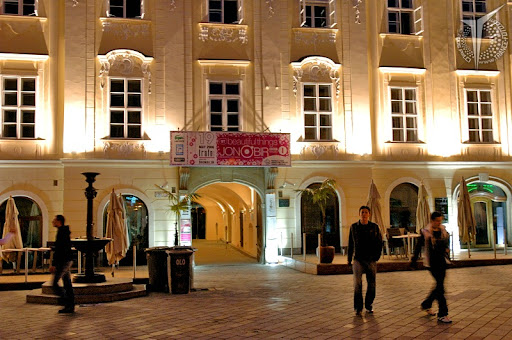
Hlavni Namesti is still a recognisable old market square, now a meeting place and café-fringed plaza with a smart fountain at its centre. Franciscan and Protestant churches gaze across each other in friendly sectarian proximity, while the buildings maintain a kind of uniform aesthetic despite ranging in architectural style from baroque to early-20th-century art nouveau.
Behind it, the Primacialne Namesti is a less-imposing square but houses one of the city’s most impressive edifices, the Primate’s Palace. Back when the city was part of the Austrian Empire and known as Pressburg, Napoleon signed a treaty with the Holy Roman Emperor Francis II here, in the Hall of Mirrors, after humiliating him at the battle of Austerlitz in 1805. The impression remains that the Slovakians were relaxed about seeing their imperial master humbled.
Bratislava seems to have cultivated a cynical irreverence over the centuries. Maybe it’s the Hungarian influence, but sly playfulness persists in the ornamentation on the streets of the old town. The most obvious examples are the three bronze statues, one of a paparazzo leaning round a street corner with camera at the ready, one of a Frenchman (assumed to be an affectionate satire of Napoleon) leaning on a bench near Hlavni Namesti, and, most strangely, one of a workman’s head emerging from a manhole on Panska Street. Take my word for it; coming back through the deserted old town in a thick blizzard after a few Carpathian brandies (you haven’t lived until you’ve tried it, and might not live much longer afterwards), it is quite disturbing to see a snow-capped head emerging from the sewers.
One guidebook accuses Bratislava’s castle of looking like “an upturned bed” and it’s not an unfair description. The building started as a fortress and was variously remodelled as a palace, religious retreat and military barracks. Each use left its mark, as did second world war air-raids. It’s not a place to look at, but rather to gaze from, given that it offers commanding views over Bratislava’s picturesque old quarter and the regimented grids of the housing on the other side of the Danube.
You can see three nations from here. Beyond the tower blocks, that’s Austria to the west, and Hungary to the south.
The museum of folk music in the castle has a vaguely Scottish feel to it, with endless arrays of pipes, drums, wooden whistles and outlandish attire. The National Museum is more eclectic, with furniture, rural crafts and a few middling examples of modern art. If you wonder why all the Slovakians are heading for one area of the museum, they are thronging to the ice hockey hall of fame. The sport is an obsession here.
Non-hockey players get their padding from the local food. Slovakian cuisine can be a treat in cold weather, a burden in the summer. The decades of dearth encouraged a reliance on cheap staples, dumplings made from flour or potato, with cabbage, curd cheese and pancakes. More recently the Slovakians have rediscovered their Austro-Hungarian culinary influences and brought back richly sauced goose and duck dishes and freshwater fish recipes for pike, carp and trout.
For the finest traditional Slovakian meal in the area, you will have to make a little effort to travel half-an-hour out of town to the village of Slovensky Grob, which has been staging “goose feasts” for the last century or so. The Husacina U Galika restaurant observes the traditional way of cooking its goose. The bird is washed in milk, roasted with apples, then roasted again to crisp it. The result is unctuous, sweet and happily greasy.
Otherwise, Bratislava restaurants tend to incline towards the loyal pig. The restaurant boards along Michalska proudly proclaim a “hog-killing feast”. Sausages, trotters, offal and ham await inside the Im Hof restaurant. Further down the street, Lyra specialises in goulash, Hungarian or Moravian style, both designed to soak up the local beer, which might not have the purists purring as in the Czech Republic, but is superior to most of our insipid lagers.
The Bratislava culinary speciality is a daunting dish called bryndzove halušky, a potato dumpling with sheep’s cheese, a nightmare cocktail of carbs and fat, but surprisingly flavoursome.
What is upsetting is that most of the shopping now seems to take place in Tesco on Kamenne Namesti. I stood gazing at a shelf stacked with around a hundred different flavours of tea. Alongside me, an elderly Slovakian, who must have lived through decades of deprivation in the communist era, spat out a Slavic tirade of disgust. When he turned to me for a response and I feebly asked “anglicky?” he pointed out in pretty decent English that you could get the same tea in one of the small shops in town for at least 10 crowns less, but that the snobs thought it trendier to shop in Tesco. In a piquant inversion of what happens in the west.Slovakia Economic progress APRIL 2008
The good news continues
- Slovakia passes the Lisbon treaty
- March HICP (due on Wednesday) should confirm that Slovakia meets the nominal Maastricht inflation criterion with a big buffer
- The 12-month rolling trade deficit now stands at -0.6% of GDP……the full-year 2008 trade balance could reach a surplus worth 0.2% of GDP !!!
- Retail sales surprised again coming in at 16.6% YoY
- The probability for 2008 Eurobond issuance decreased
- As expected, the government passed updated fiscal targets for 2008-2011
February industrial production accelerated to 11.5% YoY