Showing posts with label tourism. Show all posts

Paris - Bratislava by train and investments in Slovakia - updated

2011 UPDATE

Foxconn (the company that makes the iphone for Apple) has just bought Sony's factory in Slovakia. Along with Samsung, this is making Slovakia a hotspot for the production of high quality electronics. It seems that after cars Giant electronics behemoths are setting up shop. It is intriguing that Foxconn is Chinese and yet it chooses to invest in Slovakia for its european investments.

In other news the transformation of Bratislava's transport and integration with 2 Ten-t rail corridors is about to begin mirroring the work Austria's rail started 60km away in Vienna. 

Here are some graphics and visualisations of the cutting edge infrastructure that is going to be built in Bratislava:

Disused station in Filialka...


to be replaced by

new filialka station (close to existing ursinyho tram stop)


NEW INVESTMENTS IN SLOVAKIA

Transportation links and proximity to other eurozone countries' markets seen as strategic reasons to invest in Slovakia by asian investors.
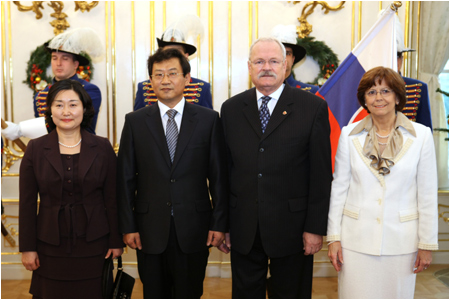

The South-Korean companies Kia and Samsung want to continue broadening their activities in Slovakia, South Korean Ambassador to Slovakia Seok-soong Seo told Economy Minister Lubomir Jahnatek at their meeting on Tuesday. “The ambassador informed the minister that the main Korean investors, Kia and Samsung, would continue expanding their activities in Slovakia in the coming years, so Slovakia is becoming a more and more important partner to South Korea,” the ministry said.

The Slovak Trade and Development Agency (SARIO) just announced that in total so far this year there are 85 investment projects meaning that about EUR 2.4billion to EUR 2.5 billion will come into Slovakia as investments.

The Director of the SARIO direct foreign investments division Andrea Chovancova informed that these investors are going to create more than 12,000 jobs in Slovakia.

The agency is currently working on 139 investment projects at present in total.

Why Bratislava? Why Slovakia?

The key reason behind all these long term bets in Slovakia's and Bratislava's success are not cost based anymore. Bratislava is significantly above the average in the EU, in terms of wealth and prices for most goods are comparable to London or Athens.

Bratislava's good connections with Austria and the rest of europe are to receive a further boost.


In a previous posting we discussed the new european transport networks. Part of the major and transformational projects headed by the EU is TEN-T that aspires to connect the different parts of europe together with transportation links to boost trade among other things.


Bratislava has been included in two of these project including  the one to Paris via Vienna and Stuttgard. This is obviously a transformational project for Bratislava as it links the city ever tighter to old-european capitals such as Vienna and Paris but it also makes Bratislava a part of the core european transport networks enhancing access in an environmentally sensitive way likely to survive the unsustainable boom in cheap filghts and their operators.


This is a relevant point as land transport is crucial if environmental concerns curb the affordability of cheap flights through which much of the eastern parts of the EU are linked to the older EU members. For example if one is stuck in Bucharest and wishes to travel to Frankfurt, the obvious choice would be to fly. However both because of the crisis but also because governments are increasing the taxes on polluting forms of travel, economic development via the airport is not a future-proof plan. This project therefore is vital for Bratislava as it can mean that the city becomes a hub for traffic from other regional capitals like Prague, Budapest etc. who would connect via Bratislava to the fast train network heading west. It could in fact become the replacement of the popular cheap flights. As natural a choice as taking the eurostar train between London and Paris.


Why is this more than just trains crossing borders
  1. Vienna's Sudbanhof station is already being demolished to make way for the infrastructure and new upgraded connection to Bratislava for the high speed trains. More on this big event Imagefolder, english (PDF, 1,65 MB)
  2. This project will be run using ERTMS ("European Rail Traffic Management System"). This is a major industrial project being implemented by Europe, a project which will serve to make rail transport safer and more competitive. One component of ERTMS, the European Train Control System (ETCS), guarantees a common standard that enables trains to cross national borders and enhances safety, speed, and cost competitiveness.

  3. Establishing an efficient trans-European transport network (TEN-T) is a key strategy for competitiveness and employment in Europe. If Europe is to fulfil its economic and social potential, it is essential to build the missing links and remove the bottlenecks in our EU transport infrastructure, as well as to ensure the sustainability of our transport networks into the future. Furthermore, it integrates environmental protection requirements with a view to promoting sustainable development.

  4. In view of the growth in traffic between Member States, expected to double by 2020, the investment required to complete and modernise a true trans-European network in the enlarged EU amounts to some € 500 billion from 2007 to 2020, out of which € 270 billion for the priority axis and projects.

  5. The speeds make this an alternative to planes. The train, TGV, already allows travellers to go from Paris to Reims in 45 minutes, and from Paris to Strasbourg, on the German border, in just two hours and 20 minutes. Under the old schedules, the trip to Strasbourg was nearly twice as long, at three hours and 50 minutes. TGV stands for "train a grande vitesse," which literally means high-speed train.

  6. The areas of Bratislava that are likely to be affected by all this are likely to be:
    Hlavna Stanica - Stare Mesto (Old Town)
    Filialka - Stare Mesto (Racianske Myto/Ursinyho)


Some visualisations of the Bratislava station for this end of the Paris Bratislava line now follow.

This is how the New Bratislava station and area will look


Potent stuff for the medium to long term future of this city.


and what about the trains that will run on the lines? The competing technologies are ICE from Germany or TGV from france

just see this (who needs planes...)


another one with some very happy frenchies :) well done!


The new train station of Bratislava - Hlavna Stanica as it will be in about 2-3 years

In a previous report, (you might want to open it to have some background) we discussed the long overdue reconstruction of the Bratislava main train station that links Bratislava to Vienna.

The newly released pictures we are showing here show how the station will look. The area will be transformed from this drab communist vision of the 1980es:


Back to its original facade from 1905


The current reconstruction of the station hall will remove the 1980es exterior to reveal the historical facade of the station. This historical building will reconstructed to the original design by the architect F. Pfaff from the year 1905.

The building was originally
Opened 1848
Rebuilt 1988
Formerly known as Pressburger Hauptbahnhof

Some original pictures for your enjoyment


Amadeus / Mozart in Vienna & Bratislava

Mozart in Bratislava performing a torrent of his first compositionsIt is well known that Wofgang Amadeus Mozart first played in Bratislava as a child prodigy in 1762.

W.A. Mozart and his family travelled to Bratislava at "the request of the Hungarian nobility" on the 11 December 1762 passing by Petronell and Hainburg.

Leopold Mozart bought a carriage. In this carriage the Mozarts travelled during their great Western Europe trip one year later too. On Saturday 24 December 1762 the Mozarts left Bratislava at 8.30 in the morning and arrived in Vienna at 8:30 in the evening. Today this short trip takes 45min on the Autobahn connecting Bratislava and Vienna.

Amadeus. The famous play after which Miloš Forman made his Oscar movie is staged at the Slovak National Theatre for the first time ever.

Martin Huba, Lenka Máčiková Vladimír Kobielsky, František Kovár, Branislav Bystriansky Ondrej Kovaľ, Alena Ďuránová Ondrej KovaľsOndrej Kovaľ, Martin Huba

This is a play by the contemporary British playwright Peter Shaffer which had its premiere in London a long time ago only to become a classic repertoire piece. And no wonder – the author tells the story of the brilliant composer Wolfgang Amadeus Mozart and his less talented contemporary and competitor Antonio Salieri.

The play depicts the eternal conflict between a prodigious and an average artist, conventional and nonconformist composer, a rebel and a member of the establishment.


Shortly after its premieres in London and New York, Amadeus received several prestigious awards (The British Critics Award and a Tony Award in the US), and the Broadway production ran over for more than thousand performances. Miloš Forman based his most successful film on the play and received an Oscar for it in 1984, Peter Shaffer received both major American awards for his screenplay: the Golden Globe and the Oscar.

Sometimes even an enormously successful play, one staged to great acclaim all over the world, falls into oblivion after several seasons. Shaffer´s Amadeus has a different fate. Its topic is universal and eternal, like Mozart´s operas. Time is an uncompromising judge: only that, what is unique, will survive.

The eternal conflict between brilliance and mediocrity will come alive where it first began: on a theatre stage. The historic building of the SND forms a highly suitable backdrop.

Sunday 31. January 2010 - 18:00
until
Detail Buy the ticket
Sunday 28. March 2010 - 18:00 Detail Buy the ticket


Information from
http://www.snd.sk/?drama&predstavenie=amadeus

Bratislava a traveller's review

Bratislava may be unspoilt, chocolate-box pretty and hailed as ‘the new Prague’, but Tom Lappin also enjoyed the Slovakian capital’s refreshing irreverence

There has been an enduring quest for nearly two decades now, or at least since the Berlin Wall came down. Jaded Euro-hipsters gather and raise a mournful toast to the old Czech capital and argue about where they will find the ‘new Prague’.

The consensus is that the Bohemian jewel is now tarnished, ruined by too many goateed college kids, hyperinflation and all that free-market vulgarity that ensues when a mournful but beautifully atmospheric city shakes off the yoke of half a century of state oppression.

Various replacements have emerged. The Baltic capitals had a chance, until the first stag parties staggered down their Ryanair stairways onto the tarmac, clutching their carry-outs.

-----------------------------------------------------------------------------

we stayed here http://flickr.com/photos/59085645@N00/94189841/ for about a year and we loved every minute of it

-----------------------------------------------------------------------------


For a closer approximation of the tranquil melancholy of Warsaw Pact Prague, though, near neighbour Bratislava is perfect. Slovakia was always the unfashionable part of that bolted-together convenience state Czechoslovakia. Since independence (achieved in the touchingly named Velvet Divorce of 1993) it has maintained a dignified reticence in contrast to the absinthe-swigging, supermodel-breeding, footballing geniuses of the Czech Republic.

The Slovakians slipped quietly into the EU with the last intake, but Bratislava remains a staid, even reserved Mitteleuropa city, blessed with old town squares as beautiful as any in Old Europe, cursed with the obligatory stretches of social realist housing blocks, but as yet slow to succumb to the homogenising influence of global commerce. So much so that it’s jarring to witness the only exception, a garish branch of Accessorise next to the austere medieval Michalska gate-tower on the northern edge of the old town.

It has escaped the swift free-market makeover inflicted on so many eastern European chocolate-box cities because most Slovakian tourism is still directed to the east and the hiking possibilities of the Tatra Mountains. Many visitors are just passing through the airport on their way to Poprad and the peaks. It would be easy to upset the beauty of Bratislava’s small old town with a few ill-considered developments. For the time being it has been sensitively preserved. The businesses here tend to be small shops, inviting coffee-houses, or those murkily cellar-like restaurants characteristic of all Europe east of the Rhine.

The old town’s main thoroughfare is the street that becomes Michalska after Venturska, cafes alternating with baroque mini-palaces built by the Hungarians. As Bratislava’s tourist industry grows, this will be the city’s prime site. For now it has an easy grace, tourists mingling with locals looking for ground coffee or fresh pastries.

Hlavni Namesti is still a recognisable old market square, now a meeting place and café-fringed plaza with a smart fountain at its centre. Franciscan and Protestant churches gaze across each other in friendly sectarian proximity, while the buildings maintain a kind of uniform aesthetic despite ranging in architectural style from baroque to early-20th-century art nouveau.

Behind it, the Primacialne Namesti is a less-imposing square but houses one of the city’s most impressive edifices, the Primate’s Palace. Back when the city was part of the Austrian Empire and known as Pressburg, Napoleon signed a treaty with the Holy Roman Emperor Francis II here, in the Hall of Mirrors, after humiliating him at the battle of Austerlitz in 1805. The impression remains that the Slovakians were relaxed about seeing their imperial master humbled.

Bratislava seems to have cultivated a cynical irreverence over the centuries. Maybe it’s the Hungarian influence, but sly playfulness persists in the ornamentation on the streets of the old town. The most obvious examples are the three bronze statues, one of a paparazzo leaning round a street corner with camera at the ready, one of a Frenchman (assumed to be an affectionate satire of Napoleon) leaning on a bench near Hlavni Namesti, and, most strangely, one of a workman’s head emerging from a manhole on Panska Street. Take my word for it; coming back through the deserted old town in a thick blizzard after a few Carpathian brandies (you haven’t lived until you’ve tried it, and might not live much longer afterwards), it is quite disturbing to see a snow-capped head emerging from the sewers.

One guidebook accuses Bratislava’s castle of looking like “an upturned bed” and it’s not an unfair description. The building started as a fortress and was variously remodelled as a palace, religious retreat and military barracks. Each use left its mark, as did second world war air-raids. It’s not a place to look at, but rather to gaze from, given that it offers commanding views over Bratislava’s picturesque old quarter and the regimented grids of the housing on the other side of the Danube.

You can see three nations from here. Beyond the tower blocks, that’s Austria to the west, and Hungary to the south.

The museum of folk music in the castle has a vaguely Scottish feel to it, with endless arrays of pipes, drums, wooden whistles and outlandish attire. The National Museum is more eclectic, with furniture, rural crafts and a few middling examples of modern art. If you wonder why all the Slovakians are heading for one area of the museum, they are thronging to the ice hockey hall of fame. The sport is an obsession here.

Non-hockey players get their padding from the local food. Slovakian cuisine can be a treat in cold weather, a burden in the summer. The decades of dearth encouraged a reliance on cheap staples, dumplings made from flour or potato, with cabbage, curd cheese and pancakes. More recently the Slovakians have rediscovered their Austro-Hungarian culinary influences and brought back richly sauced goose and duck dishes and freshwater fish recipes for pike, carp and trout.

For the finest traditional Slovakian meal in the area, you will have to make a little effort to travel half-an-hour out of town to the village of Slovensky Grob, which has been staging “goose feasts” for the last century or so. The Husacina U Galika restaurant observes the traditional way of cooking its goose. The bird is washed in milk, roasted with apples, then roasted again to crisp it. The result is unctuous, sweet and happily greasy.

Otherwise, Bratislava restaurants tend to incline towards the loyal pig. The restaurant boards along Michalska proudly proclaim a “hog-killing feast”. Sausages, trotters, offal and ham await inside the Im Hof restaurant. Further down the street, Lyra specialises in goulash, Hungarian or Moravian style, both designed to soak up the local beer, which might not have the purists purring as in the Czech Republic, but is superior to most of our insipid lagers.

The Bratislava culinary speciality is a daunting dish called bryndzove halušky, a potato dumpling with sheep’s cheese, a nightmare cocktail of carbs and fat, but surprisingly flavoursome.

What is upsetting is that most of the shopping now seems to take place in Tesco on Kamenne Namesti. I stood gazing at a shelf stacked with around a hundred different flavours of tea. Alongside me, an elderly Slovakian, who must have lived through decades of deprivation in the communist era, spat out a Slavic tirade of disgust. When he turned to me for a response and I feebly asked “anglicky?” he pointed out in pretty decent English that you could get the same tea in one of the small shops in town for at least 10 crowns less, but that the snobs thought it trendier to shop in Tesco. In a piquant inversion of what happens in the west.