
Bratisalva christmass market

pictures from Bratislava (1 day old)

Plus Forced smile competition between Robert Fico (Slovakia's PM)
and
Vladimir Putin russia's ehm master of puppets or every other job he likes.
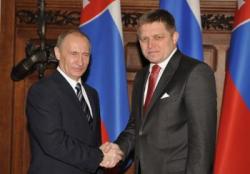
Don't you just hate trade missions...
 Václav Havel, the former president of Czechoslovakia, dissident and one of the key figures of the Velvet Revolution that toppled Communism in the former federation has become an honorary citizen of Bratislava. The Slovak capital granted him honorary citizenship on the occasion of the 20th anniversary of the fall of the totalitarian regime for his fight for freedom, democracy and assisting in the process of Slovakia's integration into Europe.
 The great statesman and philosopher/king Václav Havel said that he respects the award all the more after discovering the personalities who have received it. He has had a long and and enduring relationship with Bratislava, whose people he said he considers very amiable both while he was in office and after his retirement from active politics.
He characterised personality as uniqueness of the human soul and deeds, and as what differentiates one human being from his fellows. Another awardee was the first Austrian Ambassador to Slovakia, Maximilian Pammer. Havel and Pammer received their awards in person.
Havel will receive it on the occasion of the 20th anniversary of the fall of communism in Czechoslovakia, which Slovaks and Czechs mark on November 17.
The resistance to the communist regime's excesses were very much felt in Bratislava as well as Prague. A mass demonstration took place on Hviezdoslav Square in downtown Bratislava and then moved to the Square of the Slovak National Uprising) SNP. Students presented various demands and asked the people to participate in the planned general strike for Monday, November 27. A separate demonstration demanding the release of the political prisoner and christian activist Ján Čarnogurský (the later Prime Minister of Slovakia) took place in front of the Palace of Justice. Alexander Dubček delivered an address at this demonstration – his first appearance during the Velvet Revolution. As a result, Čarnogurský was released on November 23."The diplomas will be handed at a ceremonial meeting of the Bratislava City Hall on the occasion of the 20th anniversary of the fall of the totalitarian regime. Its preliminary date is November 18, 2009," the City Hall said in a statement.
Havel, a playwright and a leading dissident under the former communist regime, was the last Czechoslovak president (1989-92) and the first Czech president (1993-2003).
Even under the communist regime he was known as one of the most promitent thinkers and human rights fighters. Havel contributed to the fall of communism in 1989 to a great extent.
In the past, Havel was repeatedly nominated for the Nobel Peace Prize.
Three years ago, Havel was presented with an honorary doctor's degree in Bratislava on the occasion of his 70th birthday.
Last year, the Slovak premiere of Havel's latest play Leaving was staged in the Slovak National Theatre in Bratislava.


In related news: According to the European Union energy commisioner gas consumers won’t suffer if Ukraine starts another transit war with Russia this winter.
Kiev blocked transit pipelines from Russia last January in a payment row, leading to power cuts across the EU. But Energy Commissioner Andris Piebalgs says they've agreed ways to avoid Ukraine altogether.AP: “Our gas storages are 100% full, we've increased all types of switching opportunities for countries which can't cover gas for a very long period. We also have emergency plans if they are needed. On the Russian side I believe there are also plans for increasing supply from other pipelines if there is a problem with one of them. During January there will be more gas flowing through the Yamal Europe pipeline. So it is important that both sides reunite and that the final consumer does not feel threatened at all.”
More background on the pipeline and it's significance (from wikipedia):On 18 December 1959, the 10th session of the Council for Mutual Economic Assistance (Comecon), held in Prague, adopted a decision and an agreement was signed on construction of a trunk crude oil pipeline from the USSR into Poland, Czechoslovakia, GDR and Hungary.[2] Each country was to supply all necessary construction materials, machinery and equipment. In 1962, first oil reached to Czechoslovakia, in September 1963 to Hungary, in November 1963 to Poland, and in December 1963 to GDR. The whole of the pipeline was put into operation in October 1964. The first oil pumped through the Druzhba pipeline originated from the oil fields in Tatarstan and Samara (Kuybyshev) Oblast. In 1970s the Druzhba pipeline system was further prolonged at the expense of parallel lines.[3]
The pipeline begins from Almetyevsk in Tatarstan, southeastern Russia, where it collects oil from western Siberia, the Urals, and the Caspian Sea. It runs to Mozyr in southern Belarus, where it splits into a northern and southern branch. The northern branch crosses the remainder of Belarus across Poland to Schwedt in Germany.[2] It supplies refineries in Płock and in Schwedt. The northern branch is also connected by the Płock-Gdansk pipeline with the Naftoport terminal in Gdansk, which is used for oil re-exports.[4] In Schwedt the Druzhba pipeline is connected with the MVL pipeline to Rostock and Spergau.
The southern branch runs south through Ukraine. In Brody the Druzhba pipeline is connected with the Odessa-Brody pipeline, which is currently used to ship oil from the Druzhba pipeline to the Black Sea. In Uzhgorod the pipeline splits into lines to Slovakia (Druzhba-1 - original Druzhba route) and to Hungary (Druzhba-2). The line through Slovakia is divided once again near Bratislava: one branch leading in a northwest to Czech Republic and the other going southward to Hungary. The Druzhba-1 pipeline branches off toward Hungary at Ipeľ, crosses the Hungarian border at Dregelypalank and leads to Százhalombatta.[2] In Hungary, the Druzhba-1 pipeline supplies Duna refinery while Druzhba-2 supplies Duna and Tisza refineries.[5]
The Mažeikių refinery in Lithuania and Ventspils oil terminal in Latvia are connected to the main pipeline by the branch pipeline from Unecha junction in Bryansk Oblast. This branch has ceased operation in 2006 and is not likely to become operational in any time soon.
The part of Druzhba pipeline system, which runs via Belarus, is 2,910 kilometres (1,810 mi) long. The length of the pipeline in Ukraine is 1,490 kilometres (930 mi), in Poland in 670 kilometres (420 mi), in Hungary 130 kilometres (80 mi), in Lithuania 332 kilometres (206 mi), in Latvia 420 kilometres (261 mi), and in Slovakia and in the Czech Republic together around 400 kilometres (250 mi).[2][6]
The Druzhba pipeline currently has a capacity of 1.2 to 1.4 million barrels per day. Work is currently underway to increase this in the section between Belarus and Poland. The pipe diameter of the pipeline varies from 420 millimetres (17 in) to 1,020 millimetres (40 in).[3] It uses 20 pumping stations.
The Russian part of the pipeline is operated by the oil company Transneft through its subsidiary OAO MN Druzhba. In Belarus the operator is Gomeltransneft Druzhba, in Ukraina UkrTransNafta, in Poland PERN company, in Slovakia Transpetrol, in the Czech Republic Mero and in Hungary MOL.[7]
Schwechat–Bratislava two-way oil pipeline project was proposed in 2003. It would allow to supply the OMV owned Schwechat Refinery from the Druzhba pipeline.[7]
"the chief architect has actually stated that he thinks the (world
financial) crisis is a stroke of fortune for the Slovak capital because it
will give it some time for planning to catch up with the pace of
development "
Certainly some overly oppressive developments were being planned. The
relatively loose laws on the height new buildings may reach led to ugly
buildings.
Despite what real estate agents on the payroll of developers say Ruzinov in
Bratislava looks too much like luxurious version of Petrzalka. Buildings
that look like office blocks turn out to be housing.
One cannot help but think that these buildings will be ungovernable,
difficult to maintain & once their newness fades a bit, places for poor
people to live...
This is especially true when one considers how expensive the rents are in
these buildings.
In short Ruzinov is not really close to the centre. There is no feeling of
community. They urban quagmires of the future. I hope that smaller &
greener developments will take their place.
' the worst of the carnage that has now reached the UK's shores, arguably sending London prime yields below those in Prague and Warsaw. But exactly what we mean by Central Europe will also come into question. Just as real distinctions are now being made between prime and non-prime assets, we're likely to start seeing CEE Prime and CEE Secondary countries. Poland, the Czech Republic and possibly Slovakia belong to the first. Hungary, however, is now being seen differently.
'
Another endorsement of Slovakia.
An hour after the 48-year-old woman was hospitalised in a Bratislava hospital, doctors had to resuscitate her because she suffered from serious arrhythmia. Her overall circulation failed. The woman was put into induced sleep and connected to respiratory equipment. Six hours later the critical situation repeated, but this time doctors failed to resuscitate her, which was confirmed by the autopsy as well.
Slovakia is well-prepared for a possible flu pandemic but the situation is now stable and the number of registered flu cases is not exceeding the norm, Health Minister Richard Raši told TASR on November 9.

Furthermore, Barack Obama is still standing at the crossroads. Some old hands around him yearn for a third Clinton term -- government as subsidiary of corporate America. Ardent progressive followers, on the other hand, hope his heart really leans to the left, toward the public provision of public goods.
But at bottom, the issue isn't one ideology or another - we're not that kind of country. The issue is inequality. Two British researchers have just made news with a study over three decades, showing that where income is more evenly distributed, people are healthier in mind, body and spirit. You can find out more about their report on our website at pbs.org.* They found that violence, mental illness, overcrowded prisons, drugs, and obesity are more likely in a society where the gap between the have's and have-not's is as great as it is in the United States.
Our gap grew over the past quarter century as capitalism went on a spree of speculating, swindling and cheating. The great collapse is a painful correction. Our long term rescue, however, depends not on any "ism," but on democracy's ability to create a more level playing field, where the health of a battered woman in San Antonio is every bit as valued as a majordomo's on Wall Street.
This is a book with a big idea, big enough to change political thinking, and bigger than its authors at first intended. The problem they originally set out to solve was why health within a population gets progressively worse further down the social scale; they estimate that together they have clocked up more than 50 person-years gathering information from research teams across the globe. Their eureka moment came when they thought of putting the medical data alongside figures showing the extent of economic inequality within each country. They say modestly that since dependable statistics both on health and on income distribution are internationally available, it was only a matter of time before someone put the two together. All the same, they are the first to have done so.
Their book charts the level of health and social problems — as many as they could find reliable figures for — against the level of income inequality in 20 of the world’s richest nations, and in each of the 50 United States. They allocate a brief chapter to each problem, supplying graphs that display the evidence starkly and unarguably. What they find is that, in states and countries where there is a big gap between the incomes of rich and poor, mental illness, drug and alcohol abuse, obesity and teenage pregnancy are more common, the homicide rate is higher, life expectancy is shorter, and children’s educational performance and literacy scores are worse. The Scandinavian countries and Japan consistently come at the positive end of this spectrum. They have the smallest differences between higher and lower incomes, and the best record of psycho-social health. The countries with the widest gulf between rich and poor, and the highest incidence of most health and social problems, are Britain, America and Portugal.
Richard Wilkinson, a professor of medical epidemiology at Nottingham University, and Kate Pickett, a lecturer in epidemiology at York University, emphasise that it is not only the poor who suffer from the effects of inequality, but the majority of the population. For example, rates of mental illness are five times higher across the whole population in the most unequal than in the least unequal societies in their survey. One explanation, they suggest, is that inequality increases stress right across society, not just among the least advantaged. Much research has been done on the stress hormone cortisol, which can be measured in saliva or blood, and it emerges that chronic stress affects the neural system and in turn the immune system. When stressed, we are more prone to depression and anxiety, and more likely to develop a host of bodily ills including heart disease, obesity, drug addiction, liability to infection and rapid ageing.
Societies where incomes are relatively equal have low levels of stress and high levels of trust, so that people feel secure and see others as co-operative. In unequal societies, by contrast, the rich suffer from fear of the poor, while those lower down the social order experience status anxiety, looking upon those who are more successful with bitterness and upon themselves with shame. In the 1980s and 1990s, when inequality was rapidly rising in Britain and America, the rich bought homesecurity systems, and started to drive 4x4s with names such as Defender and Crossfire, reflecting a need to intimidate attackers. Meanwhile the poor grew obese on comfort foods and took more legal and illegal drugs. In 2005, doctors in England alone wrote 29m prescriptions for antidepressants, costing the NHS £400m.
The danger is not from the petty authoritarian tendencies of Robert Fico the PM of Slovakia as portrayed in some fairly US centric Slovak commentators on the right. It is true that power is exercised fairly strongly in Slovakia (but that was true of the Dzurinda administration which had a fairly radical and successful political agenda with some excesses).
That is actually to be welcomed as in Slovakia governments still have the power to change policy rather than trying to copy each other like in the UK or the US. Fico is an old-fashioned conviction politician who does seem to want to entrench some social democratic standards in Slovakia and actually believes in certain things and within the ability of the state budget he has provided some support to weaker people without for the most part restricting the ability of those who can take care of themselves from prospering. The fact that he doesn't seem to adore and suck up to rich people is not bad at all.
It is also understandable for example to hate tabloids (they have tried to disturb his personal life on many occasions with a unbelievable audacity) as he does because they do express the worst in a society and they do try to subvert the political debate to serve their owners interests (e.g. the Sun in the UK). Although i don't like the press law in Slovakia, I always thought that tabloid journalists engage in very murky circles. We need to draw a line between the financial times and the Sun. Tabloids are a caricature of journalism and a force for evil. Broadsheets however should not be put in the same bag. Fico should respect constructive and intelligent criticism and debate.
The decline of the business model of newspapers makes them even more likely to be bought by organised interests that want to have the upper hand in the political debate. Again this has happened in any country with thriving tabloids that express and represent the worst in human nature.
If one looks to the UK, the extreme consensus between Labour and the Conservatives has hollowed out politics of all relevance and has led to what feels like an ungoverned state. The result is that Britain, from a fairly well governed state, is ending up as an over-indebted country with an increasingly extremist electorate (Anti-EU, BNP growing, curtailed civil liberties through extreme anti-terror laws) and it certainly feels like it is the beginning of this process.
Free market economics has changed our democracies. Ironically these policies are bringing about authoritarianism back. The mechanism this works through are principally two.
Ergo: Too much political consensus between left and right is a mistake
So where has this footballisation of politics and public life come from. Why are so many governments turning more and more authoritarian?
A review of a very interesting book about how increasingly the excesses of the right wing ideologues like Tony Blair (no mistake here) stemming from the time of Reagan have pushed the emergence of a feudal flavour of capitalism to be found in economically prosperous but culturally and democratically backward and stifling states like Malaysia or Singapore. Note that corruption is endemic in this sort of Fascistic regime. Its a fusion of tame consumer/citizens, propaganda, really low quality of democracy and essentially a well disguised oligarchy with some democratic traits.
Because there are no ideas or ideals in the debate, the debate becomes irrelevant. People don't vote so the extremists get bigger and bigger shares. Also a public fed a diet of tabloid news is likely to be far more susceptible to extremist politics. The stifling consensus where whatever one votes they get the same policies has brought about stability but also an erosion of democracy and brought about the politician who is popular not because he wants to do things that you as a citizen agree with, but because you like his dress sense, or you would like to be as rich as him. Berlusconi is in that mould at least partially.
Ironically globalisation and competition is now forcing European and American states to lose any flourishes of democracy and free speech they developed in the past to revert to gameshow host type of leaders (e.g. Berlusconi, Zapatero, Blair, Bush). The citizen is economically free (kind of because corruption is playing its part to skew even this). But policy is strictly set and permanent and not something that an elected leader can change. The countries that this is entrenched in the most are the US and the UK.
-----------------------------
Review by Samuel Brittan
Published: November 2 2009 06:24 | Last updated: November 2 2009 06:24

By John Kampfner
Simon & Schuster £18.99, 304 pages
It is no longer a startling observation that the more western governments have spoken about freedom and democracy in the struggle against their enemies, the more the freedom part, at least, has been curtailed. In Britain, the Thatcher government tightened the screws on freedom of expression. The Blair government went further in curtailing historical rights such as habeas corpus and free speech.
In my view, the most profound study of this process in its historical context is Ben Wilson’s What Price Liberty? John Kampfner’s Freedom for Sale, on the other hand, makes up in breadth what it lacks in depth. While Wilson was mainly concerned with Britain, with a few glances across the Atlantic, Kampfner, a British political journalist, includes the US, Italy, Russia, Singapore, China, India and the Arab Emirates, and in nearly all he discovers similar erosion. Like Wilson, he attacks the thesis that capitalism inevitably leads to personal and political freedom as well as democracy. He cites Benjamin Franklin, who declared in 1755 that “those who would give up essential liberty to purchase a little temporary safety deserve neither liberty nor safety”. The excuse has always been that freedom is sacrificed for prosperity and security. Kampfner is inclined to concede that there might be something in this.
If he had only included the Scandinavian countries, for instance, in his survey, he could have seen that personal and political freedom need not be an impediment to prosperity. Too many businessmen regard critics of the Chinese and Russian regimes as doctrinaire nuisances who impede their making of money.
Security is more difficult; but Kampfner has little difficulty in showing that the restraints imposed by the Blair government went far beyond the legitimate struggle against terrorism. During his term of office Blair “had bequeathed to his successor a surveillance state unrivalled anywhere in the democratic world”.
It seems to me that the problem with Blair was – to put it kindly – an aversion to abstract thought. Hence his sneering remarks about the liberal tradition. With Gordon Brown it is different. He believes the hallmark of progressive thinking is a positive attitude to the state against “right wing” laisser faire. While this attitude stems from a preoccupation with the economic and social arguments of the 20th century, it spills over into a carelessness about civil liberties as well. In practice both New Labour prime ministers were guided by the demands of the security chiefs and the desire to be seen to be “tough”.
Politicians and mandarins tend to confuse politically embarrassing leaks with threats to national security, as Kampfner points out. On a more trivial but revealing level, Kampfner quotes a French journalist writing from the UK: “Here you are actively encouraged to denounce your neighbour for not paying road tax or putting a bin out early … There are councils that spy on their taxpayers as if they were common criminals… the Home Office proposes to set up a database holding information on every telephone call made, every email sent and every website visited by every single British citizen.” Nor do the media, who value excessively their access to top government figures, come off much better. To get the point, you only have to hear or read that “Brown has decided” or “Cameron has decided” on matters where these politicians thankfully still have no such power.
Kampfner pessimistically accepts that an authoritarian capitalism on the Singapore model is spreading worldwide: the people have made their Faustian bargain. Yet I still cherish the hope, not that the masses will read John Stuart Mill, but that enough personal experiences of the basic inhumanity of this model will lead to some kind of liberal reaction in some countries and some times.
However while a LABOUR government is making very few noises about this big
adjustment in labour (in other words permanently less positions). France is
at least sounding concerned about its citizens..
Reading a title like the one below sounds alien in US & UK largely because
anglo governments tend to be dismissive of people in difficulties.
Certainly in this crisis most people losing their jobs are not lazy or bad
workers.. In fact people that should be downsized like traders arranging
for CDOs or derivatives are not & these people have cost our generation our
pensions.
Overall it would help a lot if the richest 1% of each country made many
more sacrifices as a patriotic duty to deal with a huge spate of private
suffering.
Anyway have a read & see what you think.
Labour minister urges companies to prevent staff stress
French Labour Minister Xavier Darcos (photo) asked firms with more than
1,000 employees to lead talks with unions on reducing workplace stress. At
former state-owned monopoly France Telecom, 24 employees have committed
suicide in 18 months.
By News Wires (text)
REUTERS - French companies must prevent stress in the workplace to stem a
wave of suicides, Labour Minister Xavier Darcos said on Friday.
At France Telecom, Europe's third-biggest telecoms firm and a former
state-owned monopoly, 24 employees have committed suicide since the start
of 2008, and others have attempted to kill themselves. An employee of car
maker Renault committed suicide on Wednesday.
"We have long underestimated psychological risks, as it is easier to spot
someone falling into a blast furnace than someone who is suffering," Darcos
told a council on work conditions. "And yet (psychological risks) are real,
as the situation ... at France Telecom has shown in a particularly tragic
way."
Darcos urged 2,500 French firms with more than 1,000 employees to conclude
talks with unions on reducing stress, which labour leaders say is the
reason for the spate of suicides, by Feb. 1 next year.
France Telecom has already begun negotiations which are based on a 2008
agreement with unions.
The government, which is France Telecom's biggest shareholder with 27
percent stake, has been closely involved in trying to manage the fallout
from the suicides.
Unions blame restructuring and work pressure at France Telecom for the wave
of suicides, saying that some staff are being left behind in the firm's
transformation from a staid government agency to a private company with
profit targets and intense competition.
Darcos also called on small and medium-sized companies to put together
measures to provide information on psychological risks and spot problems
with support from workplace health services.
He also called on regional heads of firms in the process of restructuring
to take into account the psychological risks of the transition.
A dedicated advisory body will be created to advise firms and monitor those
which are slow to act.
A report will be made public on a dedicated website,
www.travailler-mieux.gouv.fr. France will put forward a second plan on
workplace health by the end of this year.
From farm to fork
Oct 9th 2009
From Economist.com
Bar codes that let shoppers trace their food back to the field
DESPITE its preoccupation with hygiene, America's dirty secret is that it is one of the most dangerous places in the developed world to eat. Every year 76m Americans become ill because they have consumed contaminated food—a staggering 26,000 cases per 100,000 population. In Britain, where people consume far fewer hamburgers, generally eat out less often and buy nowhere near as many ready-meals, there are 3,400 cases of food poisoning per 100,000 population annually. France is safer still, with only 1,200 annual instances per 100,000 people.
Most cases of food poisoning are mild, with victims recovering in a day or two. Sometimes, however, foodborne illnesses kill or cause permanent health problems. In the United States around 5,000 people die and a further 325,000 wind up in hospital each year as a result of food poisoning. The annual cost to the country, in medical treatment and lost productivity, is more than $35 billion.
AP
The wave of food scares that has swept America over the past few years has caused a crisis in the country's $1 trillion food industry. One of the most notorious outbreaks, caused by the virulent Escherichia coli O157:H7 bacterium, happened in 1993. Four children died, dozens of people went to hospital with kidney failure and hundreds more became seriously ill after eating undercooked hamburgers from the Jack-in-the-Box chain of restaurants. Since then, the regulations governing the sale of ground beef have been tightened considerably.
The deadliest foods to be found on the stalls in street markets and the shelves of supermarkets, though, are not meat or poultry but leafy vegetables and fruit. That is because unlike ground beef, which is cooked at a temperatures which destroy bugs, fruit and leafy vegetables tend to be eaten raw. The outbreak of O157 in 2006, which killed five people and made a further 205 ill, was tied to raw spinach. Meanwhile, America's largest epidemic of foodborne disease in over a decade—last year's Salmonella infection that claimed two lives, hospitalised 250 people and affected more than 1,300 others—was traced back through the supply chain initially to tomatoes and then to jalapeño peppers. Now there are doubts whether either was really to blame.
Tracking down the source of a foodborne infection is notoriously difficult. The vast majority of incidents are transitory in nature—a leaky toilet, a wandering animal, a momentary lapse of hygiene in the field or factory. '
The rest of the article ends up being an advertorial for
RFID tags & their vendors.
Conclusion don't eat in the US.
Having lived in the UK for 14 years, I was amazed at how far the
governments since Thatcher went to please business. One had the constant
feeling that big business owned the government.
The defence they used for their policies was like this:
Be good to business so they flourish and/or relocate here from other
countries. Which means good economy & strong UK.
However in practice it worked like this:
UK government sucking up to the rich, including autocrats in arab countries
but only if they have money.
Among the businesses that came to London, too many where fraudulent or at
the edge, many engaged in unethical practices. On most occasions the UK
sold their citizenship to any sleazeball with money..
The UK's unethical stance created a horrible competition downwards in
standards. Other EU countries had to relax rules to stay competitive.
Too much of the UK's prosperity is tied to immoral practices like
laundering money. It was also trying to force other EU countries to lower
taxes on business like this -a sort of policy imperialism-.
Much of this anything goes atmosphere gave birth to the horrible crisis.
Because unsupervised the bankers took crazy risks looking at their personal
interest, hoping that the bonuses will be so large they can retire and
will not be there if the bets went wrong. Many were right!
Now responsible governments after putting things right & indebting us all
to do so want to insure this doesn't happen again. Except the US & the UK
policy is still in thrall to the rich & the bankers.
Now read on:
'Their comments came as Sweden added its voice to growing demands for
regulation of bankers' bonuses and called a meeting of European leaders to
forge consensus ahead of a G20 summit in Pittsburgh.
Fredrik Reinfeldt, Sweden's prime minister, whose country holds the
revolving EU presidency, urged European leaders to agree co-ordinated
measures to prevent a return to "business as usual" in the financial
sector. "We've seen a tendency to go back to the same kind of bonus system
we saw before the financial crisis," he said.
The finance ministers of Sweden, France, Spain, Germany, Italy, Luxembourg
and the Netherlands wrote to the Financial Times to call for a ban on
bonuses guaranteed for more than a year and regulations to make sure
payouts mirrored bank performance over time.
Signs that the bonus culture was returning to the financial sector was "a
punch in the face of all the people who are quickly becoming unemployed",
they said.
Mr Reinfeldt said bonuses would be high on the agenda when leaders of the
27 EU countries met in Brussels on September 17 to co-ordinate the bloc's
position before the G20 summit later in the month.
The Swedish prime minister was optimistic that the EU would present a
united front in Pittsburgh, despite signs of tension over a number of
issues. France and Germany have led calls for restrictions on bonuses while
the UK has been more cautious, amid fears that an EU crackdown could hurt
London's financial services industry.
'


"After the shock came the arguments. No one expected the Office for National Statistics to say the economy shrank by 0.4 per cent in the third quarter; the survey data and early official data had been too strong.
Few were therefore minded on Friday to modify their entrenched positions about the UK economy, the policies needed to revive it or whether the figures contained any useful information. Stuck in the middle of these clashes, of course, was the ONS.
Its preliminary data on gross domestic product are an attempt to provide an early snapshot of economic performance. The downside is that its coverage is limited, with this first estimate based on only 40 per cent of the total hard data on output and nothing on spending or incomes.
George Osborne, the shadow chancellor, said: "This is deeply disappointing news. Britain is now in the deepest and longest recession in its modern history. Britain's economy is still shrinking a full six months after France and Germany started growing."Meanwhile, economists agreed that the GDP figures made it more likely that the Bank of England would extend its efforts to create money and pump it into the economy in November by expanding the £175bn programme of asset purchases known as quantitative easing.
Yet the most vociferous arguments took place in the City, where analysts clashed over the importance of the figures.Danny Gabay of Fathom Financial Consulting insisted the appropriate reaction was far greater caution about predicting recovery.
"The UK has some formidable headwinds, not least of which is the over-burdened consumer which is having to cope with a broken banking system, rising unemployment, and falling income growth," he said.
This view was described as "baloney" at Goldman Sachs, which put greater weight on more optimistic recent surveys of companies. Analysing the accuracy of the past decade's preliminary GDP figures, Kevin Daly, Goldman Sachs economist, concluded that they contained "no statistically useful information about growth" because they were so heavily revised, often years after the event.
For example Britain has secured an exemption, or thinks it has, from the charter of fundamental rights. The charter is given legal force by Lisbon. It is full of things like the right to strike and a "right of access to preventive health care".
So lets get this right. Having the right to access preventive healthcare is controversial? The labour party disagrees with the right to strike?
What kind of labour party is it?
It sounds to me that Britain does not have genuine political choice which invalidates its democracy.
 A huge €1.5 billion, five-year project bringing a US casino to Bratislava has been announced.

 realized in Slovakia in 2000. After several successful Hungarian projects the Polus Center, Bratislava was the company's first foreign development. With this project TriGranit was a pioneer, because this was the Slovak capital's first American style commercial and entertainment centre. It was followed by the opening of Millennium Towers I, and II office towers - in 2001 and 2003 - what again fulfilled already the existing market demands. These were Bratislava?s first "A" class office buildings.
 Harrah's (Las Vegas Casino operator) Managing Director of Development, Andrew Tottenham, said at a press conference in the Slovakian capital of Bratislava that the Metropolis could be followed by other projects in Europe but not on the same scale, according to Reuters. This is going to be their flagship in Europe.
 I am a major fan of Ivan Sramko (photo on the right -Robert Fico Slovak PM is on the left-). He is the central bank governor of Slovakia and exactly the right kind of mature and serious banker with a distinctly old-fashioned banking pedigree that oozes a sustainability and soberness largely missing in the western and particularly Angloamerican institutions and boardrooms.
In 1980 he graduated from the University of Economics in Bratislava, Faculty of Management. Between 1981 and 1990 he worked as Head of financial units in several corporations.
From 1990 to 1991 Mr Sramko was Deputy Director of VUB - ING, a.s. (advisory banking company).
In 1991 - 1992 he was appointed Head of the Task Force of the VUB Bank establishing the joint venture of VUB - Credit Lyonnais.
Between 1992 and 1998 he held the position of General Manager of Istrobanka, a.s. (subsidiary of Bank für Arbeit und Wirtschaft AG, Vienna, the then-subsidiary of Slovenska poistovna, a.s., Bratislava), and was Deputy Chairman and later Chairman of its Board of Directors.
From 1998 Mr Sramko was a member of the management of Tatra banka, a.s. (subsidiary of Raiffeisen International Bank-Holding AG, Vienna, the then-subsidiary of Raiffeisen Bank, Vienna), and from 2000 to 2002 a member of its Board of Directors.
From 11 January 2002 to 31 December 2004 Mr Sramko served as a Deputy Governor of the National Bank of Slovakia. He was appointed Governor of the NBS effective from 1 January 2005.
Mr Sramko is a Member of the Governing Council of the European Central Bank, a Governor in the International Monetary Fund and an Alternate Governor in the European Bank for Reconstruction and Development.
Since 1998 he has been a member of the Board of the Slovak-Austrian Chamber of Commerce and since 2003 a Chairman of the Managing Board of the University of Economics in Bratislava.
He is fluent in English and German.
He is married and has three children.
 Posts
All Comments
Posts
All Comments


