Showing posts with label reform. Show all posts

What is the politics of Slovakia and the Euro as well as the eurozone/EU


Sovereign euro Risk of Slovakia according to the rating agencies

September 2011 Sovereign risk Currency risk Banking sector risk Political risk Economic structure risk Country risk

A BB A AA BBB A

Sovereign risk
Stable: The commitment to fiscal consolidation will remain strong, and debt levels should remain well below EU thresholds. 

Currency risk
Stable: Growing concerns regarding the solvency and competitiveness of some euro area members are potentially negative for the single currency. However, interest rate differentials should favour the euro in the short term.

Banking sector risk
Stable: Slovakia's banking sector is very conservative and very profitable but also very conservative in its asset allocation. The banking sector has been resilient to the aftermath of the global crisis of 2008-09. However, some foreign banks with branches in Slovakia could face distress because of the euro area crisis.

The Slovak capital Bratislava, the economic hub of the country


Political risk
The centre-right government looks less stable than its predecessor, but it is more investor-friendly. None of the parties likely to make it into parliament in a general election threatens Slovakia's international creditworthiness.

Economic structure risk
The economy's dependence on exports of automotives, machinery and electronics weighs heavily on the outlook for the economy, and could make medium-term growth more volatile.


Slovakia is led by a four-party, right-wing coalition, in which the largest party is the Slovak Democratic and Christian Union-Democratic Party (SDKU-DS the political party that brought about the 19% flat tax). The government has delivered pro-business changes that dilute workers' rights in the hope that will reduce the disincentives to hire people. This has dismayed many given widespread reform fatigue. Fiscal consolidation will be the main economic policy issue in the coming years.

The chances of the current coalition surviving until the election scheduled for 2014 are fair given that the overcast global environment does not favour major changes. But personal and programmatic clashes could bring it down before then. Real GDP growth is slowing in 2011 as the government is performing fiscal consolidation with a view to put aside funds in case there is a global crisis. Growth until 2015 will be slower than in the boom years but fairly fast in the chastened environment but at least this is not over levaraged unstable growth. Inflation is settling around 2.5% in 2012-15. The current account is expected to register deficits averaging around 3.4% in 2011-15.

Political outlook The centre-right ruling coalition turned one year old in July. Coalition parties have shown resilience despite frequent disputes. Disagreements between ruling parties could spill over in late 2011 when parliament debates the government's recent decision to sanction Slovakia's financial contribution to the European Stability Mechanism (ESM) from 2013.

Economic policy outlook
Slovakia's fiscal consolidation effort has been progressing in line with plans in 2011. At end-July the state budget posted a deficit of €1.67bn (US$2.3bn), 30.4% smaller year on year.

Economic forecast
In June seasonally adjusted industrial output fell by 2.2% month on month. The economic sentiment indicator (ESI; 2005=100), which had moved lower in the second quarter, after climbing in the first quarter, edged down further in July, dropping by 1.6 points month on month, to 93.9. This reflected weaker confidence in the industrial sector, owing to weakening demand of trade partners in the EU.


The new train station of Bratislava - Hlavna Stanica as it will be in about 2-3 years

In a previous report, (you might want to open it to have some background) we discussed the long overdue reconstruction of the Bratislava main train station that links Bratislava to Vienna.

The newly released pictures we are showing here show how the station will look. The area will be transformed from this drab communist vision of the 1980es:


Back to its original facade from 1905


The current reconstruction of the station hall will remove the 1980es exterior to reveal the historical facade of the station. This historical building will reconstructed to the original design by the architect F. Pfaff from the year 1905.

The building was originally
Opened 1848
Rebuilt 1988
Formerly known as Pressburger Hauptbahnhof

Some original pictures for your enjoyment


Harabin, the mafioso-friendly justice minister

UPDATE - Harabin has ceased to be in this position of minister of justice, the new minister is a woman and a fairly normal choice.
-------------------------------------------------------------------------------------

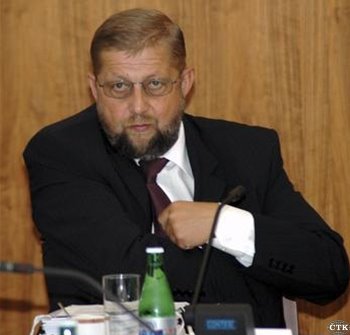
Would you buy a used car from this man? Stefan Harabin defender of the Mafia
(in the photo he is reaching for his gun as part of a media management move...)

Would you buy a used car from this man? Stefan Harabin defender of the Mafia
Well fair is fair, when there are some disturbing developments in Bratislava in terms of corruption which is my major worry for the country we must point them out. The good news is that corruption usually is easily fixable afterwards and does not derail the direction the country has taken with EU accession.
Despite being very bad reputationally and in terms of the political climate, petty to medium strength corruption of jobs for the boys and dodgy contracts will not destroy Slovakia and some of them existed within the Dzurinda government too (Odious ANO party being a case in point). That does not mean to say its hermless or good...

The major representative of Vlado Meciar (populist and drunkard extraordindaire) in Fico's government is the justice minister Stefo Harabin. He is a rather odd figure, and certainly very pro-mafia. I suppose after Fico refused the Slovak Intelligence Services brief to Meciar and kept him personally out of government, he had to compromise somewhere. He gave the justice ministry to Meciar/Harabin and now these guys are getting rid of much of the good work done in this field from the previous government. Withstanding criticism and using it to improve one-self constructively is a sign of a mature person, Harabin clearly doesn't have that and he proceeded to act like a bull in a china shop inside the ministry so far.

I think Fico should not underestimate how much damage this is going to do to him politically, I obviously don't know the internals of the coalition negotiations, but he should have tried to fob Meciar off with an unimportant ministry like Agriculture or Defence or both. Justice is important in a country with a corruption problem.

Important Suggestion: the business world should provide employment to the unfairly dismissed justices, If you are an employer in Slovakia consider helping justice by employing one of these excellent judges as a lawyer or counsel.

Ľudovít Bradáč (Banská Bystrica)
Robert Urban (Žilina), both heads of regional courts,
and district court chief justices
Peter Hrnčiar (Žilina),
Milan Růžička (Veľký Krtíš)
and Peter Bebej (Dolný Kubín).

as a show of support for judges that try to clean up the murky world of politics. I am sure they are very capable lawyers and this would send a message that the Meciar style corruption is a thing of the past, and will not be tolerated.


this is just a battle lost and not the war. The big question remains as to how R. Fico feels himself about these developments... He has legal training himself so surely he knows exactly what is going on. If Fico resents these changes then sooner or later Meciar will lose the last strands of voter support and be consigned in the dustbin of history, lets hope he goes under 5% in the next election.

Here is an article about from the Slovak spectator. Meciar has become more corrupt with age not less... Presumably all his sponsors are now in the underworld. If this phenomenon is restricted to the justice ministry and for only 5 years, no lasting damage will be done, but i certainly don't like it one bit.

ARTICLE
Harabin sacks critical justices
JUSTICE Minister Štefan Harabin, nominated to his post by the ruling Movement for a Democratic Slovakia (HZDS), has started getting rid of critics in the judiciary, the Sme daily wrote.

Yesterday he recalled five heads of regional and district courts. All of them were considered to be fighters against corruption. They are pro-reform justices who in the past called on Harabin to leave his post while he was still the head of Slovakia's Supreme Court.

The recalled justices include Ľudovít Bradáč (Banská Bystrica) and Robert Urban (Žilina), both heads of regional courts, and district court chief justices Peter Hrnčiar (Žilina), Milan Růžička (Veľký Krtíš) and Peter Bebej (Dolný Kubín).

Harabin said via his press department that he made the personnel changes because the officials had not fulfilled their duties as chief justices. He would not specify the reasons for their recall, however.

[10/5/2006 12:01:07 PM]