Showing posts with label Robert Fico. Show all posts

Centre right wins

It seems that our predictive ability is uncanny

My concern remains at the insistence of the right to make hiring and firing  extremely easy. This is something that most decent societies take a moderate position on. It rewards unscrupulous employers at a time of high unemployment, and SDKU should not underestimate how much this might help to send them to opposition once again... If they allow again employers to keep employees as temps forever...

The mixed bag of results from the election mean the following

  1. We are likely to get the first Slovak female PM, ms Radicova (pictured) given that the guy hugging her is the leader of the hungarian minority party, chances are that relations with Hungary are going to be vastly improved
  2. Robert Fico (PM) is still popular by a united left of centre. His party resembles PASOK in greece of the 1990es to 2001. Corrupt to a certain extent, enough to keep itself relevant, and keep the right on its toes.
  3. The right has won the election in the sense that the 4 parties that form the right (Christian non-democrats, Hungarians, Christian democrats, SAS neoliberals) are fairly moderate and would provide a welcome counterbalancing interregnum for Fico during which he can reconsider some of his extremist excesses (not so much in policy but in style).
  4. Most of the press is anti-Fico perhaps overly so. The left should be respected and the country needs a serious newspaper of the responsible left.
  5. Preliminary results of Slovakia’s general election, released Sunday by the Slovak Statistics Office, are likely to lead to the replacement of Prime Minister Robert Fico’s left-of-center cabinet with a business-friendly right-of-center coalition that will try to improve the country’s recently strained relations with Hungary. (However the Hungarian side seems to be on a nationalist crescento of its own making)
  6. The new ruling coalition will likely include politicians who represent Slovakia’s large Hungarian minority, potentially helping Slovakia mend fences with its southern neighbor.
  7. Although Mr. Fico’s Smer-Social Democrats party came first in Saturday’s elections, taking 34.8% of the vote, it won’t likely find suitable coalition partners in the 150-seat parliament.
  8. Preliminary results showed the Slovak Democratic and Christian Union, or SDKU, with 15.4% of the vote, followed by the liberal Freedom and Solidarity Party, or SaS, with 12.1%, the Christian Democratic Movement KDH with 8.5%, and the Hungarian minority party Most-HID with 8.1%. Final election results are expected late Sunday.
  9. The new parliament will thus be dominated by right-of-center parties led by the Christian Democratic SDKU, and the Hungarian minority party Most-HID. This coalition of four that will also include the Christian Democratic KDH and the liberal Freedom and Solidarity Party, and will hold a total of 79 parliament seats, compared with 62 seats to be held by Smer. The remaining nine mandates will be in the hands of the extremist Slovak Nationalist Party, or SNS (who's vote halved and nearly didn't make it to parliament!).
  10. The Freedom and Solidarity Party (SAS) was formed last year by Richard Sulik, an economist who designed the flat-rate tax system introduced by the previous SDKU-led governments that ruled in 1998-2006. Mr. Sulik’s party, supported by mostly young voters thanks to its Internet-centered campaign, will be a novice in the Slovak parliament. Its agenda that includes the decriminalization of cannabis use for medical purposes and registered partnerships for same-sex couples is likely to face strong headwinds in this conservative country.

  11. Nevertheless the solid result of Mr. Sulik’s party, the third-largest grouping after Smer and SDKU with 22 seats in the incoming parliament, showed voters’ discontent with the more established two junior partners in Mr. Fico’s outgoing leftist coalition cabinet.

  12. Slovakia will have the first woman PM! A very good signal to be sent abroad. The Christian Democrats SDKU led by, run by Iveta Radicova, a sociology professor and a former presidential candidate, has long opposed Slovakia’s current labor regulations introduced by the Smer-led cabinet, which stipulate minimum wage requirements and limit employers’ freedom to dismiss employees.
  13. Talking to reporters in a live television broadcast in the small hours of Sunday, Ms. Radicova, likely to become the first-ever female prime minister of Slovakia, sounded upbeat about her country’s prospects.
“Slovakia chose the path of responsibility that will help tackle its current problems,” Ms. Radicova said, referring mainly to lackluster economic growth and high unemployment.
“We’ll again turn Slovakia into Europe’s tiger,” she said, referring to the country’s reputation during the double-digit economic growth period in 2007 and 2008.

Slovakia vs. Czech republic - Economic development

chart: Koruna and GDPBasically Slovakia had an abrupt crisis with a sharp contraction but also an equally large improvement.

Zdenek Tuma, the governor of the Czech National Bank, said being in the euro had helped spare Slovakia the worst of the economic disruption that affected the rest of the region including his country.

For example Slovakia’s cost of borrowing on international markets was cheaper than for the Czech Republic.

Slovakia’s economy is forecast to grow 3.1 per cent in 2010, far greater than the 0.3 per cent forecast by the Czech finance ministry.

As growth returns, investors are trickling back, with some saying they are tempted by the prospect of avoiding currency risk. “The euro allows us to make long-term plans and it eliminates exchange rate risks caused by the volatility of the Slovak crown,” says Vladimir Machalik, a spokesman for Volkswagen Slovakia, which is starting production of a new small car in its factory outside Bratislava.

In a further sign of confidence Taiwan’s AU Optronics signed a €191m agreement last month to open an LCD television component factory in Slovakia.

Although Slovak workers have become slightly more expensive than those of Poland and Hungary, they are still much cheaper than their rivals in western Europe, and investors already in the country are unlikely to make decisions to relocate based on possibly temporary changes in exchange rates.

Politically, joining the euro has proved to be a coup for Robert Fico, the prime minister. A survey shows that almost 80 per cent of Slovaks approve of their new currency, which Mr Fico has called Slovakia's “shield”.

It also proves that despite his faults Robert Fico is a commited left of centre politician that agrees with the overall development strategy of Slovakia, but wanted to make sure that where there are market failures or lack of competition this is rectified and that there are real rules in the game.

However, Czechs have maintained their reservation about rushing towards the common currency. Mirek Topolanek, former prime minister and leader of the centre right Civic Democratic party, says the Czech Republic may be ready in 2015 to begin discussing joining the exchange rate mechanism, a precursor to joining the euro.

But Czech businesses do not seem to share this assessment. “We (Czech republic) need the euro as soon as possible in order to be able to address the current problems caused by the world financial crisis,” says Jaroslav Cerny, spokesman for Skoda Auto, a Volkswagen subsidiary.

“A failure to introduce the euro may drive not only our current suppliers, but also all potential investors, out of the Czech Republic.”

New central bank governor

The Slovak Cabinet on Wednesday agreed with the Finance Ministry proposal to nominate Jozef Makuch for the post of governor of the National Bank of Slovakia (NBS), the central bank of the Slovak Republic. After Parliament votes on the nomination, the current member of the NBS Bank Board will replace the incumbent central bank’s governor Ivan Sramko as of January 1, 2010. Mr. Sramko’s term in office is to expire on December 31.

On the face of it this is a normal change that until last year was mandatory (a central bank governor could not stay on more than one term). Except on an emotional level I am sad to see Ivan Sramko go, he was the architect of the euro accession on so many levels.

Irrespective of all that we must bear in mind that:
  1. The central bank governor of a country of 5.4 million in the eurozone does not hold much sway anymore ever since Slovakia joined the EURO. Policy is decided collectively in Frankfurt by the best policymakers old europe has to offer. It is now a less important post.

  2. The profile of the new central bank governor is quite distinguished and it is normal for power to rotate to reduce the chance of corruption.
My wish would be that Robert Fico would try to promote more people of a varied background with solid professional success rather than political faceless wonders. His government is displaying a passivity about dealing with long term issues.


The new man
Doc. Ing. Jozef Makuch, PhD. was born on 26 August 1953 in Podhajska, Slovakia.

In 1976 he graduated from the Faculty of National Economy of the University of Economics in Bratislava. Mr Makuch ended his post-graduate advanced studies in 1985 and was appointed Associate Professor in 1989.

In July 1976 he was a Loan Inspector in the Bratislava for the Czechoslovak State Bank. From 1978 he was Assistant Professor at the Chair of Finance at the Faculty of National Economy, University of Economics in Bratislava. In September 1989 he became Associate Professor at the same school. In the years 1991 to 1994 he was Dean of the Faculty of National Economy of the University of Economics. From January 1993 till December 1996 he was a Member of the Bank Board of the National Bank of Slovakia (NBS).

In February 1994 he was appointed Chief Executive Director of the Research Department of the NBS. In November 2000 he was appointed Chairman of the Financial Market Authority and from April 2002 to December 2005 he was the Chairman of the Board of the Financial Market Authority (FMA).

In the position of the Chairman of the FMA Council he was responsible for the management and coordination of the supervision over the capital market sectors, insurance and pension savings. He represents Slovakia in the Committee of European Securities Regulators (CESR). He is also a representative in international association of supervisory bodies in insurance (IAIS).

Mr Makuch's professional experience was complemented with further education in banking and currency policy, organized by international financial institutions (International Monetary Fund, World Bank) and foreign central banks. He himself has been a lecturer at several conferences in and outside Slovakia.

Jozef Makuch is a Member of the Scientific Board of the Faculty of National Economy of the University of Economics in Bratislava, a member of the Editing Board of the periodicals of Biatec, (Accounting, Auditing, Taxation) and the scientific periodical of the Faculty of Finance of the Matej Bel University. Mr.Makuch has published dozens of professional works - text books, monographs, research works, etc. both in and outside Slovakia.

He speaks English and has a passive knowledge of German and Russian.

Doc. Ing. Jozef Makuch, PhD. is married and has three children.

On 30 November 2005 the Government of the Slovak Republic appointed Mr Makuch a Member of the Bank Board of the National Bank of Slovakia, effective from 1 January 2006, from 1 February 2007 he is the Executive Director for Security and Premises.

Tax changes coming - budget neutral

Robert Fico seems to want to change how the weight of funding the budget are spread among taxpayers. He seems to want to reduce retail taxes and shift the burden onto the banks who have had record profits.

Tentative signs of a reduction in VAT (retail taxes/indirect taxes) along with the abolition of one tax rate fits all were discussed by the Prime Minister of Slovakia Robert Fico recently.

The very rough translation is that he favours a reduction of value added tax (VAT), but with the condition that a progressive income tax would replace the current flat rate.

"I am ready to do so," said the Prime Minister on Thursday in a speech.

Fico also agrees with the reduction in excise duty on fuel, subject to the introduction of additional taxes on banks and the privatized companies.

"The only way to combat the world financial crisis is solidarity - international and domestic. Everyone must contribute in some way and we will do everything possible to maintain a civilised social standard in 2009"Fico noted.

The government he will not tax benefits, contributions or gifts at birth of a child (tradition in Slovakia), or impose other such burdens.

"I'm sorry to say there that there is no way to change the Labour Code, to reduce labour taxes and levies given the situation" said Fico. The government of Robert Fico is ready if necessary to allocate additional resources to mitigate the impact of economic crisis on the Slovak economy, and is continuing the checks of public spending for areas of additional cuts.

"I am glad that our people are no longer just cheap workforce. I am glad that there are other factors we can offer foreign investors. Slovakia's notable political stability, Schengen membership, the euro, the good business environment, a skilled workforce with progressive values and a strong work ethic, are important for attracting investors to the territory of Slovakia," said Fico .

Courting Volkswagen, it looks like the car sector in Slovakia will benefit from further german investment


"Bratislava is home to one of Volkswagen's factories, which stands out for its high quality. For this reason as well as on the grounds of good conditions for futher investments, Slovakia is considering pushing for the manufacture of a new Volkswagen in Bratislava," said Fico, who will further discuss the issue with Volkwagen managers later in the day.

Fico during his one-day visit to Germany noted that the Government granted investment stimuli for this purpose last year. "We have a high-quality, not-too-expensive labour force, a favourable business environment. We've adopted the euro virtually problem-free, and unlike other countries we have a very stable political situation," said Fico, listing the further advantages of doing business in Slovakia.

The two also talked about measures to be taken to counter the effects of the global economic crisis. They saw eye-to-eye in that they favour joint European action, repudiate any expression of protectionism and stress that prior to adopting fresh measures it is necessary to evaluate the effects of previous ones.

"I welcome the words of Slovak Premier Robert Fico, who spoke out against dumping, protectionism and the race for subsidies. We have to find a common Europe-wide language here," stressed Wulf.

"Either we act within the EU based on solidarity and survive, or everyone acts on his own account and all of us will lose," weighed in Fico.

The Government approved the investment state aid by way of personal income-tax relief worth €14.3 million in December. The carmaker should spend this on expanding its production range by a new model to be made at its factory in Devinska Nova Ves near Bratislava. The investment would be spread over a period of three years and would create 760 new jobs.

Sins of NGOs in Slovakia and elsewhere

Robbo seems to want to make the life of NGO more difficult. It seems that although that he is broadly well within the political parameters of the EU political consensus, the current government is however rather suspicious of the propaganda spread by NGOs.

Lets clarify that when we talk about NGOs we do not focus on things like greenpeace or unicef. we are talking about strange outfits that seem to have limitless funding to affect the political climate

Now read on:


The following is an excerpted article from The Economist:
Sins of the secular missionaries

Aid and campaign groups, or NGOs, matter more and more in world affairs. But they are often far from being "non-governmental", as they claim. And they are not always a force for good
A YOUNG man thrusts his crudely printed calling card at the visitor. After his name are printed three letters: NGO. "What do you do?" the visitor asks."I have formed an NGO.""Yes, but what does it do?""Whatever they want. I am waiting for some funds and then I will make a project."
Once little more than ragged charities, non-governmental organisations (NGOs) are now big business. Somalia, where that exchange took place, is heaven for them. In large parts of the country, western governments, the United Nations and foreign aid agencies cannot work directly; it is too dangerous. ...outsiders must work through local groups, which become a powerful source of patronage. "Anybody who's anybody is an NGO these days," sighs one UN official.

And not just in Somalia. NGOs now head for crisis zones as fast as journalists do: a war, a flood, refugees, a dodgy election, even a world trade conference, will draw them like a honey pot. Last spring, Tirana, the capital of Albania, was swamped by some 200 groups intending to help the refugees from Kosovo. In Kosovo..., the ground is now thick with foreign groups competing to foster democracy, build homes and proffer goods and services. Environmental activists in Norway board whaling ships; do-gooders gather for the Chiapas rebels in Mexico.

In recent years, such groups have mushroomed. A 1995 UN report on global governance suggested...nearly 29,000 international NGOs existed. Domestic ones have grown even faster. By one estimate, there are now 2m in America alone, most formed in the past 30 years. In Russia, where almost none existed before the fall of communism, there are at least 65,000. Dozens are created daily; in Kenya alone, some 240 NGOs are now created every year.

Most of these are minnows; some are whales, with annual incomes of millions of dollars and a worldwide operation. Some are primarily helpers, distributing relief where it is needed; some are mainly campaigners, existing to promote issues deemed important by their members. The general public tends to see them as uniformly altruistic, idealistic and independent. ...the term "NGO", like the activities of the NGOs themselves, deserves much sharper scrutiny.
Governments' puppets?

The tag "Non-Governmental Organisation" was used first at the founding of the UN. It implies...NGOs keep their distance from officialdom; they do things...governments will not, or cannot, do. In fact, NGOs have a great deal to do with governments. Not all of it is healthy. Take the aid NGOs. A growing share of development spending, emergency relief and aid transfers passes through them. According to Carol Lancaster, a former deputy director of USAID, America's development body, NGOs have become "the most important constituency for the activities of development aid agencies". Much of the food delivered by the World Food Programme, a UN body, in Albania last year was actually handed out by NGOs working in the refugee camps. Between 1990 and 1994, the proportion of the EU's relief aid channelled through NGOs rose from 47% to 67%. The Red Cross reckons...NGOs now disburse more money than the World Bank.

And governments are happy to provide that money. Of Oxfam's #98m ($162m) income in 1998, a quarter, #24.1m, was given by the British government and the EU. World Vision US, which boasts of being the world's "largest privately funded Christian relief and development organisation", collected $55m-worth of goods that year from the American government. Medecins Sans Frontieres (MSF), the winner of last year's Nobel peace prize, gets 46% of its income from government sources. Of 120 NGOs which sprang up in Kenya between 1993 and the end of 1996, all but nine received all their income from foreign governments and international bodies. Such official contributions will go on, especially if the public gets more stingy. Today's young, educated and rich give a smaller share of their incomes away than did -- and do -- their parents.

In Africa, where international help has the greatest influence, western governments have long been shifting their aid towards NGOs. America's help, some $711m last year, increasingly goes to approved organisations, often via USAID. Europe's donors also say...bilateral aid should go to NGOs, which are generally more open and efficient than governments. For the UN, too, they are now seen as indispensable. The new head of the UN's Development Programme says the body "will put a lot more emphasis on relations with NGOs". Most such agencies now have hundreds of NGO partners.

So the principal reason for the recent boom in NGOs is ...western governments finance them. This is not a matter of charity, but of privatisation: many "non-governmental" groups are becoming contractors for governments. Governments prefer to pass aid through NGOs because it is cheaper, more efficient -- and more at arm's length -- than direct official aid.
Governments also find NGOs useful in ways that go beyond the distribution of food and blankets. Some bring back useful information, and make it part of their brief to do so. Outfits such as the International Crisis Group and Global Witness publish detailed and opinionated reports from places beset by war or other disasters. The work of Global Witness in Angola is actually paid for by the British Foreign Office.

Diplomats and governments, as well as other NGOs, journalists and the public, can make good use of these reports. As the staff of foreign embassies shrink, and the need to keep abreast of events abroad increases, governments inevitably turn to private sources of information. In some benighted parts of the world, sometimes only NGOs can nowadays reveal what is going on.
Take...human rights, the business of one of the biggest of the campaigning NGOs, Amnesty International. Amnesty has around 1m members in over 162 countries, and its campaigns against political repression, in particular against unfair imprisonment, are known around the world. The information it gathers is often unavailable from other sources.

Where western governments' interests match those of campaigning NGOs, they can form
effective alliances. In 1997, a coalition of over 350 NGOs pushed for, and obtained, a treaty against the use of landmines. The campaign was backed by the usual array of concerned governments (Canada, the Scandinavians) and won the Nobel peace prize.
NGOs are...interesting and useful to governments because they work in the midst of conflict. Many were created by wars: the Red Cross after the Battle of Solferino in 1859, the Save the Children Fund after the first world war, MSF after the Biafran war. By being "close to the action" some NGOs, perhaps unwittingly, provide good cover for spies -- a more traditional means by which governments gather information.

In some cases, NGOs are taking over directly from diplomats: not attempting to help the victims of war, but to end the wars themselves. Some try to restrict arms flows, such as Saferworld, which is against small arms. Others attempt to negotiate ceasefires. The Italian Catholic lay community of Sant' Egidio helped to end 13 years of civil war in Mozambique in 1992. International Alert, a London-based peace research group, tried the same for Sierra Leone in the mid-1990s. Last year, Unicef (a part of the UN) and the Carter Centre, founded by ex-President Jimmy Carter, brought about a peace deal of sorts between Uganda and Sudan. There are now roughly 500 groups registered by the European Platform for Conflict Prevention and Transformation. "Civil war demands civil action," say the organisers.

Larger NGOs have pledged not to act as "instruments of government foreign policy". ...at times they are seen as just that. Governments are more willing to pay groups to deliver humanitarian aid to a war zone than to deliver it themselves. Last autumn, America's Congress passed a resolution to deliver food aid to rebels in southern Sudan via USAID and sympathetic Christian groups (religious NGOs earn the label RINGOs, and are found everywhere).
Perhaps the most potent sign of the closeness between NGOs and governments, aside from their financial links, is the exchange of personnel. In developing countries, where the civil service is poor, some governments ask NGOs to help with the paperwork requested by the World Bank and other international institutions. Politicians, or their wives, often have their own local NGOs. In the developed world, meanwhile, increasing numbers of civil servants take time off to work for NGOs, and vice versa: Oxfam has former staff members not only in the British government, but also in the Finance Ministry of Uganda. This symbiotic relationship with government (earning some groups the tag GRINGO) may make the governments of developing countries work better. It may also help aid groups to do their job effectively. ...it hardly reflects their independence.

NGOS can also stray too close to the corporate world. Some, known to critics as "business NGOs", deliberately model themselves on, or depend greatly on, particular corporations. Bigger ones have commercial arms, media departments, aggressive head-hunting methods and a wide array of private fund-raising and investment strategies. Smaller ones can be overwhelmed by philanthropic businesses or their owners: Bill Gates, the head of Microsoft, gave $25m last year to an NGO that is looking for a vaccine for AIDS, transforming it overnight from a small group with a good idea to a powerful one with a lot of money to spend.
The business of helping
In 1997, according to the OECD, NGOs raised $5.5 billion from private donors. The real figure may well be higher: as leisure, travel and other industries have grown, so too have charities. In 1995 non-profit groups (including, but not only, NGOs) provided over 12% of all jobs in the Netherlands, 8% in America and 6% in Britain.
Many groups have come to depend on their media presence to help with fund-raising. This is bringing NGOs their greatest problems. They are adapting from shoebox outfits, stuffing envelopes and sending off perhaps one container of medicines, to sophisticated multi-million-dollar operations. In the now-crowded relief market, campaigning groups must jostle for attention: increasingly, NGOs compete and spend a lot of time and money marketing themselves. Bigger ones typically spend 10% of their funds on marketing and fund-raising. The focus of such NGOs can easily shift from finding solutions and helping needy recipients to pleasing their donors and winning television coverage. Events at Goma, in Congo, in 1994 brought this problem home. Tens of thousands of refugees from Rwanda, who had flooded into Goma, depended on food and shelter from the UN High Commissioner for Refugees and from NGOs. Their dramatic plight drew the television cameras and, with them, the chance for publicity and huge donations. A frantic scramble for funds led groups to lie about their projects. Fearful...the media and then the public might lose confidence in NGOs, the Red Cross drew up an approved list of NGOs and got them to put their names to a ten-point code of conduct, reproduced above.
Since then, NGOs have been working hard to improve. More than 70 groups and 142 governments backed the 1995 code of conduct, agreeing...aid should be delivered "only on a basis of need". "We hold ourselves accountable to both those we seek to assist and those from whom we accept resources," they pledged. Yet in Kosovo last year there was a similar scramble, with groups pushing to be seen by camera crews as they worked. Personnel and resources were even shifted there from worse wars and refugee crises in Africa.
As they get larger, NGOs are also looking more and more like businesses themselves. In the past, such groups sought no profits, paid low wages -- or none at all -- and employed idealists. Now a whole class of them, even if not directly backed by businesses, have taken on corporate trappings. Known collectively as BINGOs, these groups manage funds and employ staff which a medium-sized company would envy. Like corporations, they attend conferences endlessly. Fund-raisers and senior staff at such NGOs earn wages comparable to the private sector. Some bodies, once registered as charities, now choose to become non-profit companies or charitable trusts for tax reasons and so that they can control their spending and programmes more easily. Many big charities have trading arms, registered as companies. One manufacturing company, Tetra Pak, has even considered sponsoring emergency food delivery as a way to advertise itself. Any neat division between the corporate and the NGO worlds is long gone. Many NGOs operate as competitors seeking contracts in the aid market, raising funds with polished media campaigns and lobbying governments as hard as any other business. Governments and UN bodies could now, in theory, ask for tenders from businesses and NGOs to carry out their programmes. It seems only a matter of time before this happens. If NGOs are cheap and good at delivering food or health care in tough areas, they should win the contracts easily.
Good intentions not enough
It could be argued...it does not matter even if NGOs are losing their independence, becoming just another arm of government or another business. GRINGOs and BINGOs, after all, may be more efficient than the old sort of charity.
Many do achieve great things: they may represent the last hope for civilians caught in civil wars, for those imprisoned unfairly and for millions of desperate refugees. There are many examples of small, efficient and inspirational groups with great achievements: the best will employ local people, keep foreign expertise to a minimum, attempt precise goals (such as providing clean water) and think deeply about the long-term impact of their work. Some of these grow into large, well-run groups.
...there are also problems. NGOs may be assumed to be less bureaucratic, wasteful or corrupt than governments, but under-scrutinised groups can suffer from the same chief failing: they can get into bad ways because they are not accountable to anyone. Critics also suspect... some aid groups are used to propagate western values, as Christian missionaries did in the 19th century. Many NGOs, lacking any base in the local population and with their money coming from outside, simply try to impose their ideas without debate. For example, they often work to promote women's or children's interests as defined by western societies, winning funds easily but causing social disruption on the ground.
Groups that carry out population or birth-control projects are particularly controversial; some are paid to carry out sterilisation programmes in the poor parts of the world, because donors in the rich world consider there are too many people there. Anti-"slavery" campaigns in Africa, in which western NGOs buy children's freedom for a few hundred dollars each, are notorious. Unicef has condemned such groups, but American NGOs continue to buy slaves -- or people they consider slaves -- in southern Sudan. Clearly, buying slaves, if that is what they are, will do little to discourage the practice of trading them.
NGOs...get involved in situations where their presence may prolong or complicate wars, where they end up feeding armies, sheltering hostages or serving as cover for warring parties. These may be the unintended consequences of aid delivery, but they also complicate foreign policy.
Even under calmer conditions, in non-emergency development work, not all single-interest groups may be the best guarantors of long-term success. They are rarely obliged to think about trade-offs in policy or to consider broad, cross-sector approaches to development. NGOs are "often organised to promote particular goals...rather than the broader goal of development," argues Ms Lancaster. In Kosovo last spring, "many governments made bilateral funding agreements with NGOs, greatly undermining UNHCR's ability to prioritise programmes or monitor efficiency," says Peter Morris of MSF. This spring in Kosovo, "there were instances of several NGOs competing to work in the same camps, duplication of essential services," complains an Oxfam worker. And whatever big international NGOs do in the developing world, they bring in western living standards, personnel and purchasing power which can transform local markets and generate great local resentment. In troubled zones where foreign NGOs flourish, weekends bring a line of smart four-by-fours parked at the best beaches, restaurants or nightclubs. The local beggars do well, but discrepancies between expatriate staff and, say, impoverished local officials trying to do the same work can cause deep antipathy. Not only have NGOs diverted funds away from local governments, but they are often seen as directly challenging their sovereignty.
NGOs can also become self-perpetuating. When the problem for which they were founded is solved, they seek new campaigns and new funds. The old anti-apartheid movement, its job completed, did not disband, but instead became another lobby group for southern Africa. As NGOs become steadily more powerful on the world scene, the best antidote to hubris, and to institutionalisation, would be this: disband when the job is done. The chief aim of NGOs should be their own abolition.

latest Bratislava buzz


Robert Fico went to Frankfurt with Ivan Sramko the excellent Central banker that has kept a steady hand on the economic decision-making in Slovakia since his appointment by Dzurinda.

They met the European Central Bank chief Jean-Cluade Trichet in Frankfurt, and seem to have convinced the rest of europe that Slovakia has every intention but also a rising economy that can support the undertakings necessary to enter the eurozone.

It seems that given a steady 12 months of current policy will see Slovakia through to both Schengen and Euro membership, before all the other EU entrants bar tiny Slovenia.

Bratislava I can tell you is buzzing with investment, and many people are realising what a comfortable and cozy place its center is. A little known fact though is what lovely place it is to live in. Very affordable, and yet it still has all the amenities a larger capital like Vienna has.

Its political and economic leadership has serious communication issues, that is for sure. But the management of the economy has been prudent, and rotation of power beneficial for the maturity of this country's political life.

The fact that Slovak wages and living standards are rising by 8% per annum with productivity rising even faster than that (i.e. the growth is benefiting everyone in the country) and comparing it to the USA where the robber barons have returned via lobbying under the guise of de-regulation and aredriving living standars for much of the middle class down, makes me feel lucky and priviledged in my decision to base myself in this lovely corner of central europe.

In the US the poor really feel the pain of this lack of re-distribution. Repeal of common sense regulation coupled with a society that worships entertainers and doesn't bother to vote or value productive enterprises (why is Wall St. worshipped more than manufacturing?) has created a fine mess that is only just starting to unfold.

Europe is the place to be, particularly new europe.

bringing Slovak labour code more in-line with the mainstream

I believe that the Fico's granting of some of the requests made by the labour unions were not excessive.

Fico insisted that the revised Labour Code will have no negative impact on economic growth and employment. This is probably true as the virtuous cycle that has taken place in Slovakia allows for building a more balanced society, and legislating some minimum standards.

What this means in the real world is that for example employers cannot play around with the law and deny a full-time job indefinately as many did below so they avoid materntiy costs. Practices like that are really barbaric, and maternity benefits are there for a reason. If we do not invest in our future through the next generation, we will suffer ourselves. continuous and ever accelerating accumulation of money and profit cannot be the only criterion of success and status in society.

Globalisation has brought about such a massive free-market shift in politics that to maintain sensible centrist policies, most european countries can and should easily elect left wing governments and still have a right wing tilt...

Anyway Fico said:
"We have to give employees the rights they deserve as citizens of an EU member," the PM said following a meeting with representatives of the Confederation of Trade Unions.

Labour flexibility for the employee means:
- Little or no paid holiday
- unpaid and frequent overtime
- taking on additional duties for little or no extra pay
- zero job security at a time that mortgages are the only way of buying property
- no pensions, or unreliable pension provision at a very old age (assuming that somebody gives you a job after 55 which is a very big assumption indeed)

Very rarely is it a positive.

Many people have bought into the idea that by espousing US style capitalism everybody will be rich. This is not true. There will be winners but most people will be losers. This trend is driven by greedy people and it causes problems in all sorts of aspects of life. From alienation and psychological problems, to obesity, family breakdown, consumerism, enviromental destruction to feed the consumeristic excesses and reshaping everything to a product to be bought a sold. Monetising human relationships and turning all into money is a false idol and will impoverish all of us, mentally, and otherwise.

finally a sensible article about the situation in Slovakia in the western press

Slovakia's Reforms Deserve Second Look

The go-slow approach of the country's premier has been criticized, but it appears necessary to correct past mistakes and chart a better way forward

Central Europeans have become used to permanent revolution over the past 17 years and are still being urged to make further reforms to catch up with Western Europe and cope with global competition. Any politician who questions this is condemned as "anti-reform," as if that ends the argument.

Reform should be a banned word for journalists covering central Europe. Its unqualified use implies that the tide is going only one way and that you can either go with the flow - preferably as speedily as possible, catching the wave and being borne aloft - or you can futilely rail against it, march into the waves and drown.

But there is not just one model that central European societies must adopt. Western Europe has diverse economic models ranging from the United Kingdom's free market to the French social market, and it is a political decision which one a new member should adopt. To demand "reforms" begs the question of which direction the reforms should be heading.

Before applauding reforms one must also examine the content, to see if they are really needed and well prepared, as well as the timing, because it can sometimes be better both politically and economically for governments to take their time introducing complex and painful changes.

Robert Fico, Slovakia’s leftist premier since July, has suffered more than most from this simplistic misperception of reform.

His rightwing predecessor, Mikulas Dzurinda, pushed through the most radical reform program in the region. Economists and business people were so enamored that they cited Slovakia as a model for sclerotic Western Europe. Conversely, Fico was disparaged as the anti-reform candidate who would try to turn the clock back.

Business was therefore shocked by the scale of Fico’s victory and his decision to opt for the "worst case" scenario of a coalition of his Smer movement and two nationalist fringe parties.

Fico’s initial lukewarm commitment to adopting the euro in 2009 led to a plunge in the value of the Slovak crown at the end of June. The central bank spent more than 3 billion euros - around one quarter of its reserves - trying to arrest the crown’s fall before Fico and his business-friendly finance minister, Jan Pociatek, were able to restore confidence in the euro timetable.

Since that inauspicious start the worst fears have not been realized. Many of Fico’s campaign promises have been cut back and the reform framework has been preserved. For example, the flat income tax has been maintained, though personal allowances have been reformed to force high earners to pay more tax.

The crown is now at record levels and the rating agency Moody’s even increased Slovakia’s credit rating in October to A1. The country is likely to be chosen as the site of a huge new LCD plant by Samsung, demonstrating that foreign investors remain bullish.

Economists and business people now damn Fico with faint praise, commending him for making only minor changes to Dzurinda’s reforms, as if anything his government did would necessarily be negative. They now either see his government as a giant waste of time or, if they are charitable, as a period when the country treads water and catches its breath before another giant wave of reforms.

TRIED AND FAILED
This overlooks first of all the problems with Dzurinda’s reforms. Many were successful but others, notably in the more complex areas of health care, education, and welfare, either failed or created huge discontent or both.

For example, long-term unemployed - primarily Roma - were forced to do unskilled manual work just to receive a lower level of benefits than they had previously been entitled to. The aim was to cut welfare spending and improve incentives to work. However, given that many Roma live in areas of very high unemployment and discrimination, this simply deepened poverty and alienation.

The reforms were also shallow because the Dzurinda government did not tackle the issue of how they would be administered. The impact of the reforms was eroded by a state administration and local government that remained overstaffed, inefficient, and obstructive. Ironically for a government that liked to boast about attracting foreign investment, a good example of this is Sario, the investment promotion agency, which remains a pale shadow of CzechInvest, its Czech counterpart.

The reforms also ignored the chronic unemployment and poverty in eastern Slovakia. Bratislava and western Slovakia boomed, but for those in the east migration was the only way out. Only at the very end of his government did Dzurinda target investment incentives at eastern Slovakia and accelerate motorway building to link it the west.

Using the healthy economy he has inherited from Dzurinda, Fico plans both to improve the reforms and address problems that have been neglected. For example, social benefits are being increased to tackle poverty, while Pociatek plans big cuts in state administration through an ambitious e-government revolution.

In other fields Fico’s party - true to its Slovak name - plans to go in a different direction altogether. The flawed and unpopular health-care reform has already been canceled, while next year the Social Affairs Ministry should reform Dzurinda’s liberal labor law, aiming to restore workers’ and trade union rights and to maintain the flexibility that employers crave.

Overall, Fico’s reforms will be much more modest than Dzurinda’s, but it is often essential to pause in order to assess and correct the impact of reforms and to build popular support for the next step.

It should not be forgotten that Dzurinda never really had a popular mandate for his bold reform program. Most of the reforms were at best sketchy before his coalition’s narrow election victory. His government rushed the implementation of the reforms because it knew it would never have a second chance.

By contrast, Fico now enjoys record electoral support and is in a strong position to win the next election and push through further reforms at a time and pace of his own choosing.

Robert Anderson is a Prague-based correspondent for the Financial Times. The opinions expressed in this article represent his personal views.

HIGHER severance pay, shorter work time, limitation of temporary work contracts

Macko Ushko says:   :)
Whoever is again the changes below should explain why...

the current labour code is Slovakia is like saying to employers, employees are crap you can treat the like dogs if you like... Not even Britain (which is the most anti-employee EU country) has the laxity that there is in Slovakia.

As an employer you can have people working like slaves and minimum civilised standards can be circumvented, this is clearly unfair and exploitative... These are fair changes and Fico should be congratulated for putting this right at a time when Tony Blair has failed to do such things for all these years in power. Continental europe is a civilised place, if somebody wants to behave to employees as if they are chinese or indians they should go and live there, and sell their products and services only there! (but oh no they want to pollute & exploit producing stuff in china but sell in expensive shops in London...)

I also find that KOZ the labour union in Slovakia is actually quite responsible and reasonable. This crap with using part time labour to get away from rewarding people fairly needs to stop, particularly because it might piss off the germans who have standards in these things so much that the EU money that flows into slovakia may not do so in the future. Its unfair competition for Slovakia to prostitute its people's labour like China is doing. China is a Communist dictatorship, but the freedom fighters of the western media seem to forget that little detail... Why isn't bush trying to topple the Commies in China then? Isn't there oppression there? China allows western investment and big profits so they are not evil anymore... Pathetic...

here is the news item in full:

Planned changes in Labor Code favors employees

HIGHER severance pay, shorter work time, limitation of temporary work contracts for employees and the restriction of forced employment through trade licenses are among the planned changes in the Labor Code revisions which Labor Minister Viera Tomanová wants to submit to the government by March of next year.

However, employers, who are happy with the current Labor Code, are against the planned changes being demanded by the labor unions, Pravda wrote.

Labor unions are demanding that the work week should not exceed 48 hours including work emergencies at workplaces. They also want employees to enjoy the same rights regardless of whether the employees are part-time or full-time. Currently part-time employees who work fewer than 20 hours per week are entitled to a shorter notice period and lower severance pay.

“It is discrimination that we want to eliminate,” said Vladimír MojÅ¡ from the Confederation of Labor Unions (KOZ).

PM Robert Fico also supports changes in the Labor Code.

“It is definitely not right that Slovakia has a law which enables people to work from dawn till dusk. I think there should be certain limits,” Fico said recently.


Corruption and Fico

Macko Ushko says:   :) Slovak spectator has a very interesting article about Robert Thicko complaining about attempts to corrupt him. Now i have to say i didn't expect this, i actually find it very encouraging that he personally is prepared to talk about it.

Of course the obvious thing many will say is why doesn't he turn the corrupters to the authorities. The answer is simple, corruption at this level works in a VERY careful way, the real corrupters would never have met or have anything to do with the nexus of people doing the approaching to Fico so it is not that simple. Had he tried to reveal who they were or tried he might have been found dead after all. There are huge stakes in things like that. I think its courageous that he warned them off.

There is a serious underworld in every country including Slovakia of course they mainly grew under Meciar but since they 1990es they are being in effect pressed to clean up by buying legitimate businesses and shutting up and stop being criminal, so the country can join the EU mainstream in this respect also. Its unfair of course because these are ill gotten gains, but this is the history of most societies' development, its better to have these dangerous people running a shop rather than running the government or killing people (see Bulgaria Ukraine etc etc).

This is actually good news, him talking about it publicly should be recognised as a positive, and clearly distinguish him from Meciar. Maybe the guy is a true nationalist, wanting to do good for Slovakia. He might be slightly misguided on economics (But so was Dzurinda, the transpetrol or airport privatisations were "stupid" ones). But overall the trend is good. Fico is not outright corrupt. He didn't come to government for the money, it was his silence on this matter so far and the Meciar factor was my main concern, this move by him is laudable and we should recognise a positive development when we see one. If he wanted to make big bucks and build vila electra v.2 then he wouldn't say what he just has, he would keep quiet on the issue..

This ofcourse doesn't mean that
1. the bastards in the regions are not very corrupt further down the food chain HZDS in particular
2. we should stop keeping an eye on him. He is a young man and as far as i know he is not rich so he might be tempted still...
3. His ministers like Dzurinda's are a completely dodgy lot, Harabin in particular, Pociatek and Jahnatek.

my conclusion: If the economy is not defaced, the corruption is kept lower than Dzurinda, Slovakia joins the Euro and the price for all this will be a little bit of Socialism, Meciar still in politics but powerless, and we have to hear some pointless thundering about the evil hungarians now and then with no consequence, then i raise my glass of orange juice to Fico. If he does these things then he is a true patriot and has a very good chance becoming a respectable political leader of the center-left and deservedly so, but only if he keeps the conditions above...

see story here http://www.slovakspectator.sk/clanok.asp?cl=25018

Now Slovak spectator can take this stupid graphic off

"Fico claims attempts have been made to corrupt him

PRIME Minister Robert Fico suggested that there have been attempts to corrupt him. However, he has never filed any charges in this respect.

During an October 30 conference of the employers association Klub 500, Fico said that “had I agreed at the very beginning with the proposed procedure in the case of [oil transportation company] Transpetrol [which Slovakia is trying to buy back from the bankrupt Yukos], neither I nor 15 of my generations to come would have ever had to work again”.

Fico’s spokeswoman Silvia Glendová told Sme that the PM did not turn to the police because “he could be filing charges from morning till the evening”.

Svetlana Husárová, a spokeswoman of the Slovak General Attorney’s Office noted, however, that “it is a civic duty of the prime minister to file a criminal announcement if he has any such information”.

According to Fico there is a system in Slovakia that produces large amounts of money that serve to enrich individuals and to finance political parties.

“This is a system that is able to produce billions of crowns, which really are classic dirty crowns,” he said.

[10/31/2006 10:33:19 AM]"

shamelessly ripped off from lemuel

shamelessly ripped off from lemuel
here is our hungarian eater
http://www.myheritage.com


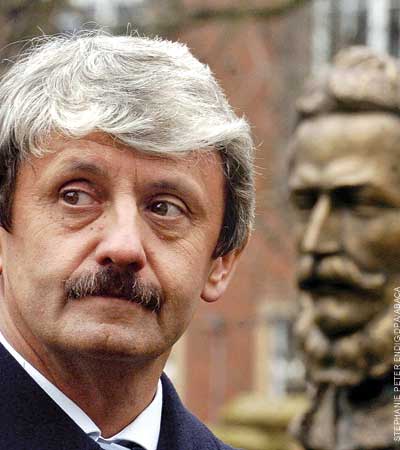
Those early years at the Communist party paid off note the natural poise and apparchik smile similarity between Mikhail and Fico...

and after a special request from Roger

http://www.myheritage.com


hmmm

step by step how to create your election winning coalition

some interesting ideas by a Slovak PHD student in Denmark on the recipe for winning elections (i would say that this could have worked in any country with a electoral system favouring coalitions )

Another interesting piece is how the European Union is civilising the Thatcherite excesses of the UK's anti employee stance:
  1. Britain in the Social Chapter, giving British workers the rights already enjoyed by their continental colleagues.

  2. implemented EU wide laws on working time, limiting the length of time workers can be obliged by their employer to work to 48 hours per week.

  3. required, for the first time in Britain, a guaranteed right to paid holiday.

  4. brought in the European works council laws giving new rights to workers in transnational companies.

  5. introduced proper procedures for information & consultation of workers on all significant changes affecting companies with over 50 employees.

  6. reversed the burden of proof in discrimination cases, putting the onus on employers to prove that they do not discriminate.

  7. give both parents the right to time off when a child is born or adopted.

  8. brought in measures to give part time workers the same rights as full time workers as regards training, pensions, maternity rights and leave.

  9. improved the rights of temporary workers regarding pay and paid leave.

  10. brought in fines for airlines for deliberate overbooking as well as doubled cash compensation for stranded air passengers with the right to meals, refreshments and hotel accommodation if necessary while passengers wait.

The best balance for Slovakia is:


BUT neither should it be further to the right!

Dzurinda says Fico is not going to change Slovakia's direction


I think this is the second time former PM Mikulas Dzurinda goes on the record to show that Slovakia should not be lumped in with other CEE countries. The country is largely disciplined and its behaving more like Estonia and Slovenia rather than Poland or Hungary.


If true, then i think that is the best outcome, a denmark like social protection with pro business policies to pay for it but not at the expense of employee welfare. This ought to be a civilised country's credo, and i would dearly like to see Slovakia go in that direction.


From the interview of Dzurinda to the Associated Press:


Former Slovak Prime Minister Mikulas Dzurinda expressed optimism Wednesday that the economic reforms he pushed will largely survive under the leftist-led bloc that ousted him this summer. In eight years as prime minister, Dzurinda oversaw the introduction of a flat tax and other pro-market reforms that made Slovakia popular with foreign investors. This summer, he was succeeded by Robert Fico, a left-wing leader who had pledged to dismantle many of the reforms, rattling foreign investors. But Dzurinda told The Associated Press that, as the new government approaches four months in office, he has grown increasingly optimistic that Fico will leave in place the bulk of his pro-market policies. "I feel that the mainstream of reforms in Slovakia will be kept," Dzurinda said by telephone from Bratislava.
Fico came to power on promises to introduce new taxes on the rich, arguing that Dzurinda's economic reforms had hurt the poor, the unemployed and pensioners. The coalition that Fico's Smer-Socialist Democratic Party built also generated anxieties because it includes an ultranationalist group, the Slovak National Party, and former authoritarian Premier Vladimir Meciar's Movement for a Democratic Slovakia.


Dzurinda, however, said he was relieved to see that so far, Fico was only making "cosmetic" changes to the reforms his government put through. "They do really very, very small changes," Dzurinda said. "I notice that they are evidently afraid to do something substantial because they understand that the Slovak economy is fantastically healthy." "So now I am more optimistic about reforms to Slovakia," he said. But Dzurinda said he also fears that the government will fail to tackle other reforms left unfinished — such as to the health and education systems.
"The good news is that the government is afraid to completely abolish our reforms, especially in the area of the economy," he said. "But the bad news is that the government is very populist and unable to ensure continuity of our policy." "The less he (Fico) does, the better for the country," he said. Slovakia has seen strong economic growth and a sharp fall in unemployment in recent years.

On RogerH's suggestion origina story here :)

truth and lies

Commenting on a recent Slovak Radio article

"Prime Minister Robert Fico is convinced that his government achieved more for the people during three months than the Cabinets of Mikulas Dzurinda during eight years."


Macko says ---> This statement is not fully true, for working poor people maybe, but certainly not for unemployed Slovaks pensioners or economically inactive people. The leftist measures taken so far are logical and are not problematic, but if they carry on far to the left then that would not be desirable anymore. <---


After Fico's Cabinet approved the draft state budget for 2007 he said that in spite of bad starting points left by the previous government, they managed to prepare a good budget for people as well as for the trustworthiness of the Slovak crown, which has firmed to a record point.

Macko says ---> well that is not true, Slovakia can afford much more now that the european money and the economy upswing is benefiting the economy handsomely. This is misleading... <---


The budget deficit will be below 3 percent of gross domestic product. The Slovak Academy of Sciences (SAV) will get SKK 100 million more than originally proposed.

Macko says ---> wise decision and good for Slovakia so it can join the Euro. Its good for the future. <---


The Cabinet will also allocate SKK 5 million to secure an archeological site at Bojna in the Topolcany district. By this the Prime Minister wants to secure that significant findings, which can move dating of the arrival of Christianity in Slovakia before Saints Cyril and Methodius.

Macko says ---> this is not newsworthy... <---


The Cabinet wants to obtain money for its goals by savings in the state administration. "We will not obtain money to the detriment of people, i.e. by hikes in taxes and fees," said Fico.

Macko says ---> no tax hikes anywhere? in all taxes? for how long? <---


Next year ministries must reduce the number of employees in organizations fully or partially financed from the state budget by 20 percent. Their budgets will be lower by 10 percent and they should save 15 percent in public procurement. At the Defense Ministry this will also affect modernization, while the Foreign Affairs Ministry should re-assess the number of employees at embassies. Economy Minister Lubomir Jahnatek said after the Cabinet session that only one minister is satisfied with the state budget - Finance Minister Jan Pociatek. According to the Prime Minister, the National Bank of Slovakia (NBS) governor Ivan Sramko also appraised the draft state budget.

Macko says ---> I vote for Ivan Sramko for PM :) <---

Press Watch: FT on Slovakia

Press Watch
Another one from the Financial times

"By contrast, Slovaks have lived through turbulent times. After escaping from Mr Meciar’s grip in 1998, the country embarked on liberal reforms and leapt from laggard to leader in post-Communist transition and attracted big foreign investors, headed by motor manufacturers. But with unemployment stubbornly high, voters lost patience and this summer elected Mr Fico on an anti-reform ticket. Despite warnings from EU partners, Mr Fico’s Smer party allied itself with Mr Meciar and Mr Slota’s nationalists.

Pavol Demes, head of central and eastern Europe at the German Marshall Fund, a US public policy institution, says the worst fears about the Fico government have not been realised. However, Slovakia’s Hungarian minority is worried about Mr Slota, business people are concerned about how electoral promises will be reconciled with commitments to fiscal discipline and the Europe-wide Party of European Socialists is preparing to suspend Smer over its ties with the nationalists.

Business people are concerned about the divisive effects of the anti-Communist purge. However, they are less worried about macroeconomic policy: growth is strong and the budget is under control, with the planned 2006 and 2007 deficits below 3 per cent of gross domestic product – the ceiling for joining Europe’s monetary union.

Across the region, however, aspirations to membership of the eurozone have been a victim of post-accession politics. Before 2004, governments were pledging early entry – notably in Hungary, which wished to join by this year. But Hungary’s 2006 budget deficit target is a towering 10 per cent of GDP.

Slovakia remains committed to a firm date – 2009 – but there are doubts whether Mr Fico will stick to a timetable set by his predecessor. Some new EU members are well ahead, with Slovenia joining next year and the Baltic states due in 2008. But for the rest in central Europe, the aim is for 2010-14.

Postponing their single-currency ambitions allows governments to delay reforms required to bring deficits down to the euro-entry 3 per cent. Economists warn that central Europe is miss
ing an opportunity to undertake reforms that will be needed later, perhaps in more difficult conditions.

Meanwhile, developments in the region are affecting relations with EU partners. Poland, in particular, is finding it hard to square its new-found assertiveness with the need for EUwide co-operation, even in energy, where Warsaw wants close ties.

There is little danger that big west European states will turn on central Europe. But if central European countries develop unpredictable reputations they will find it harder to influence their partners. This is particularly important for further enlargement, favoured by most central Europeans.

Central Europe is not doomed to political irrelevance. Given its strong economic record and importance to world business, it will not be ignored. However, the region needs consistent and predictable leadership if it is to make its voice heard at the EU table.
"

Not a bad summary very close to my own view

Not a bad summary very close to my own view
http://www.isn.ethz.ch/news/sw/details.cfm?ID=16759

"...European economic elites, who fear that Fico will undo some of the neo-liberal reforms introduced under Dzurinda, have also condemned the (governing coalition) partnership.

The trans-Atlantic connection, which was very strong after US President George W Bush’s visit to Bratislava last year, has gone strangely quiet. Fico made it clear in his campaign that pulling Slovak troops out of Iraq was one of his highest priorities. This has become a reality, as the upcoming rotation of Slovak troops will be the last despite pleas from Washington for their continued commitment.

Doubts aside, the new coalition has confirmed its commitment to its international obligations. And although Slovakia is withdrawing its troops in Iraq, Fico has pledged to continue to help rebuild Iraq by other means. Fico also has promised Brussels that his government would continue with reforms, including plans to adopt the Euro by 2009.

So for now, it seems that 100 days is not enough to determine what effect Fico's coalition of strange bedfellows with have on Slovakia's future, as the internal political power struggles continue to play themselves out.

Slovakia has been touted as a model of democratic reform for former Soviet satellite states. A stable rise in GDP, increasing wages, falling unemployment and continuing foreign investment signify success. However, internal political developments since the June elections have set Slovakia on a path that is not altogether clear.

Smer, which means "direction" in Slovak, should live up to its name. Arguably, Slovakia must mature and not be so easily swayed towards the extreme by following populist parties. The hope is that Fico will be able keep a watchful eye on Meciar and Slota, keeping their negative influence to a minimum while continuing to implement vital reforms and uphold international commitments.


Zachary Wieluns is a Slovak-based writer. He has a BA in History from Colby-Sawyer College in New Hampshire and an MA in Euroculture from the University of Groningen in the Netherlands.

The views and opinions expressed herein are those of the author only, not the International Relations and Security Network (ISN)."