Showing posts with label dzurinda. Show all posts

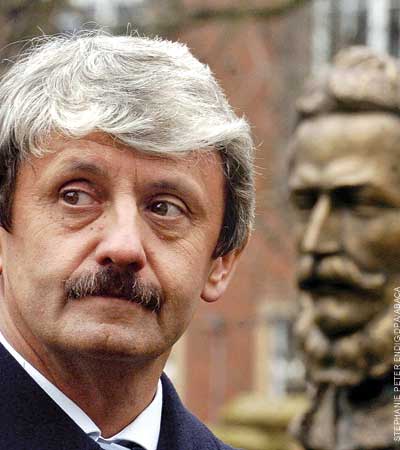
Dzurinda says Fico is not going to change Slovakia's direction


I think this is the second time former PM Mikulas Dzurinda goes on the record to show that Slovakia should not be lumped in with other CEE countries. The country is largely disciplined and its behaving more like Estonia and Slovenia rather than Poland or Hungary.


If true, then i think that is the best outcome, a denmark like social protection with pro business policies to pay for it but not at the expense of employee welfare. This ought to be a civilised country's credo, and i would dearly like to see Slovakia go in that direction.


From the interview of Dzurinda to the Associated Press:


Former Slovak Prime Minister Mikulas Dzurinda expressed optimism Wednesday that the economic reforms he pushed will largely survive under the leftist-led bloc that ousted him this summer. In eight years as prime minister, Dzurinda oversaw the introduction of a flat tax and other pro-market reforms that made Slovakia popular with foreign investors. This summer, he was succeeded by Robert Fico, a left-wing leader who had pledged to dismantle many of the reforms, rattling foreign investors. But Dzurinda told The Associated Press that, as the new government approaches four months in office, he has grown increasingly optimistic that Fico will leave in place the bulk of his pro-market policies. "I feel that the mainstream of reforms in Slovakia will be kept," Dzurinda said by telephone from Bratislava.
Fico came to power on promises to introduce new taxes on the rich, arguing that Dzurinda's economic reforms had hurt the poor, the unemployed and pensioners. The coalition that Fico's Smer-Socialist Democratic Party built also generated anxieties because it includes an ultranationalist group, the Slovak National Party, and former authoritarian Premier Vladimir Meciar's Movement for a Democratic Slovakia.


Dzurinda, however, said he was relieved to see that so far, Fico was only making "cosmetic" changes to the reforms his government put through. "They do really very, very small changes," Dzurinda said. "I notice that they are evidently afraid to do something substantial because they understand that the Slovak economy is fantastically healthy." "So now I am more optimistic about reforms to Slovakia," he said. But Dzurinda said he also fears that the government will fail to tackle other reforms left unfinished — such as to the health and education systems.
"The good news is that the government is afraid to completely abolish our reforms, especially in the area of the economy," he said. "But the bad news is that the government is very populist and unable to ensure continuity of our policy." "The less he (Fico) does, the better for the country," he said. Slovakia has seen strong economic growth and a sharp fall in unemployment in recent years.

On RogerH's suggestion origina story here :)

US media to Slovakia "why didn't you elect Dzurinda for a 3rd term as we told you, are you -errr hmmm errr- undemocratic or somefin?"

Macko says:
US media to Slovakia "why didn't you elect Dzurinda for a 3rd term as we told you, are you -errr hmmm errr- undemocratic or somefin? What a crazy place no -democratic stability-, elections can actually be electing a party we did not endorse! You can't have just anybody getting elected, especially if they are errr popular with the people god forbid. Elections should elect errr the unpopular guys that suit our interests and speak english and support the war on terror, and stuff. what are you doing you commies electing a mildly left wing government after 8 years of a radically right wing one"


Well this below is another one of those articles that seem to have much more information about Poland and Hungary but nevertheless adds the Slovak electorate in for its audacity not to elect Dzurinda for a 3rd term... I read this and i have to say that i resent some of this analysis.
  1. Slovakia went through much bigger reforms than anybody else in such a small period of time. A rebalancing of the right wing reforms with some social modernisation and support are overdue, i agree that SNS and Meciar are awful electoral companions to do this with, but i doubt Fico is stupid, he is planning to give them almost no say in government, he needs them much less than they need him. I think he doesn't like them either, he is just ruthless and he thinks they will be more pliable in a coalition.
  2. Slovakia had Dzurinda in for 2 terms (8 years) and its now time to balance this with letting the left in for a while. unlike america in europe there are more political choices than the right or the very right... (democrats and republicans)... Its a system which allows for the people to be able to really change things with their votes rather than do cosmetic changes, shocking though this may seem to the US political culture, its a system called democracy where the people and not the lobbyists control the country !!shock!horror!! IT is arrogant to basically say that the left is not a legitimate political choice! Its also undemocratic.
  3. This article seems to analyse the neighbouring countries to Slovakia much better though. Maybe because the author is central/east eu or russian. There is good stuff in there but he seems to not be able to reach the logical conclusion. central europe is having upheavals as its transforming into something new at breakneck speed. You don't make omellette without breaking eggs...
  4. Fico's reign so far has been sensible, slovakia has good developments happening in its economy and there haven't been crazy policies like in Hungary. As much socialism as EU fiscal rules allow is a centrist policy i can easily live with, and this seems Fico's direction (smer :) my first slovak joke...) Anyway its corruption that worries me not Slovakia's attitude towards democracy.
  5. the slovak left has not evolved far enough yet, and Dzurinda was a tad too right wing, that is why he lost the elections. Another reason is that he never was/is a popular guy.
  6. The Wall Street Journal (in which the article below appeared originally) overall is written by a pathetic bunch of McCarthyist extreme moronic right morons, which makes conservative newspapers in europe look like radical socialistic ones... Most of the paper is unreadable for its one-sided coverage of the world, its a bit like Sky television news but in print... shudder at the thought... This article though is the least bad i ve seen there for a while...


    ----------
    Unpopular Democracy
    By Ivan Krastev

    Europe's best-kept secret is not that old Europe has second thoughts about the euro. Its best-kept secret is that new Europe has second thoughts about the merits of democracy. Of all the world's regions, Central Europe is most skeptical that it's the best form of government out there, according to "Voice of the People 2006," an international poll conducted by Gallup International in May.Not that Central Europeans dreamily hope for the return of communism or any other form of authoritarianism. But a large majority says their countries aren't run according to the will of the people. Almost two-thirds of the publics in the eight recent EU entrants from the region plus Bulgaria and Romania judge that elections in their countries have not been free and fair. Surprised at how post-communist societies have soured on politics? Don't be. Recent events in Poland, Slovakia and Hungary show that the people there have a point.

    Poland sent the first warning signal that strange doings were afoot. Last fall, the Law and Justice Party — led by the identical twins Lech and Jaroslaw Kaczynski — swept into the presidency (held by Lech) and the government (in which Jaroslaw is prime minister) promising a moral revolution against cronyism and the gap between winners and losers that they blamed on post-communist elites.

    As it turned out, the Kaczynskis' radicalism was directed more at rewriting the past than at solving the problems of the present. The enemies of choice turned out to be not so much the former communists who lost power last year, or bad governance, but the "liberal" media, the independent Central Bank and the European Union. The twins' year in power has been marked by an addiction to conspiracy theories and the return of nationalistic rhetoric. Listening to the new Polish leaders, you get the feeling that World War II isn't over.

    On Friday, resisting pressure for more social spending, the prime minister expelled the Self-Defense party from the government. The prospect that the Peasant Party will join the coalition isn't inspiring. So the Polish public will be stuck either with early elections that offer an unappetizing menu of parties or a more unstable government. Is it any wonder that Poles are losing their enthusiasm for democracy?

    The Slovak elections earlier this summer were next. For the last eight years, Slovakia has been Europe's favorite success story. It introduced a flat tax, managed to attract more foreign investment (per capita) than any other former communist country and get into NATO and the EU, all the while making the world forget about its flirtation with authoritarian populism early on in its life as a free state. Or so we thought, until in June voters returned to power the nationalist parties that had turned Slovakia into a beer-swilling Belarus in the 1990s. Not such a happy ending, after all.

    Now in Hungary, thousands are on the streets demonstrating and burning cars. The largest protests there since communism fell in 1989 were triggered by a leaked tape of Hungarian Prime Minister Ferenc Gyurcsany addressing top Socialist Party officials in May. In his speech, he admitted that the party had consistently deceived the public about the state of the economy to win re-election the previous month. It is hard to ask Hungarian, or any, voters to make sacrifices and endorse an austerity package, as Gyurcsany wants them to, when their prime minister is deliberately trying to deceive them about the state of the economy.

    So it's not surprising that so many in Central Europe think democracy doesn't work for them. The pressure of the new globalized world has sharply divided societies between winners and losers. After decades of grim stability, people in the region have to get used to permanent insecurity. The last decade was also an age of comparisons. People weren't satisfied with living better than yesterday; they wanted to live like those in most developed countries.
    The process of joining the EU changed the nature of these fledgling democratic systems for the worse. Governments preferred to consult on their policy agendas with Brussels, not voters. The outcome is that the dividing line between left and right has been blurred and the only real divide left is between "the corrupt elite" and "the people." The fact that the winners in the new system turned out to be the old party apparatchiks and secret police collaborators also did not contribute to the legitimacy of the new order in Central Europe.

    The tragedy is that voters are forced to choose between so-called reformers, who are not so secretly becoming anti-democratic, and the populist movements that are openly anti-reformist and anti-liberal. If you are a voter in the new European democracies you can either opt for a "Gyurcsany cocktail" — mix "noble lies" with neglect for public concerns while fulfilling the EU's dictums — or for the "populist cocktail" of anti-communism, nationalism, cultural conservatism and excessive social spending.

    Brussels faces a bad choice, too. Demonizing populists is easy but dangerous. Populist movements are ugly and anti-liberal. In truth, though, they represent not an attack on democracy but a demand for democracy. Europe's attempt to punish populists, to isolate them and to endorse "reformers" like Gyurcsany, will only increase the public's mistrust of both the EU and the democratic process.

    Ignoring the current moral and political crisis in Central Europe will not work either. Populist parties don't simply oppose the existing elites; they oppose the very consensuses that made the EU possible: a rejection of nationalism and economic protectionism, political tolerance and moderation. But old Europe can't be too critical of the newcomers when economic protectionism and populism is thriving in its half of the continent as well.

    What Central Europe needs today is not just reformist policies but reformist politics. It is not enough for governments to implement reform policies; they should make an effort to get the people on board. The time when it was enough to say that "we are doing it because of the EU" and expect the people to buy it is over. Without more respect for the demands of the voters, Europe risks falling victim to more populist primitivism, and faces hard days ahead.
    Ivan Krastev is chairman of the Center for Liberal Strategies in Sofia, Bulgaria. This comment was published in the The Wall Street Journal.