truth and lies

Commenting on a recent Slovak Radio article

"Prime Minister Robert Fico is convinced that his government achieved more for the people during three months than the Cabinets of Mikulas Dzurinda during eight years."


Macko says ---> This statement is not fully true, for working poor people maybe, but certainly not for unemployed Slovaks pensioners or economically inactive people. The leftist measures taken so far are logical and are not problematic, but if they carry on far to the left then that would not be desirable anymore. <---


After Fico's Cabinet approved the draft state budget for 2007 he said that in spite of bad starting points left by the previous government, they managed to prepare a good budget for people as well as for the trustworthiness of the Slovak crown, which has firmed to a record point.

Macko says ---> well that is not true, Slovakia can afford much more now that the european money and the economy upswing is benefiting the economy handsomely. This is misleading... <---


The budget deficit will be below 3 percent of gross domestic product. The Slovak Academy of Sciences (SAV) will get SKK 100 million more than originally proposed.

Macko says ---> wise decision and good for Slovakia so it can join the Euro. Its good for the future. <---


The Cabinet will also allocate SKK 5 million to secure an archeological site at Bojna in the Topolcany district. By this the Prime Minister wants to secure that significant findings, which can move dating of the arrival of Christianity in Slovakia before Saints Cyril and Methodius.

Macko says ---> this is not newsworthy... <---


The Cabinet wants to obtain money for its goals by savings in the state administration. "We will not obtain money to the detriment of people, i.e. by hikes in taxes and fees," said Fico.

Macko says ---> no tax hikes anywhere? in all taxes? for how long? <---


Next year ministries must reduce the number of employees in organizations fully or partially financed from the state budget by 20 percent. Their budgets will be lower by 10 percent and they should save 15 percent in public procurement. At the Defense Ministry this will also affect modernization, while the Foreign Affairs Ministry should re-assess the number of employees at embassies. Economy Minister Lubomir Jahnatek said after the Cabinet session that only one minister is satisfied with the state budget - Finance Minister Jan Pociatek. According to the Prime Minister, the National Bank of Slovakia (NBS) governor Ivan Sramko also appraised the draft state budget.

Macko says ---> I vote for Ivan Sramko for PM :) <---

Vlado Meciar undermining the coalition just after 100 days... a taste of things to come...

Older and not wiser

A very interesting short from the state news agency SITA on what Vlado Meciar the merry crook dinosaur has said about his participation in the coalition...


"HZDS: We Want What Belongs to Us The governing-coalition HZDS party is dissatisfied with its position in the governing Coalition, Hospodarske noviny daily reports. HZDS chairman Vladimir Meciar has already provided hints about the possible consequences of this. HZDS MPs have shown their disagreement with the state budget proposals for 2007. In addition, according to Meciar, even the Cabinet's tax reforms will not be approved in Parliament.

First of all Meciar's party failed to receive the top posts it wanted, now the party's regional members are unhappy about the slow pace at which regional posts are being allocated. "Many of our people had to leave their posts very quickly in 1998 (when Meciar's HZDS-led government lost power). They want to come back now," said HZDS MP Milan Rehak. On the other hand, HZDS's coalition partner, the Slovak National Party (SNS) appears to be satisfied with the way power has been allocated. "

Press Watch: FT on Slovakia

Press Watch
Another one from the Financial times

"By contrast, Slovaks have lived through turbulent times. After escaping from Mr Meciar’s grip in 1998, the country embarked on liberal reforms and leapt from laggard to leader in post-Communist transition and attracted big foreign investors, headed by motor manufacturers. But with unemployment stubbornly high, voters lost patience and this summer elected Mr Fico on an anti-reform ticket. Despite warnings from EU partners, Mr Fico’s Smer party allied itself with Mr Meciar and Mr Slota’s nationalists.

Pavol Demes, head of central and eastern Europe at the German Marshall Fund, a US public policy institution, says the worst fears about the Fico government have not been realised. However, Slovakias Hungarian minority is worried about Mr Slota, business people are concerned about how electoral promises will be reconciled with commitments to fiscal discipline and the Europe-wide Party of European Socialists is preparing to suspend Smer over its ties with the nationalists.

Business people are concerned about the divisive effects of the anti-Communist purge. However, they are less worried about macroeconomic policy: growth is strong and the budget is under control, with the planned 2006 and 2007 deficits below 3 per cent of gross domestic product – the ceiling for joining Europe’s monetary union.

Across the region, however, aspirations to membership of the eurozone have been a victim of post-accession politics. Before 2004, governments were pledging early entry – notably in Hungary, which wished to join by this year. But Hungary’s 2006 budget deficit target is a towering 10 per cent of GDP.

Slovakia remains committed to a firm date – 2009 – but there are doubts whether Mr Fico will stick to a timetable set by his predecessor. Some new EU members are well ahead, with Slovenia joining next year and the Baltic states due in 2008. But for the rest in central Europe, the aim is for 2010-14.

Postponing their single-currency ambitions allows governments to delay reforms required to bring deficits down to the euro-entry 3 per cent. Economists warn that central Europe is miss
ing an opportunity to undertake reforms that will be needed later, perhaps in more difficult conditions.

Meanwhile, developments in the region are affecting relations with EU partners. Poland, in particular, is finding it hard to square its new-found assertiveness with the need for EUwide co-operation, even in energy, where Warsaw wants close ties.

There is little danger that big west European states will turn on central Europe. But if central European countries develop unpredictable reputations they will find it harder to influence their partners. This is particularly important for further enlargement, favoured by most central Europeans.

Central Europe is not doomed to political irrelevance. Given its strong economic record and importance to world business, it will not be ignored. However, the region needs consistent and predictable leadership if it is to make its voice heard at the EU table.
"

Central Europe cannot afford to delay the euro

Central Europe cannot afford to delay the euro

With a deadline for monetary union, financial markets would have been less inclined to question commitment to a stable exchange rate

WOLFGANG MUNCHAU Financial Times


We all had a good laugh at the admission by Ferenc Gyurcsány, the Hungarian prime minister, that he lied morning, noon and night. But it is worth stepping back to look at the story behind the lies, and beyond Hungary. The 10 accession countries enjoyed seemingly miraculous economic runs through the 1990s, which ended at around the time of European Union accession, in 2004. Growth rates are still good and in some cases impressive. However, several of the states are growing at the expense of stability.

According to Lars Christensen of Danske Bank, Hungary’s budget deficit will reach 11.3 per cent of gross domestic product this year. Poland is forecast to do better, with 5.4 per cent GDP growth and a budget deficit of 3 per cent. But he says it faces political risks that could eventually translate into economic instability.

Hungary’s economy has already
shown signs of instability. A big chunk of its deficit in 2000-2004 came in the form of mortgage subsidies. Hungarians have since discovered the allure of the foreign currency mortgage – mostly denominated in Swiss francs and euros. With a housing bubble about to burst, and unsustainable budget and current account deficits, the Hungarian economy is a time-bomb.

Poland looks in better shape and certainly has no problems with foreign currency mortgages. But appearances may be deceptive. The country should be running a much smaller budget deficit given its position in the economic cycle.

Meanwhile, the new Polish government is openly challenging the independence of the central bank by setting up a new financial supervisory body. It also plans to include the pursuit of economic growth in the bank’s formal mandate. The economic
consequences of this political battle are still uncertain but it could clearly have a negative effect.

The primary reason, in my view, for the stalling central European economic engine has been the reluctance by several governments – including Hungary and Poland and recently the Czech Republic – to
embrace monetary union as quickly as possible. This does not quite apply to all countries. Slovenia will join the euro next year. Lithuania also wanted to join, but was rejected this year, for reasons that were not entirely justified. This may serve as a further disincentive for others to make the effort. But this is not the main reason why some countries are
dragging their feet.

Those that prevaricated may have thought they needed more time for transition. There are indeed some sound economic reasons why countries in transition should not prematurely fix their exchange rates.

However, this should have been an argument against joining the EU, not against delaying membership of the
eurozone. Under EU law, the new entrants were legally bound to run their economic policy compatibly with membership of the eurozone.

Central European countries should have followed the example of Italy and Spain in the 1990s. Both countries made adoption of the euro their top priority. While the euro did not solve Italy’s structural problems, it certainly led to substantial budgetary reforms that otherwise would not have taken place. Italy may find life inside the eurozone unbearable, but life outside would be far worse.

Hungary could have set itself a firm target for euro membership, say January 1 2009. The Hungarian government would have found it easier to implement responsible fiscal policies under those circumstances and financial markets would have been less inclined to question Hungary’s commitment to a stable exchange rate. Poland has benefited
from an implicit assumption by investors that it will eventually enter the euro. But this goodwill may be withdrawn in due course, when investors realise that the zloty is there to stay for much longer.

Central bankers have long understood the importance of the euro to the economic transformation
process. Hanna Gronkiewicz- Waltz, former Polish central bank chief, told me in the late 1990s that she hoped Poland would adopt the euro within a few years. Her successor, Leszek Balcerowicz, former finance minister, also made it his priority to prepare Poland for the single currency. But the central bankers lost the battle, not least Mr Balcerowicz, who will be replaced at the end of the year.

You may ask at this point: does it matter? The UK, Sweden and Denmark all did well outside the eurozone. Why should Poland and Hungary be different? The difference is that British mortgages are predominantly denominated in sterling, not euros. Nor do the UK, Sweden and Denmark face an acute current account crisis, run budget deficits of 10 per cent of GDP or have governments that openly flout EU law. When the global financial markets start to panic – and we got a
hint of this in May – my prediction is that the UK will be fine, but Hungary will suffer. Big uncertainties lie ahead for Poland. The fundamental lie of central European politics is that there is a good life outside the eurozone, but inside the EU.

Not a bad summary very close to my own view

Not a bad summary very close to my own view
http://www.isn.ethz.ch/news/sw/details.cfm?ID=16759

"...European economic elites, who fear that Fico will undo some of the neo-liberal reforms introduced under Dzurinda, have also condemned the (governing coalition) partnership.

The trans-Atlantic connection, which was very strong after US President George W Bush’s visit to Bratislava last year, has gone strangely quiet. Fico made it clear in his campaign that pulling Slovak troops out of Iraq was one of his highest priorities. This has become a reality, as the upcoming rotation of Slovak troops will be the last despite pleas from Washington for their continued commitment.

Doubts aside, the new coalition has confirmed its commitment to its international obligations. And although Slovakia is withdrawing its troops in Iraq, Fico has pledged to continue to help rebuild Iraq by other means. Fico also has promised Brussels that his government would continue with reforms, including plans to adopt the Euro by 2009.

So for now, it seems that 100 days is not enough to determine what effect Fico's coalition of strange bedfellows with have on Slovakia's future, as the internal political power struggles continue to play themselves out.

Slovakia has been touted as a model of democratic reform for former Soviet satellite states. A stable rise in GDP, increasing wages, falling unemployment and continuing foreign investment signify success. However, internal political developments since the June elections have set Slovakia on a path that is not altogether clear.

Smer, which means "direction" in Slovak, should live up to its name. Arguably, Slovakia must mature and not be so easily swayed towards the extreme by following populist parties. The hope is that Fico will be able keep a watchful eye on Meciar and Slota, keeping their negative influence to a minimum while continuing to implement vital reforms and uphold international commitments.


Zachary Wieluns is a Slovak-based writer. He has a BA in History from Colby-Sawyer College in New Hampshire and an MA in Euroculture from the University of Groningen in the Netherlands.

The views and opinions expressed herein are those of the author only, not the International Relations and Security Network (ISN)."

Thirteen investors arrive in Slovakia so far in 2006

(From Slovak Spectator)
THIRTEEN new investors have come to Slovakia this year, but the state investment agency is concealing the total value of their investments.

According to the SARIO national trade and investment development agency, it is impossible “to publish the amount of the planned investments because the information is considered a business secret”, said SARIO spokeswoman Soňa Junasová.

"The new investors should create 4,390 new jobs in the country. Another 4,253 jobs should be created indirectly," Junasová told the SITA news agency.

The largest number of investors is involved in the IT services sector, followed by the automotive and electrical engineering industries.

The biggest investor is Sony, which will build an LCD television factory in the industrial park in Nitra. The company plans to invest almost €73 million and employ 3,000 people, 1,500 of whom will be relocated from Sony's existing factory in Trnava.

[10/6/2006 12:01:32 PM]


other Slovakia/EU metrics


Harabin, the mafioso-friendly justice minister

UPDATE - Harabin has ceased to be in this position of minister of justice, the new minister is a woman and a fairly normal choice.
-------------------------------------------------------------------------------------

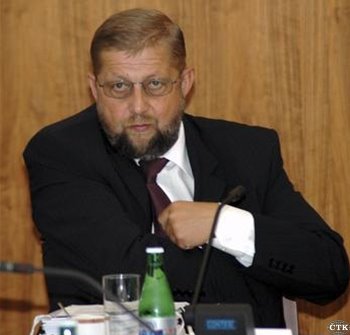
Would you buy a used car from this man? Stefan Harabin defender of the Mafia
(in the photo he is reaching for his gun as part of a media management move...)

Would you buy a used car from this man? Stefan Harabin defender of the Mafia
Well fair is fair, when there are some disturbing developments in Bratislava in terms of corruption which is my major worry for the country we must point them out. The good news is that corruption usually is easily fixable afterwards and does not derail the direction the country has taken with EU accession.
Despite being very bad reputationally and in terms of the political climate, petty to medium strength corruption of jobs for the boys and dodgy contracts will not destroy Slovakia and some of them existed within the Dzurinda government too (Odious ANO party being a case in point). That does not mean to say its hermless or good...

The major representative of Vlado Meciar (populist and drunkard extraordindaire) in Fico's government is the justice minister Stefo Harabin. He is a rather odd figure, and certainly very pro-mafia. I suppose after Fico refused the Slovak Intelligence Services brief to Meciar and kept him personally out of government, he had to compromise somewhere. He gave the justice ministry to Meciar/Harabin and now these guys are getting rid of much of the good work done in this field from the previous government. Withstanding criticism and using it to improve one-self constructively is a sign of a mature person, Harabin clearly doesn't have that and he proceeded to act like a bull in a china shop inside the ministry so far.

I think Fico should not underestimate how much damage this is going to do to him politically, I obviously don't know the internals of the coalition negotiations, but he should have tried to fob Meciar off with an unimportant ministry like Agriculture or Defence or both. Justice is important in a country with a corruption problem.

Important Suggestion: the business world should provide employment to the unfairly dismissed justices, If you are an employer in Slovakia consider helping justice by employing one of these excellent judges as a lawyer or counsel.

Ľudovít Bradáč (Banská Bystrica)
Robert Urban (Žilina), both heads of regional courts,
and district court chief justices
Peter Hrnčiar (Žilina),
Milan Růžička (Veľký Krtíš)
and Peter Bebej (Dolný Kubín).

as a show of support for judges that try to clean up the murky world of politics. I am sure they are very capable lawyers and this would send a message that the Meciar style corruption is a thing of the past, and will not be tolerated.


this is just a battle lost and not the war. The big question remains as to how R. Fico feels himself about these developments... He has legal training himself so surely he knows exactly what is going on. If Fico resents these changes then sooner or later Meciar will lose the last strands of voter support and be consigned in the dustbin of history, lets hope he goes under 5% in the next election.

Here is an article about from the Slovak spectator. Meciar has become more corrupt with age not less... Presumably all his sponsors are now in the underworld. If this phenomenon is restricted to the justice ministry and for only 5 years, no lasting damage will be done, but i certainly don't like it one bit.

ARTICLE
Harabin sacks critical justices
JUSTICE Minister Štefan Harabin, nominated to his post by the ruling Movement for a Democratic Slovakia (HZDS), has started getting rid of critics in the judiciary, the Sme daily wrote.

Yesterday he recalled five heads of regional and district courts. All of them were considered to be fighters against corruption. They are pro-reform justices who in the past called on Harabin to leave his post while he was still the head of Slovakia's Supreme Court.

The recalled justices include Ľudovít Bradáč (Banská Bystrica) and Robert Urban (Žilina), both heads of regional courts, and district court chief justices Peter Hrnčiar (Žilina), Milan Růžička (Veľký Krtíš) and Peter Bebej (Dolný Kubín).

Harabin said via his press department that he made the personnel changes because the officials had not fulfilled their duties as chief justices. He would not specify the reasons for their recall, however.

[10/5/2006 12:01:07 PM]

US media to Slovakia "why didn't you elect Dzurinda for a 3rd term as we told you, are you -errr hmmm errr- undemocratic or somefin?"

Macko says:
US media to Slovakia "why didn't you elect Dzurinda for a 3rd term as we told you, are you -errr hmmm errr- undemocratic or somefin? What a crazy place no -democratic stability-, elections can actually be electing a party we did not endorse! You can't have just anybody getting elected, especially if they are errr popular with the people god forbid. Elections should elect errr the unpopular guys that suit our interests and speak english and support the war on terror, and stuff. what are you doing you commies electing a mildly left wing government after 8 years of a radically right wing one"


Well this below is another one of those articles that seem to have much more information about Poland and Hungary but nevertheless adds the Slovak electorate in for its audacity not to elect Dzurinda for a 3rd term... I read this and i have to say that i resent some of this analysis.
  1. Slovakia went through much bigger reforms than anybody else in such a small period of time. A rebalancing of the right wing reforms with some social modernisation and support are overdue, i agree that SNS and Meciar are awful electoral companions to do this with, but i doubt Fico is stupid, he is planning to give them almost no say in government, he needs them much less than they need him. I think he doesn't like them either, he is just ruthless and he thinks they will be more pliable in a coalition.
  2. Slovakia had Dzurinda in for 2 terms (8 years) and its now time to balance this with letting the left in for a while. unlike america in europe there are more political choices than the right or the very right... (democrats and republicans)... Its a system which allows for the people to be able to really change things with their votes rather than do cosmetic changes, shocking though this may seem to the US political culture, its a system called democracy where the people and not the lobbyists control the country !!shock!horror!! IT is arrogant to basically say that the left is not a legitimate political choice! Its also undemocratic.
  3. This article seems to analyse the neighbouring countries to Slovakia much better though. Maybe because the author is central/east eu or russian. There is good stuff in there but he seems to not be able to reach the logical conclusion. central europe is having upheavals as its transforming into something new at breakneck speed. You don't make omellette without breaking eggs...
  4. Fico's reign so far has been sensible, slovakia has good developments happening in its economy and there haven't been crazy policies like in Hungary. As much socialism as EU fiscal rules allow is a centrist policy i can easily live with, and this seems Fico's direction (smer :) my first slovak joke...) Anyway its corruption that worries me not Slovakia's attitude towards democracy.
  5. the slovak left has not evolved far enough yet, and Dzurinda was a tad too right wing, that is why he lost the elections. Another reason is that he never was/is a popular guy.
  6. The Wall Street Journal (in which the article below appeared originally) overall is written by a pathetic bunch of McCarthyist extreme moronic right morons, which makes conservative newspapers in europe look like radical socialistic ones... Most of the paper is unreadable for its one-sided coverage of the world, its a bit like Sky television news but in print... shudder at the thought... This article though is the least bad i ve seen there for a while...


    ----------
    Unpopular Democracy
    By Ivan Krastev

    Europe's best-kept secret is not that old Europe has second thoughts about the euro. Its best-kept secret is that new Europe has second thoughts about the merits of democracy. Of all the world's regions, Central Europe is most skeptical that it's the best form of government out there, according to "Voice of the People 2006," an international poll conducted by Gallup International in May.Not that Central Europeans dreamily hope for the return of communism or any other form of authoritarianism. But a large majority says their countries aren't run according to the will of the people. Almost two-thirds of the publics in the eight recent EU entrants from the region plus Bulgaria and Romania judge that elections in their countries have not been free and fair. Surprised at how post-communist societies have soured on politics? Don't be. Recent events in Poland, Slovakia and Hungary show that the people there have a point.

    Poland sent the first warning signal that strange doings were afoot. Last fall, the Law and Justice Party — led by the identical twins Lech and Jaroslaw Kaczynski — swept into the presidency (held by Lech) and the government (in which Jaroslaw is prime minister) promising a moral revolution against cronyism and the gap between winners and losers that they blamed on post-communist elites.

    As it turned out, the Kaczynskis' radicalism was directed more at rewriting the past than at solving the problems of the present. The enemies of choice turned out to be not so much the former communists who lost power last year, or bad governance, but the "liberal" media, the independent Central Bank and the European Union. The twins' year in power has been marked by an addiction to conspiracy theories and the return of nationalistic rhetoric. Listening to the new Polish leaders, you get the feeling that World War II isn't over.

    On Friday, resisting pressure for more social spending, the prime minister expelled the Self-Defense party from the government. The prospect that the Peasant Party will join the coalition isn't inspiring. So the Polish public will be stuck either with early elections that offer an unappetizing menu of parties or a more unstable government. Is it any wonder that Poles are losing their enthusiasm for democracy?

    The Slovak elections earlier this summer were next. For the last eight years, Slovakia has been Europe's favorite success story. It introduced a flat tax, managed to attract more foreign investment (per capita) than any other former communist country and get into NATO and the EU, all the while making the world forget about its flirtation with authoritarian populism early on in its life as a free state. Or so we thought, until in June voters returned to power the nationalist parties that had turned Slovakia into a beer-swilling Belarus in the 1990s. Not such a happy ending, after all.

    Now in Hungary, thousands are on the streets demonstrating and burning cars. The largest protests there since communism fell in 1989 were triggered by a leaked tape of Hungarian Prime Minister Ferenc Gyurcsany addressing top Socialist Party officials in May. In his speech, he admitted that the party had consistently deceived the public about the state of the economy to win re-election the previous month. It is hard to ask Hungarian, or any, voters to make sacrifices and endorse an austerity package, as Gyurcsany wants them to, when their prime minister is deliberately trying to deceive them about the state of the economy.

    So it's not surprising that so many in Central Europe think democracy doesn't work for them. The pressure of the new globalized world has sharply divided societies between winners and losers. After decades of grim stability, people in the region have to get used to permanent insecurity. The last decade was also an age of comparisons. People weren't satisfied with living better than yesterday; they wanted to live like those in most developed countries.
    The process of joining the EU changed the nature of these fledgling democratic systems for the worse. Governments preferred to consult on their policy agendas with Brussels, not voters. The outcome is that the dividing line between left and right has been blurred and the only real divide left is between "the corrupt elite" and "the people." The fact that the winners in the new system turned out to be the old party apparatchiks and secret police collaborators also did not contribute to the legitimacy of the new order in Central Europe.

    The tragedy is that voters are forced to choose between so-called reformers, who are not so secretly becoming anti-democratic, and the populist movements that are openly anti-reformist and anti-liberal. If you are a voter in the new European democracies you can either opt for a "Gyurcsany cocktail" — mix "noble lies" with neglect for public concerns while fulfilling the EU's dictums — or for the "populist cocktail" of anti-communism, nationalism, cultural conservatism and excessive social spending.

    Brussels faces a bad choice, too. Demonizing populists is easy but dangerous. Populist movements are ugly and anti-liberal. In truth, though, they represent not an attack on democracy but a demand for democracy. Europe's attempt to punish populists, to isolate them and to endorse "reformers" like Gyurcsany, will only increase the public's mistrust of both the EU and the democratic process.

    Ignoring the current moral and political crisis in Central Europe will not work either. Populist parties don't simply oppose the existing elites; they oppose the very consensuses that made the EU possible: a rejection of nationalism and economic protectionism, political tolerance and moderation. But old Europe can't be too critical of the newcomers when economic protectionism and populism is thriving in its half of the continent as well.

    What Central Europe needs today is not just reformist policies but reformist politics. It is not enough for governments to implement reform policies; they should make an effort to get the people on board. The time when it was enough to say that "we are doing it because of the EU" and expect the people to buy it is over. Without more respect for the demands of the voters, Europe risks falling victim to more populist primitivism, and faces hard days ahead.
    Ivan Krastev is chairman of the Center for Liberal Strategies in Sofia, Bulgaria. This comment was published in the The Wall Street Journal.

interesting pictures in Bratislava flats to stay (longer term rent without the usual psychos as landlords) The fact they spoke english helped too :)

Renting in Bratislava

I stayed for a year in this posh place.


I found that central Bratislava is the best place to rent really

i also stayed here.


click to see more


click to see more


H.E. Robert Fico, Prime Minister of Slovak Republic, Visits the NYSE
09/22/2006

His Excellency Robert Fico, Prime Minister of Slovak Republic, visits the NYSE and rings The Opening BellSM.

In may 2005 Robert Fico: Slovakia Is Not State 51 of America

This is an article I rescued from a site that seems to have dropped it recently and its about Fico. It is interesting as it provides a bit of context to the man I think

"31.05.2005 Robert Fico: Slovakia Is Not State 51 of America

Sami Rosen, AIA Israeli section

According to the recent opinion polls, Robert Fico is the most popular politician in Slovakia. He was once a member of the Communist party, but in 1999 he established his own social-democratic movement - SMER. Today it is the largest opposition party in Slovakia, holding 27 seats in the Parliament. The polls show that SMER has the best chance to win the 2006 elections, which will make its leader, Robert Fico Slovakia's next prime minister.

Pro-European Politician

Fico is seen as a pro-European politician, criticizing the pro-American stance of the present Slovak government. However, there were some controversial publications in the local mass media as to Fico's critique of the European policy.

In his recent interview over Israeli radio, Fico said that his party can be seen as pro-European. However, he followed with, "On the other hand, shortly before our entering the European Union, they opened some questions concerning the conditions under which Slovakia should enter the EU. It is true that in some areas we were very critical, for example, on the issue of nuclear power stations in Slovakia." According to him, Brussels demanded the closure of two blocks of these power stations in spite of the fact that they were completely safe, and produced electricity at a low cost. He added that despite the critique and the attempts to open this issue, his party finally respected the decision of the government on this subject. "Now our party has three members in the European Parliament, all of them are in the socialist camp" Fico stated in the interview, adding that recently the SMER Social Democratic party was adopted as a regular member of the Party of European Socialists. "So, my party can be seen as a normal European
political movement."

What Future for Slovak Politics?

Fico avoids making any predictions concerning the 2006 Parliament elections in Slovakia. According to him, it is very difficult to estimate how many people in Slovakia support left-oriented and how many support right-oriented political movements. "But people can see in real life what it means to have a right-wing political coalition," Fico said.

He then voiced criticism of the present conservative government. "You can follow results of this type of politics in Slovakia. For instance, we have poverty, something we did not have in the past. 21% of Slovak people are living in poverty. You can also see very low salaries in Slovakia, as well as a very bad social situation. These are the real results of the conservative government's policy in Slovakia, he said."

According to Robert Fico, these are also the reasons why the SMER party, "situated from the center to the left" of the political spectrum, has such significant support in this country. He admits that his ambition, and that of his party, is to win the next election in such a way as to allow the formation of a stable and potent coalition.

External Priorities: EU, Russia, Ukraine

As far as external policy is concerned, SMER's leader thinks his country is too small and not sufficiently strong politically and economically "to change world politics." Nonetheless, Fico's program. In the event of his election, is to change the "totally US-oriented" priorities of the present Slovak government. "We are currently a member-state of the European Union, but sometimes you find yourself asking, 'Are we in Europe, or are we the state number fifty two of the United States?'"

Fico argues further in the interview over "Voice of Israel" radio. According to him, if elected, his external policy would be oriented towards European issues. Fico stated that his party supports the EU foreign and military policies, urging that all the international issues must be solved in the framework of the European Union, "as we are now members of it."

Robert Fico stands for the strengthening of Slovakia's relations with Russia. "I visited Russia several times, and my ambition is to use these relations as much as possible. It is a big mistake of the conservative government to orient Slovakia exclusively toward the United States. There must be some balance in the foreign policy of Slovakia. I do really believe that in the event of our victory in the elections, planes will fly not only to the United States, but they will fly also to Russia, Ukraine, China, Japan, India."

Fico further reminds us that before 1989, Czechoslovakia was very successful in Third World countries in Africa and Latin America..

According to him, it would be right for Slovakia to continue this tradition, and he said that SMER "will do its best to continue this experience."

Ukraine's Possible Membership in the EU: A Threat or a Partner for Slovakia?

Slovakia should support any country that strives to become a member of the European Union, and Ukraine is not an exception, Robert Fico states. "On the other hand, I should say that we follow very closely all that happens in Ukraine, including this 'orange revolution'. And there is one thing I want to say to the Ukrainian people: please do not follow the Slovak experience concerning privatization, and in extensive relations with the United States. Keep balance. Keep balance between state ownership and private ownership. Keep balance as far as the social issues are concerned," - Robert Fico urges.

He further says that Slovakia seeks good neighbor relationships with Ukraine. In his opinion, although the two countries share only a short section of border, it is very important from the point of view of people's movement from Eastern to Western Europe. He expresses concern about the existing border control procedures, saying that in the future he will try to solve this problem.

Mr. Fico does not see a threat for Slovakia's position in the EU if Ukraine enters the Union. "To be in the European Union is a chance for every country. If we are now in the EU, it is up to us to use this chance as much as possible for the benefit of our country and our people" Fico says, adding that he is not afraid of Ukraine's entering the EU. "It is a chance not only for Ukraine, but also for Slovakia.

Speaking openly, at present, Slovakia attracts the investors because of the cheap labor force. Probably Ukraine will do the same." "

Deleted by Tomorrow: The Wodehouse Lecture in Sociology

Deleted by Tomorrow: The Wodehouse Lecture in Sociology

i just like this :)

... and who benefits Featuring Rupert Murdoch the globalist

On my previous post ("What is the real purpose of globalisation, who causes it to happen, and why" ) i got a comment:

MB said...
Interesting post.... you may also analyze the benefits...
9/28/2006 01:36:49 AM "

Well i feel i showed here that so far in globalised USA the benefits are mostly going to the rich the middle class loses a lot and the people suffering abject poverty benefit a little bit. So there are benefits to a rich elite. I am not arguing whether there are benefits the question is WHO BENEFITS!

I don't think that i have a lot to add to the blissfully-happy-made-in-disneyland-story we are fed by corporate owned media, but it basically comes to this, globalisation will make investment flow to places like China, where the wonderful democratic government there will be delightedly more strong and will be allowed to continue to rule without elections legitimised by all the wealth generated by selling off the labour of their citizens and the lack of decent working conditions, and will continue the good charitable work its been doing for decades keeping in place North Korea's also excellent eternal president and dearly loved leader Kim in his quest to get nuclear weapons so he can nuke california. Spreading freedom my ass... If there is money to be made capitalists would prostitute their mothers...

The investors in the USA, britain etc will get a good return of course particularly because the salaries in china are not exactly fabulous but prices for the goods in the west drop but nowhere near how little the cost to the manufacturer is. While also the important thing you know like healthcare and pensions disappear or become expensive and unaffordable, we can however afford toasters that surf the internet! OR we can afford to buy a device where our boss can email us on a sunday that our job has gone to india! (great)

But returning to the comment, i 'll bite the bullet lets do a case study!

Globalisation changes lives, lets see it through the life of a major investor in China, Rupert Murdoch, and what the advantages of globalised profits are and how they enhance (Rupert's) lifestyle so he can shape it exactly as he wants.

Of course these investors were rich anyway and already live in big houses and need a little extra help with getting the 7th yacht (to match the 7 seas) and to marry more young girls (see pic) and Rupert's alimony payments and lawyer's fees and hair dye are surely more deserving causes than a pension for you or I (scum that we are as we are not investors in china and we selfishly want to raise a family and give them an education and have roof over our head and other deviant bahaviour like that).

Lets all help people like Rupert through low corporate taxation (proprietor of Fox news, The Times, The Sun, Sky television, more here)

Who after all is a self made man: (Murdoch was born in Melbourne, Australia. His father was Sir Keith Murdoch, a well-connected member of the Australian gentry, working as a journalist and adviser to Billy Hughes, the Prime Minister of Australia and who became Australia's most influential newspaper executive and media owner. Murdoch's mother is Dame Elisabeth Murdoch, née Elisabeth Joy Greene, daughter of Rupert Greene and Marie Grace de Lancey Forth. At the age of 97 Dame Elisabeth remains a strong influence on Rupert. The young Murdoch was educated at Geelong Grammar School and later at Worcester College at the University of Oxford.)

Family life (lets see what we should all aspire to in this brave new world)

Murdoch has been married three times. His first marriage in 1956 was to Patricia Booker, with whom he had one child, Prudence Murdoch McLeod. They were divorced in 1967. Very little is known about their marriage, and Murdoch has never spoken about it publicly.

In the same year, he married an employee, Anna Tõrv, a Roman Catholic of Estonian extraction. The timing (and Murdoch's subsequent behaviour) suggests that he had begun the relationship with Tõrv well before his marriage to Patricia ended.

Torv and Murdoch had three children: Elisabeth Murdoch (born in Sydney, Australia August 22, 1968), Lachlan Murdoch (born in London, UK Sept 8, 1971), and James Murdoch, (born in Wimbledon, UK Dec 13, 1972). Anna and Rupert divorced acrimoniously in June, 1999.
Anna Murdoch received a settlement of some reported US$1.7 billion in assets. Seventeen days after the divorce, on June 25, 1999, Murdoch, then 70, married Wendi Deng, then 30, a recent college graduate and newly appointed vice-president of STAR TV. She had previously married, in 1990, Jake Cherry (born 1937), from whom she was divorced in 1992. Anna Murdoch was also remarried, in October 1999, to William Mann.

Murdoch has since had two children with Wendi: Grace (born in New York November 19, 2001) and Chloe (born in New York July 17, 2003).

There is reported to be tension between Murdoch and his oldest children over the terms of a trust holding the family's 28.5 percent stake in News Corporation, estimated in 2005 to be worth about $6.1 billion. Under the trust, his children by Wendi Deng share in the proceeds of the stock but have no voting privileges or control of the stock. Voting rights in the stock are divided 50/50 between Murdoch on the one side and his children of his first two marriages. Murdoch's voting privileges are not transferable but will expire upon his death and the stock will then be controlled solely by his children from the prior marriages, although their half-siblings will continue to derive their share of income from it.

It is Murdoch's stated desire to have his children by Wendi Deng given a measure of control over the stock proportional to their financial interest in it. However it does not appear that he has any strong legal grounds to contest the present arrangement, and both ex-wife Anna and their three children are said to be strongly resistant to any such change.

Murdoch quotes
"We can't back down now, where you hand over the whole of the Middle East to Saddam...I think Bush is acting very morally, very correctly, and I think he is going to go on with it" [1]

"The greatest thing to come out of this [war in Iraq] for the world economy...would be $20 a barrel for oil. That's bigger than any tax cut in any country." [1]

"News — communicating news and ideas, I guess — is my passion. And giving people alternatives so that they have two papers to read (and) alternative television channels." [2]
"Can we change the world? No, but hell, we can all try."[3]

On Chancellor Gordon Brown, expected to succeed Tony Blair, "I like Gordon very much and I share a lot of his values. The Calvinist background I guess... Scottish blood, you know he does seem to believe in the work ethic."

"In this country, Fox News has gotten a big, big audience that appreciates its independence. There's passion there, and it's pushed. ... It has taken a long time, but it has now changed CNN because it has challenged them — they've become more centrist in their choice of stories. They're trying to become, using our phrase, more fair and balanced." [2]

Also not to be missed
http://myspace.com/murdoch_rupert

What is the real purpose of globalisation, who causes it to happen, and why

I don't see what is so complicated in understanding what outsourcing and offshoring and globalisation do. Its not really done to source better goods or to improve people's lives (at least not in the west), its really a new lever employers have found to force employees to accept
ever DECREASING real wages (SEE WHY I SAY THIS ). It started in earnest around 2000. This is now affecting all jobs apart from higher management jobs and some obscure professions as well as localised ones such as lawyers, politicians, architects, doctors. However whatever is not packaged up and sent to India, then is done by Indians or chinese on special VISAs in the US or UK. The purpose is to lower the wages in the professions for which the VISAS are issued e.g. computer programmers. This started getting big with the millenium bug where there was a real shortage, but then the measure was expanded in order to affect many middle class jobs.


Of course India and China benefit from this and ordinarily the living standards of the indians and chinese would rise and the offshoring would not be so attractive any more from a cost saving point of view. EXCEPT of course that China & India together represent 50% OF THE POPULATION OF THE PLANET. In other words by the time this geographic arbitrage becomes less extreme the author (i am 31) will be long dead of old age (which might not be that old depending on if there are pensions and a free health system by the time i am old that is... or will decent pensions for normal people be also "competed" away, or be unaffordable, or be inefficient)

I believe that we will see a great reversal in how societies look like. The small rich club followed by a large and prosperous middle class, followed by a relatively small poverty class (which in many cases consists of people with low skills education or in some cases intelligence) will change. The poverty class is supported by social safety net and minimum wages and free healthcare ensuring a decent minimum for everyone.

All this will be replaced by a crony capitalist climate resembling pre-1930es USA. Robber barons in digital businesses owning media, many more Murdochs manipulating governments. A sizeable uber rich elite, and a vast insecure and poverty stricken middle class which is not really
that different than the poverty class except that it will desperately try to join the rich club without ever looking back. The reason this time the pressure for a new deal will not happen is that the media is now telling us what to think. History never repeats exactly of course but i think this time there are cross border issues that give the rich much more political and opinion forming clout.

I don't think we should join the US in this future... We should keep our redistributative policies, and high taxes and stable societies without the gated communities... and the african style looting of shops after natural disasters...

I might be wrong but i fear i am not...

EU Door swings shut behind new boys

Door swings shut behind new boys as EU's welcome is exhausted
By George Parker in Brussels

Bulgaria and Romania may be coming in to the European Union but the door is starting to swing shut behind them.

The accession of the two Black Sea states completes the "big bang" expansion of the EU, which began in 2004 with eight former communist countries in central and eastern Europe.

The healing of Europe's cold war divisions was a relatively easy political message for western leaders to sell but each new round of enlargement takes the EU into ever more difficult terrain.

"You could sell the Czech Republic, Hungary or Poland joining," says a senior EU official involved in the enlargement process. "People knew about the Prague Spring or Budapest 1956 or Solidarity.

"With Bulgaria and Romania it is more difficult to make the case on an emotional level, and it's going to keep getting harder."

According to a Euro-barometer opinion poll this year, some 53 per cent of EU citizens viewed enlargement with "indifference, fear, annoyance or frustration", even if a narrow majority - 55 per cent - still felt positive about the process.

The symptoms of enlargement fatigue became glaringly obvious last year when French and Dutch voters rejected the EU constitution, with No voters citing the club's eastward expansion as a prime reason for their dissatisfaction.

For France, the expansion diluted the original essence of a western club of relatively wealthy countries largely operating under the political direction of Paris. Other founder members fear that the EU has grown too big, too fast.

For the Dutch, migration was a big factor, as it now is in Britain (which was traditionally one of the biggest supporters of enlargement). The arrival of up to 600,000 east European workers in the UK between May 2004 and June this year outweighed anything the British government or European Commission had predicted.

Although new EU members in central and eastern Europe have taken enormous strides since the fall of communism, recent political developments have reinforced the fears of sceptics in "old Europe".

Poland's ruling party has been accused of populist nationalism, Slovakia's new coalition has been criticised for fanning xenophobia and Hungary's prime minister provoked demonstrations when he admitted he had lied to win a general election.

Bulgaria and Romania's failure to tackle organised crime and corruption fully or to prepare their admin-istrative systems to handle billions of euros of EU aid has done little to build confidence.

José Manuel Barroso, the European Commission president, insists enlargement benefits both old and new member states. "An enlarged Europe counts for more when we speak with China or Russia than before," he said.

But he concedes Europe needs a pause before adding to a club of 27, whose population will approach 490m people. In particular, he says it would be "unwise" to expand the Union further before it upgraded its creaking institutions, through the ratification of parts of the EU constitution.

The accession of Bulgaria and Romania is a natural break point. Only Croatia and Turkey have already started membership talks: the former is unlikely to be ready to join before 2011 at the earliest, the latter's progress towards the EU will be tortuous and may not achieve its goal.

From now on, the going gets tough. Bulgaria and Romania may have been poor (both had GDPs of 31 per cent the EU average in 2004) but other potential newcomers in the western Balkans - Serbia, Montenegro, Bosnia-Herzegovina, Kosovo, Albania and Macedonia - will be even harder and more costly to absorb. And, like Turkey, they carry heavy political baggage. While all of those countries have at least had their "membership perspective" recognised by the EU, others on the fringes face a long spell in the cold. Ukraine, Moldova, Georgia and Armenia may have to wait many years before the symptoms of "enlargement fatigue" in the EU start to subside.

Copyright The Financial Times Limited 2006

FT on central Europe & Slovakia

Juraj says ----> My previous suspicions about the motivations of some
conservative media notwithstanding, the Financial Times shows that fair
and balanced reporting can be achieved by having educated people on the
ground, and not watching crap like fox news. <----

Sick men of new Europe: why reform fatigue has hit the east
By Robert Anderson, Jan Cienski, Christopher Condon and Stefan Wagstyl

Published: September 27 2006 03:00 | Last updated: September 27 2006
03:00

Once, the sight of tens of thousands of east Europeans demonstrating
against their governments would spark waves of hope and joy in the west.

Not any more. Riots in Hungary - the first since the overthrow of
communism - are prompting doubt and concern about the region's future.
Demonstrators stormed the state television station in scenes reminiscent
of the developing world, not of the well-heeled centre of Budapest.

While only in Hungary have people lately resorted to violence, there are
also signs of instability elsewhere among the states that joined the
European Union in 2004.

In Poland, voters could soon go to the polls for the second time in a
year following the collapse of an unruly coalition. The Czech Republic
has had no effective government since a June general election produced a
hung parliament. In Slovakia, Robert Fico, the populist prime minister,
holds power with the backing of Vladimir Meciar, an authoritarian
predecessor, and Jan Slota, leader of the radical Slovak Nationalist
party. Ferenc Gyurcsany, the Hungarian prime minister, says: "There is
real rivalry in these countries between nationalist radicals and
progressives."

The dangers should not be exaggerated. Central Europe is not in crisis.
Economic growth is 2-3 percentage points faster than in western Europe.
Hostility to reforms may be no worse than in Germany, France or Italy.
More than 15 years of economic progress, EU and Nato membership and
foreign investment act as stabilising forces.

But prolonged instability would cause real harm. Mainstream parties are
courting popularity by postponing painful reforms needed to complete
post-Communist modernisation. While living standards are nearly 40 per
cent higher than in 1989, they remain 45 per cent below west European
levels. Dissatisfaction is opening doors to populists with sometimes
limited allegiance to EU principles such as fiscal rectitude,
market-based economic policies and respect for minority rights.

Trouble in central Europe could also undermine efforts to revive support
for the EU's further enlargement. While the European Commission
yesterday gave conditional approval for Romania and Bulgaria to join
next year, there is considerable uncertainty about future applicants,
notably Turkey.

The origins of the turmoil lie in reform fatigue. Some 17 years after
communism fell, central Europeans have had enough of restructuring. The
benefits of change have been unevenly spread, leaving the low-paid, the
unemployed and pensioners feeling abandoned and abused by corruption.

These sentiments were kept in check before EU accession, as few
politicians wanted to risk losing membership through political or fiscal
indiscipline. But since joining the EU in May 2004, central European
politicians no longer feel the need to be on best behaviour.

In addition, with the need to maintain consensus gone, politicians are
free to resume old quarrels, including disputes between ex-Communists
and former anti-Communists that have resurfaced in Hungary and Poland
and ethnic rows in Slovakia. Alek-sander Smolar of the Stefan Batory
Foundation, a Warsaw think-tank, says: "I think we are seeing a delayed
reaction to the whole very costly and very painful process of European
integration."

These effects differ between countries. In Hungary, where the communist
regime was relatively liberal, the post-communist transition has been
fairly smooth. Both the ex-communist Socialists and the conservative
Fidesz have shamelessly courted voters through fiscal hand-outs, which
have stretched public resources to the limit.

Mr Gyurcsany, the Socialist prime minister who won re-election this
spring, has pledged to break with the past and introduce fiscal
discipline. But he queered his pitch with an admission to party
colleagues that he won the election by lying to the public about the
government's finances (see below).

Despite the street protests, Mr Gyurcsany has held his ground, saying
his words were a call to action. While the demonstrations have eased
since the weekend, the prime minister faces a key test in local
elections on Sunday.

Like Hungary, the Czech Republic has recently followed a fairly smooth
economic course, allowing governments of both the leftist Social
Democrats and the conservative ODS to dodge painful restructuring,
notably in healthcare and pensions. With economic growth strong,
business people are unconcerned that the country was without a
government for three months and that Miroslav Topolanek, the newly
appointed ODS prime minister, is unlikely to last more than a few
months. There seems little to drive Czechs to political radicalism, but
the lack of a stable government may yet prove unsettling.

By contrast, Slovaks have lived through turbulent times. After escaping
from Mr Meciar's grip in 1998, the country embarked on liberal reforms
and leapt from laggard to leader in post-Communist transition and
attracted big foreign investors, headed by motor manufacturers. But with
unemployment stubbornly high, voters lost patience and this summer
elected Mr Fico on an anti-reform ticket. Despite warnings from EU
partners, Mr Fico's Smer party allied itself with Mr Meciar and Mr
Slota's nationalists.

Pavol Demes, head of central and eastern Europe at the German Marshall
Fund, a US public policy institution, says the worst fears about the
Fico government have not been realised. However, Slovakia's Hungarian
minority is worried about Mr Slota, business people are concerned about
how electoral promises will be reconciled with commitments to fiscal
discipline and the Europe-wide Party of European Socialists is preparing
to suspend Smer over its ties with the nationalists.

In Poland, a difficult post-Communist transition, involving a sweeping
economic overhaul, has left voters particularly disenchanted with
political elites. As a result, the conservative PiS last year won
parliamentary elections by promising to clean up politics. Voters
expected PiS to form a coalition with the liberal Civic Platform. But
the putative partners fell out, leaving PiS to cobble together a
government with support from the leftist populists of Self-Defence and
the rightwing League of Polish Families.

But PiS and Self-Defence split this month, leaving PiS to seek new
allies in the Peasants party. If it fails, another election is in
prospect. However, this instability has not stopped President Lech
Kaczynski and his twin brother, Jaroslaw Kaczynski, the prime minister,
from pursuing a radical agenda - purging ex-Communists from public life
and centralising control of institutions such as the central bank. They
have also taken an assertive approach to foreign relations -
particularly with regard to Germany and Russia, Poland's big neighbours,
where they have stirred up past enmities.

Business people are concerned about the divisive effects of the
anti-Communist purge. However, they are less worried about macroeconomic
policy: growth is strong and the budget is under control, with the
planned 2006 and 2007 deficits below 3 per cent of gross domestic
product - the ceiling for joining Europe's monetary union.

Across the region, however, aspirations to membership of the eurozone
have been a victim of post-accession politics. Before 2004, governments
were pledging early entry - notably in Hungary, which wished to join by
this year. But Hungary's 2006 budget deficit target is a towering 10 per
cent of GDP.

Slovakia remains committed to a firm date - 2009 - but there are doubts
whether Mr Fico will stick to a time-table set by his predecessor. Some
new EU members are well ahead, with Slovenia joining next year and the
Baltic states due in 2008. But for the rest in central Europe, the aim
is for 2010-14.

Postponing their single-currency ambitions allows governments to delay
reforms required to bring deficits down to the euro-entry 3 per cent.
Economists warn that central Europe is missing an opportunity to
undertake reforms that will be needed later, perhaps in more difficult
conditions.

Meanwhile, developments in the region are affecting relations with EU
partners. Poland, in particular, is finding it hard to square its
new-found assertiveness with the need for EU-wide co-operation, even in
energy, where Warsaw wants close ties.

There is little danger that big west European states will turn on
central Europe. But if central European countries develop unpredictable
reputations they will find it harder to influence their partners. This
is particularly important for further enlargement, favoured by most
central Europeans.

Central Europe is not doomed to political irrelevance. Given its strong
economic record and importance to world business, it will not be
ignored. However, the region needs consistent and predictable leadership
if it is to make its voice heard at the EU table.

Additional reporting by Robert Anderson, Jan Cienski and Christopher
Condon

Copyright The Financial Times Limited 2006

The rise and fall of Jan Slota - how being a moron and in government is not sustainable in the medium to long term

There is one positive thing. With so much focus on extremism, Slota is
trapped politically into showing how impotent he is because everything
he says now endangers Fico's government. I am pretty sure that after
this parliament Slota will be much less popular than he is now. Despite
agreeing in spirit that its embarrassing for any society to have
extremists like Slota in government, Austria and Jorg Heider (not sure
of the spelling which in a way shows how much less important he has
become these days :) ) the Austrian Jorg was very popular in the region
Karinthia (I suppose an Austrian equivalent of Zilina) and while he was
out of government and able to make radical statements as there was
little to lose and only to gain by being radical or making mad
statements.

All this shows that government is uniquely a poisoned chalice for
extremist parties, as they lose their "untested radical alternative"
status they normally enjoy by being kept out. We should be a bit more
confident in democracy's power to correct its own excesses.

Far right politicians want to be famous and deep down respectable.
Normal people don't start political parties...

manifesto of gradual improvement in the world

I am a man of action, the solutions below are not very nice sounding but i think they would improve the World politics markedly from a practical perspective, and reduce wars and tension.

1. We need to stop texans, the carolinas, and pakistanis & Saudis breeding. Forced sterilisation whatever it takes...
2. Laws to starve the US military-industrial complex to a much smaller size (i.e. be reduced by 90%).
3. A law that prevents a religious person to become US president (France has achieved it for example) Also UK needs that too. The same law needs to stipulate that the US presidents need to have come from a non redneck state, in other words only california and new england qualify. NO TEXANS.
4. Spend a huge amount of money on research an development to develop an alternative source of energy other than oil that is environmentally friendly (hydrogen?). Then we can let the middle east resume the camel shagging they were mainly famous for before the british found oil in the region in the early 1900es. So we can all get on with our lives and they can resume their crap on each other just like the Africans do, and maybe one day they will get out of the middle ages but that should be left to themselves.
5. Never elect a bush family member, only middle eastern countries such dynasties in power (hmmm coincidence?)
6. Allow limited immigration to europe on condition that religion is relinquished. The constitutions need to define religion officially as a hobby. Ideally immigration should be allowed only from secular countries without nationalistic issues. People without issues in general in fact. Young people only, sorry we have pension/health systems to maintain.
7. Special worldwide "conference" for religious fanatics and nationalists of all sides to be held continuously located in the depths of the sahara desert, where extreme religious people should be given swords no food and no water. The flight tickets need to be one way. Duration: constant until we run out of religious fanatics.
for more policies email fidis@geneza.com :)

Slovakia overly criticised: I am starting to think that there is an organised campaign against Fico and the new government from USA

Slovakia's new government is being overly criticised. I am starting to think that there is an organised campaign against Fico and the new government from USA and the Hayeck institute types. I believe that the measures and the reasonable moderate comments made by Robert Fico ever since gaining power should be recognised. Slovakia's economy has continued growing and the new government is adjusting some of the harshest aspects of Dzurinda's policies. Fico of course will not recognise the policies should be kept intact, but if you compare Slovakia with say Austria, slovakia has a much more neo-liberal economy.

I find the level at which there is a campaign (mainly by Americans which makes me wonder about who pays these people) to discredit and fight the normal transition from left to right and from right to left in this central european country.

Granted, I dont like Jan Slota or Vladimir Meciar AT ALL. But these people seem to have peripheral roles now, they are not even in the goverment themselves, Slota got 3 ministers with the most important one being in education. Generally speaking this is obviously not a good idea, but it only comes after 8 years of an ethnic hungarian party pushing through rather challenging policies. For example kids in areas where Hungarians live are taught in the Hungarian language! This is something most sovereign states would not permit. Imagine american kids of mexican ancestry getting mexican schools funded by the taxpayer. I have nothing against the Hungarians of Slovakia, but they enjoy rights very few minorities enjoy anywhere in the world...

(in the USA it would be the equivalent of a mexican party branding itself as such, I BET that this would cause a furore... - although multi-party democracy in the US is ahem unheard of, -that is right folks we just need 2 parties no more just one party state + 1 with not particularly different policies than the republicans... but I digress...)

Slota's success may in fact be a response to the extreme success of the hungarian SMK party in Slovakia. Tolerance of difference is one thing, but having policies aimed at a future change of borders and a great hungary is another.

Under EU all of these things are also rendered rather irrelevant, so over time this will cease to be a problem. Maybe this is the last gasp of nationalism which is going to be reduced as poverty is also reduced.

SNS' Jan Slota is obviously a moron, just like Jorg Haider in neighbouring Austria. The similarities don't end in that their role is to prop up a coalition. They also both represent the forgotten rural mountainous regions that feel very neglected in both countries, and in a sense reflects also the substantial moronic contigent in the respective countries. The reason that the American political system seek to absorb all political views in 2 political parties, is because in these august united states probably the extremeist gun-totting morons could form a government without needing any moderates to coalesce with. The bible-belt of inbreds has after all managed to get one of its own to be president, which means that lobbyists and special interests have had an extremely good run as he doesnt understand much and that is hardly a model to follow.

So by comparison, Slovakia is like a teeniebopper, has a very similar development with Austria (which is not exactly a model to be ashamed of since the war), is keeping all the promises of the previous goverment to international institutions and the EU.

I do not find that the overall direction of Slovakia now is on a bad path and i have no reason to believe so. Meciar is a dinosaur who is desperate to cling on and Slota well he is a drunk and an idiot, but Fico seems to just want to use their votes and then let them die away as political groupings.

Particularly for Slota and SNS, goverment is the kiss of death, as their fiery rhetoric is depleted by the realities of government. Jorg Haider in Austria is now not likely to exist as a political force in Austria after 8 years in a coalition...

I emphasise that I dont like Meciar or Slota, but neither did i like the religious fanatics of the KDH (the Slovak Taliban as they are known jokingly in Bratislava) or the hungarian nationalists Dzurinda used as his partners.

Slovakia is a young democracy and it has very positive prospects in emulating Ireland's EU career almost as well as Estonia. Fico is ruthless, but so far i happen to agree with his slightly left-off-centre politics.

Let us not forget that in many ways Slovakia is much more neoliberal than any other European country at the moment, and the excesses of the right are simply being adjusted to the left.

Specifically under Dzurinda the excesses/mistakes were:
  • such low unemployment benefits are not something one would consider remotely as a safety net
  • maternity payments are laughable
  • no incentives for couples to have children
  • No effective anti-discrimination law
  • under Dzurinda Slovakia was a card carrying memebr of the Bush invasion of iraq
  • very anti russia diplomacy which was beginning to hurt Slovakia's own national interests (oil pipeline/Yukos etc)
  • some stupid measures that allowed companies to pretty much behave as feudal overlords over their employees.
  • Blindly pro american foreign policy with little to show for it (most of the investment came from EU) in some ways it was beginning to annoy fellow EU countries as they didn't much like the neoliberal cheerleader to their east.

I have to point out that for some american some of the above items sound as very socialistic demands etc etc. But in reality many of those things are seen as natural arrangements that promote a civil society in the EU as opposed to an anarchic bloodthirsty crime-ridden jungle (e.g. texas) that the US represents. All of the above would not be accepted in Britain even.

Slovakia therefore should not focus so much on the international criticism, but should actively kill the corruption that is still a problem, keep the public finances in good order if with a twist to the social state ambitions of any mainstream EU country, and never try to emulate the USA as its a socially failed state (of anybody doubting that they should re examine the scenes of the poor in New Orleans, when the flood forced them away from their tv sets and Oprah).

How growth in the USA does not mean growth in living standards for the average person.

The blue line is how efficiently wealth is produced in the USA

The red line shows where the wages of college educated people are going in comparison to that new wealth (i.e. in the pockets of the rich). And the vast uninsured obese underclass of US is faring even worse heading DOWNWARDS! This is something we need to avoid in Europe, to avoid ending up like the US. The prosperity of a country should be relatively uniformly spread to the population.

Now here is a radical idea for the USA! A new deal!


One graph says it all

Decided to start a Blog about Bratislava and Slovakia

Decided to start a Blog about Bratislava, because most of the blogs about Slovakia and Bratislava in english were run by moronic americans preaching their judaeo-christian extreme-capitalist oligopolistic demagogic anti-democratic claptrap. Some indeed seem to be on the payroll of the state department or some conservative institutions. These maybe were ok when there was communism in Slovakia, but now there isn't they seem to be promoting an dubious agenda of americanisation (yes no z its british spelling only here) of Slovakia. You see it seems that Americans being mostly incapable of learning other languages, they prefer to americanise everybody else in order for them to travel (which is lets face it a bit rude and kind of self-obsessed).

So this is an effort in providing a centrist view and some comment that is firmly on this side of the atlantic. While many europeans have come to understand americans, respect the good things about their culture (actually most of the good things about the anglosaxon model are to be found in the UK or the nordics rather than the US but anyway)

This blog is secular (well radically secular actually, don't like any religion of any kind), liberal but pragmatic, inclusive, and doesn't take itself very seriously. We try to not be dogmatic (unless we are making jokes for comic effect) and to keep an open mind as much as possible which is a feature missing from political life. We live in the era of the press release, where debate is mainly understood in terms of "I 'll talk, and occasionally pretend that I am listening". (This is the reason why it has a comment function, so there can be some disagreement and fertile debate). This trend can exemplified by Bush's loudspeaker diplomacy.

Politically we are centrist, although we might seem very much to left for some (especially those that don't realise how far to the right politics has moved over the past 20 years).