Pre-2008 economic crisis level of economic confidence in Slovakia


Slovak business confidence has just reached its pre 2007-8 worldwide economic crisis levels. This is quite an achievement given that this is not the case with most other european states with the notable exception of Germany.

According to PriceWaterhouseCoopers and Forbes, and in a study they commisioned. The CEOs of companies in Slovakia perceive the business environment in Slovakia as positive or satisfactory, 44 percent of those polled said they had good reason to expect their revenues to rise within the next twelve months. “It is very important, how the companies active in Slovakia see the development of their future growth. The fact that they
do perceive it positively is a good signal for the future of the Slovak economy,” said Alica Pavukova, a PwC partner.


Investment comes to Slovakia

GERMAN COMPANIES TO CREATE 10,000 NEW JOBS German companies expected to create some 10,000 new jobs at its Slovak units this year, welcoming planned changes aimed to boost the labour market flexibility making Slovakia a more attractive investment spot, a survey by investors showed. Hospodarske noviny, page 1

HEWLETT PACKARD WANTS TO HIRE NEW WORKERS The U.S. Hewlett-Packard Co.(HPQ.N) said it wants to hire hundreds of new workers to boost its Slovak unit to around 2,000 by the end of the year. The company operates a service centre for the region in the central European country. Hospodarske noviny, page 1

SLOVAK KIA LURES NEXT INVESTOR Spain company Grupo Antoliny, a supplier of South Korean car maker Kia Motor (000270.KS), wants to build an assembly plant with 120 jobs near Kia's Slovak unit in northern town of Zilina, a ministry report showed. Hospodarske noviny, page 15

Digital books transform the way slovak students get study materials

I saw it recently in a demo and I think the SLOVAK TECHNICAL UNIVERSITY is now light years ahead in how it communicates with it's students. You rarely see situations when tech actually helps solve a real world problem , improve on the way it was done before, make both ecological and money savings as all this stuff was printed paper before.

The demo here is generic but this is how students at the Slovak technical university in Bratislava will get their study materials.

As far as I know only this university has such a modern system, but this is not developed internally.

GDP per inhabitant (EU average=100)


GDP per inhabitant (EU average=100)
   2008200720062005
1Inner London (UK)343334336303
2Luxembourg (LU)279275267264
3Bruxelles-Cap. / Brussels Hfdst. (BE)216221233241
4Groningen (NL)198165174164
5Hamburg (DE)188192200202
6Praha (CZ)172172162160
7Île de France (FR)168169170173
8Stockholm (SE)167165166172
9Bratislavský Kraj (SK)167160149148
10Wien (AT)163163166178
11Oberbayern (DE)162165168166
12Bremen (DE)158159157157
13Utrecht (NL)157155156158
14North Eastern Scotland (UK)157153153n/a
15Darmstadt (DE)156156158158
16Berkshire, Buckinghamshire & Oxfordshire (UK)154156164168
17Noord-Holland (NL)152151151155
18Hovedstaden (DK)152150155161
19Southern & Eastern (IE)148166163158
20Åland (FI)145143147140
 Source: Eurostat, based on purchasing power standards (PPS)

Slovak GDP is accelerating still further edging towards 5% growth next year from 3.4% currently


The February revision of the 2011 growth forecast to 3.4 percent from an originally projected 3.3 percent will boost tax revenue by 9 million euros ($12.3 million), representing less than 0.1 percent of gross domestic product, the ministry said today in a statement from Bratislava, Slovakia.
Tax revenue next year is set to exceed the original projection by 36 million euros, while in 2013 the government will probably collect 85 million euros less than planned, the ministry said. The 2012 and 2013 growth forecast was revised to 4.8 percent for each year, from 4.5 percent and 4.7 percent, respectively.

UK outside the euro, has it been a good move?


While the euro economies have been lashed to the mast of a single monetary policy, Britain’s free-floating currency and flexible interest rates have allowed it to weather the global storms.

At least that is the  conventional wisdom in the UK. Sadly, the save-the-pound brigade hit something of a snag. The economic indicators tell a rather different story. Since the financial crash, Germany and France have fared better in the single currency than has Britain outside.

The two big eurozone countries have suffered a smaller drop in output since the hurricane hit in 2007. Britain has ended up with a fiscal deficit three times that of Germany and 50 per cent above that of France. As for prices, it is the Bank that has lost the plot. Britain’s 2 per cent inflation target has been all but abandoned. Prices in Britain are rising twice as fast as in the eurozone.

Ah, but wait, I hear Messrs Balls, Osborne and King riposte in unison. Britain has at least been free to devalue sterling. The value of the pound has dropped a hefty 20 per cent during the past few years. That would be impossible were Britain trapped in the euro straitjacket.

Perhaps I am alone in thinking it odd that a central bank should be so eager to debauch its own currency. The politicians, I can understand. Like Harold Wilson in 1967 they forever cling to the deceit that sterling’s depreciation has no effect on the pounds in voters’ pockets. Besides the now cheap pound that has lost much of its value has not led to a rebalancing towards manufacturing in any meaningful way,

Devaluation has been an addiction of the politicians and professional policymakers in charge of Britain’s boom-and-bust economy for the past 60-odd years. Back in, say, 1960, one pound would buy about 12 Deutschmarks. If Germany had kept its currency, today’s figure would be about two D-Marks. Funny how German exporters still so easily outsell the British.

One or two countries in the eurozone have indeed fared worse than Britain since 2007. Ireland and Greece are the notable examples. But this raises another problem. Have Mr Balls and Mr Osborne so lowered their ambitions for Britain as to see Europe’s two smallest economies as the most useful comparator?
The uncomfortable reality is that eurozone countries against which Britain more naturally measures its performance have suffered less as a consequence of the crash. If one goes back further – say, to the creation of the euro in 1999 – the growth performance of the three economies has been pretty much of a muchness.

In truth, the real lesson from all this is a more prosaic one. Those charged with steering the economy should show a touch of humility. The thread linking the multiple mistakes in British economic policymaking in recent decades has been the righteous certainty of those making the wrong decisions.

It is visible again now at the Treasury and Bank as the senior officials so complicit in Mr Brown’s boom tell Mr Osborne the only course is the ferocious fiscal squeeze on which he has now embarked. They may, of course, be right this time. But the record hardly leaves one brimming with confidence.

Deutsche Telekom AG chooses Bratislava as its global financial centre


Deutsche Telekom AG chose Slovakia as the location for its global financial-services center, Hospodarske Noviny reported, without saying where it got the information.
The German phone company picked Slovakia over Hungary because it uses the euro and its capital Bratislava is closer to Vienna, Hospodarske said. The investment may create as many as 500 jobs, the newspaper reported.


The investment will be a global centre for financial services, and should hire its first recruits as soon as this year, Hospodárske Noviny reported. “Slovakia is an apt country for business for us; thus we will always try to evaluate new opportunities for enterprise. We will implement them on condition that all due conditions are fulfilled,” Sylvie Braunle of Deutsche Telekom told the daily.
According to an unconfirmed report by the SITA newswire, the investment was decided upon in November 2010 and both sides were only waiting only for a convenient date to announce it.

Angela Merkel, Germnay's chancellor is coming to Bratislava

Iveta Radicova, Prime Minister of Slovakia meets Angela Merkel in Bratislava, Slovak Republic

BRATISLAVA, Slovakia - German Chancellor Angela Merkel is travelling to the Slovak capital to meet her counterparts from Central and Eastern Europe in talks expected to focus on energy security and regional co-operation.

The future of the eurozone and other EU-related issues are also high on the agenda of the annual meeting of prime ministers of Slovakia, the Czech Republic, Hungary and Poland whose countries form an informal grouping known as the V4.

Merkel, together with Austrian Chancellor Werner Faymann and Ukraine's Prime Minister Mykola Azarov are scheduled to join Tuesday's meeting that marks the 20th anniversary of the group.

Volkswagen announces it will double its investments in Slovakia to a billion euros (1.36 billion dollars) in the next five years


Volkswagen’s Slovak unit has reported that the VW mother company plans to give it €1 billion over the next few years to boost car and car parts production in Slovakia.

"In the coming five years, the company will double its investment compared to the past five years," Andreas Tostmann, head of VW Slovakia, said in a press release.

He added that Volkswagen would "focus on new technologies, boost production at its car plant in Bratislava and components plant in Martin," northern Slovakia.

Volkswagen said earlier it expected to launch production of its new small family car line at its Bratislava plant this year.

The company's output in Slovakia fell in 2009 due to lower demand for expensive SUV models produced here amid the global economic slump.

But as the economy recovered in 2010, Volkswagen increased output over the first six months by 43 percent compared to the previous year.

The company has already invested more than €1.7 billion in the Euro zone countries over the last few years, according to Reuters.

The Slovak plant, which is situated near Bratislava, produces SUV models including the Volkswagen Touareg, Audi Q7, and parts of the Porsche Cayenne.

Volkswagen Slovakia, which began production in 1991, exports nearly all its output, mostly to Germany and China.

Brilliant concert in bratislava

The Danube region

http://ec.europa.eu/regional_policy/cooperation/danube/index_en.htm

Also this is the status of the Bratislava Paris fast rail connection


more:
http://tentea.ec.europa.eu/en/ten-t_projects/30_priority_projects/priority_project_17/priority_project_17.htm

Paris - Bratislava by train and investments in Slovakia - updated

2011 UPDATE

Foxconn (the company that makes the iphone for Apple) has just bought Sony's factory in Slovakia. Along with Samsung, this is making Slovakia a hotspot for the production of high quality electronics. It seems that after cars Giant electronics behemoths are setting up shop. It is intriguing that Foxconn is Chinese and yet it chooses to invest in Slovakia for its european investments.

In other news the transformation of Bratislava's transport and integration with 2 Ten-t rail corridors is about to begin mirroring the work Austria's rail started 60km away in Vienna. 

Here are some graphics and visualisations of the cutting edge infrastructure that is going to be built in Bratislava:

Disused station in Filialka...


to be replaced by

new filialka station (close to existing ursinyho tram stop)


NEW INVESTMENTS IN SLOVAKIA

Transportation links and proximity to other eurozone countries' markets seen as strategic reasons to invest in Slovakia by asian investors.


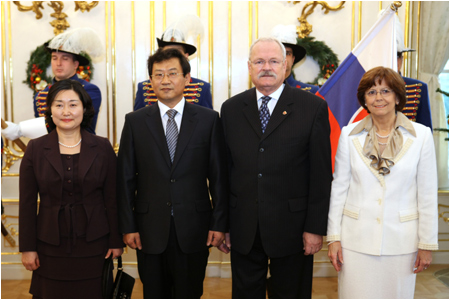
The South-Korean companies Kia and Samsung want to continue broadening their activities in Slovakia, South Korean Ambassador to Slovakia Seok-soong Seo told Economy Minister Lubomir Jahnatek at their meeting on Tuesday. “The ambassador informed the minister that the main Korean investors, Kia and Samsung, would continue expanding their activities in Slovakia in the coming years, so Slovakia is becoming a more and more important partner to South Korea,” the ministry said.

The Slovak Trade and Development Agency (SARIO) just announced that in total so far this year there are 85 investment projects meaning that about EUR 2.4billion to EUR 2.5 billion will come into Slovakia as investments.

The Director of the SARIO direct foreign investments division Andrea Chovancova informed that these investors are going to create more than 12,000 jobs in Slovakia.

The agency is currently working on 139 investment projects at present in total.

Why Bratislava? Why Slovakia?

The key reason behind all these long term bets in Slovakia's and Bratislava's success are not cost based anymore. Bratislava is significantly above the average in the EU, in terms of wealth and prices for most goods are comparable to London or Athens.

Bratislava's good connections with Austria and the rest of europe are to receive a further boost.


In a previous posting we discussed the new european transport networks. Part of the major and transformational projects headed by the EU is TEN-T that aspires to connect the different parts of europe together with transportation links to boost trade among other things.


Bratislava has been included in two of these project including  the one to Paris via Vienna and Stuttgard. This is obviously a transformational project for Bratislava as it links the city ever tighter to old-european capitals such as Vienna and Paris but it also makes Bratislava a part of the core european transport networks enhancing access in an environmentally sensitive way likely to survive the unsustainable boom in cheap filghts and their operators.


This is a relevant point as land transport is crucial if environmental concerns curb the affordability of cheap flights through which much of the eastern parts of the EU are linked to the older EU members. For example if one is stuck in Bucharest and wishes to travel to Frankfurt, the obvious choice would be to fly. However both because of the crisis but also because governments are increasing the taxes on polluting forms of travel, economic development via the airport is not a future-proof plan. This project therefore is vital for Bratislava as it can mean that the city becomes a hub for traffic from other regional capitals like Prague, Budapest etc. who would connect via Bratislava to the fast train network heading west. It could in fact become the replacement of the popular cheap flights. As natural a choice as taking the eurostar train between London and Paris.


Why is this more than just trains crossing borders
  1. Vienna's Sudbanhof station is already being demolished to make way for the infrastructure and new upgraded connection to Bratislava for the high speed trains. More on this big event Imagefolder, english (PDF, 1,65 MB)
  2. This project will be run using ERTMS ("European Rail Traffic Management System"). This is a major industrial project being implemented by Europe, a project which will serve to make rail transport safer and more competitive. One component of ERTMS, the European Train Control System (ETCS), guarantees a common standard that enables trains to cross national borders and enhances safety, speed, and cost competitiveness.

  3. Establishing an efficient trans-European transport network (TEN-T) is a key strategy for competitiveness and employment in Europe. If Europe is to fulfil its economic and social potential, it is essential to build the missing links and remove the bottlenecks in our EU transport infrastructure, as well as to ensure the sustainability of our transport networks into the future. Furthermore, it integrates environmental protection requirements with a view to promoting sustainable development.

  4. In view of the growth in traffic between Member States, expected to double by 2020, the investment required to complete and modernise a true trans-European network in the enlarged EU amounts to some € 500 billion from 2007 to 2020, out of which € 270 billion for the priority axis and projects.

  5. The speeds make this an alternative to planes. The train, TGV, already allows travellers to go from Paris to Reims in 45 minutes, and from Paris to Strasbourg, on the German border, in just two hours and 20 minutes. Under the old schedules, the trip to Strasbourg was nearly twice as long, at three hours and 50 minutes. TGV stands for "train a grande vitesse," which literally means high-speed train.

  6. The areas of Bratislava that are likely to be affected by all this are likely to be:
    Hlavna Stanica - Stare Mesto (Old Town)
    Filialka - Stare Mesto (Racianske Myto/Ursinyho)


Some visualisations of the Bratislava station for this end of the Paris Bratislava line now follow.

This is how the New Bratislava station and area will look


Potent stuff for the medium to long term future of this city.


and what about the trains that will run on the lines? The competing technologies are ICE from Germany or TGV from france

just see this (who needs planes...)


another one with some very happy frenchies :) well done!


BBC - Slovakia leads eurozone growth

http://news.bbc.co.uk/today/hi/today/newsid_9280000/9280836.stm 


After the bailouts of Greece and Ireland, what are the prospects for the wider euro area?
Economic adviser Marie Diron examines the economic growth of eurozone countries.

Finance minister of Slovakia in english talking to Martin Wolf of the Financial Times interviewed

Is Estonia a sign of what’s to come for the euro?

The most significant EU-related development over the holidays was Estonia’s official entry into the eurozone on New Year’s Day, an event that is worth revisiting as the single currency prepares for what is likely to be another year of turmoil.

As Fredrik Erixon, director of the Brussels-based European Centre for International Political Economy, notes in a new “Obituary for the Estonian kroon”, it wasn’t too long ago that the Estonian government was being advised to drop its peg to the euro and let its currency float in order to save its economy from the ravages of the European debt crisis.

But Tallinn hung tough, and as we noted in an article last month, is now poised for gross domestic product growth that is the pride of the EU. According to forecasts by Eurostat, its 4.4 per cent 2011 real GDP growth would make it the best performer in the eurozone.

When I talked to Estonian President Toomas Hendrik Ilves last month, he recalled with hard-to-contain smugness the amount of pressure the country resisted to devalue during the early days of the euro crisis. “All three Baltic economies were in serious trouble, and all kinds of people said devalue, devalue, devalue,” he said.

In his paper, Erixon cites U.S.-baed economic giants like Paul Krugman and Nouriel Roubini as among those who advocated devaluation, but officials recently told me that the International Monetary Fund was also in the Baltic devaluation camp.

Ilves argued that devaluation, even for an export-reliant economy, wasn’t a panacea. It could have reduced the price of Estonian exports and relative labour costs, he said, but because Estonia imported so many of the components that go into its exports, the gains would be marginal.

In addition, Ilves argued, Estonian home mortgages and commercial loans were largely denominated in euros. So a devaluation would have sent borrowing costs skyrocketing.

“You decapitate all those who are doing the right thing,” he said. “You’re doing in the people who are the most successful, the most economically active, the people who are doing what you want them to be doing.”

Instead, Estonia cut budgets early and deeply. Does the fact that it is now poised for a rebound bode well for other recent takers of the austerity medicine, like Greece, Ireland, Spain and Portugal? Perhaps, but the Estonians also had a few things going for them that these others – particularly Portugal and Greece – do not: an open, competitive economy and crucially, in the view of Ilves, a reserve fund that carried them through the rough times.

“We resisted the populist pressure in the good years to go and spend the reserves, and we went into the recession with strong reserves which tides us over,” he said. Other Baltics, particularly Latvia, which was forced to rely on an international bailout, were less cautious.

As a new member of the eurozone, Ilves said Estonia was ready to play its part in helping the countries who have fared less well during the recent crisis. Even though it is small and comparatively poor, Ilves said his country is well aware of what shared responsibility means – as a new member of NATO, he noted, Estonia relies on the alliance’s defence guarantees, which allows Tallinn to save more than a bit on military spending.

But if there’s one thing the euro’s 17th member won’t tolerate, he said, it’s a lecture. Here, I’ll just let Ilves speak for himself:

The poorer countries that are fiscally responsible end up paying out richer countries that are not. This would be even ok except for the occasional arrogance and haughtiness of the rich countries towards us poor east Europeans. You can’t be haughty towards us because we’re not so rich, and at the same time [argue] it’s time to bail them out. Ultimately, let’s face it: Being richer wasn’t based on being more productive. It was based on bigger loans. Wealth based on loans is not wealth.

Estonia could prove an interesting new voice in the deabte over the single currency’s future.

“Wealth based on loans is not wealth.”

Loans are denominated in the official money units.

Owning wealth aside from official money units is the only way

by which societies have built up their storehouse of a wealth of things,

thereby advancing their kind from the beginning, and preventing the decapitation of all those who are doing the right thing.

Estonia will do well in the eurozone for two reasons: it is small, and it is still an emerging market. By definition, emerging markets have a lot of catch up to do, therefore they must invest more in capital goods to become a capital-intensive economy (than a labor-intensive economy). By using more machinery and other capital, while also making substantial infrastructure improvements, cost per productivity would sharply fall. This would make them even more competitive than mature economies like Germany or Finland.

In other words, as a nation developes, its currency should appreciate in value (like China's should). By Estonia joining the euro, it would put a cap any upward pressure on its own currency, the Kroon -- by joining the euro, it would be in a currency bloc with mature economies that do not see significant upward pressure on exchange rates. Estonia, then would be playing beggar-thy-neighbor policies. A good template for Estonia is Slovakia, which has seen its unit labor costs decline throughout the past decade in relation to Germany (Spain and others saw their unit labor costs rise against Germany). Such "competitive" Eastern economies in the euro would make it even harder for Spain or Greece to compete. Report Derek Tunnicliffe

One of the lessons that Estonia might offer to others countries (inside and outside the eurozone) is that of their "flat-rate" tax system. It was untried experiment when they took it on, but it appears to be a success, in both business and personal terms. But they also try to ensure a balanced governmental budget - another lesson for all but Germany?

Corruption trends

2 things
From the former boss at the www.economist.com
http://www.billemmott.com/article.php?id=287
a radically different approach it seems to the new much more right-wing and virulently anti-euro economist

also chart of the day about corruption over the last 12 years
it seems that corruption is correlated with the business cycle, but not much else and it is improving slowly in central europe. In 20 years...

2011 predictions - how will the new year turn out?

Will the euro survive?
Yes. Despite the rolling wave of crises in peripheral European countries. It is probable that defaults will also be prevented in 2011. A less dramatic set of formal debt restructuring will happen in the PIIGSand Germany wants it to happen. As for a country leaving the Euro, that is more of 2012-13 question.

The euro will survive in the long run, and a north south divide may form, selecting countries that are able to live with Germany as direct trading partner and perhaps forming an ever closer union with it.

Will 2011 see banks fail?
2011 will be a year of bank runs in the anglosphere, banks in UK, Ireland, possibly Spain.

Will China’s bubble burst?
political risk may trigger a war involving north korea and poisoning the investments of many..

Will the US and its Nato allies start winning the war in Afghanistan?
no

Will social unrest worsen in Europe?

Most probably in the badly managed economies of the PIIGS. The utterly docile and passive public of the USA will continue to suffer silently a bit like an asian authoritarian regime, economic policy will stay the same, but the dangerous direction of US politics, with the Republicans continuing their transformation into a far right party, and the democrats continuing to be 2 parties in one. Europe's periphery may be smalshing lamposts but the rather silent rise of extreme politics in america with the tea party etc. will bring about surprising changes in the USA and not for the better,

The ongoing boom in germany will stabilise its neighbouring countries (including Slovakia), and bring about north/south divide in europe.